All species › Passerines › New World blackbirds, troupials and allies › Epaulet Oriole
Epaulet Oriole | Icterus cayanensis
Roodboegtroepiaal | Turpial boyerito | Inhapim
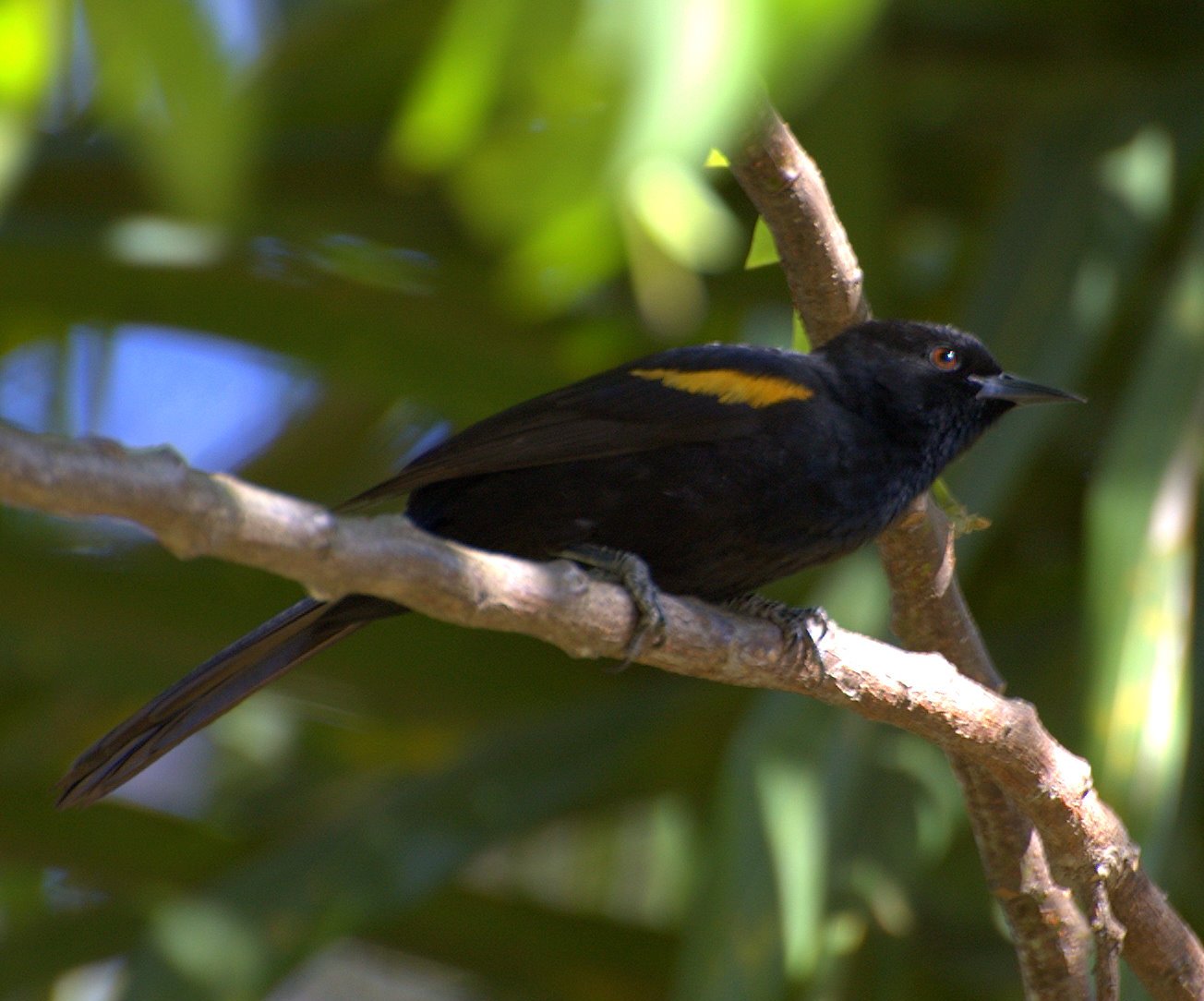
The Epaulet Oriole is a slim, mainly black oriole of South America east of the Andes, with a coloured shoulder patch. In the broad sense followed here it includes several forms that are often treated as separate species: in the guide area mainly the Amazonian form with yellow crown, shoulders, rump and thighs, and in Bolivia forms with a yellow or chestnut shoulder patch. The nominate form, with a red epaulet, lives further east.
Voice
The song is a varied series of clear, liquid whistles, often with nasal notes in between. Calls are a nasal chek and a dry chatter.
Recording: Mauricio Cuellar Ramirez (@Birding.travel) — CC BY-NC-SA 4.0 · xeno-canto
Identification
20–22 cm, slim, with a fairly long tail and a pointed, slightly decurved black bill. The plumage is largely glossy black. In the Amazonian lowlands of Colombia, Ecuador and Peru birds have a yellow crown and nape, yellow shoulders, a yellow rump and yellow thighs. In Bolivia only the shoulder patch is coloured, yellow to chestnut, or birds show little colour. The sexes are alike. Juveniles are duller, with less yellow.
Confusion species
Yellow-rumped Cacique Cacicus cela is larger, with a pale bill, a blue eye and a yellow tail base. Oriole Blackbird Gymnomystax mexicanus is larger and has a yellow head and underparts. Venezuelan Troupial Icterus icterus is larger, with an orange body and a white wing patch. Yellow-winged Blackbird Agelasticus thilius lives in highland marshes and is stockier.
Habitat
In Amazonia mainly palm swamps with moriche or aguaje palms, várzea forest, riverbanks and forest edges; in Bolivia also dry forest, Chaco, cerrado and gallery forest. Mostly below 1000 m. Forages in pairs or small groups in the treetops and in palms for insects, fruit and nectar. The nest is a shallow, hanging pouch, often under a palm frond.
Where the bird is most at home, classified by the vegetation units of the Andes and the west coast.


Range and movements
In Colombia in the eastern lowlands, in the llanos and Amazonia. In Ecuador in the eastern lowlands. In Peru in the Amazonian lowlands. In Bolivia in the lowlands of the north, east and south-east. Absent from the Galápagos. Outside the guide area in Venezuela, the Guianas, Brazil, Paraguay, Uruguay and northern Argentina.
- Resident
- dark = core range, pale = thinly spread
How and when to look
In the eastern lowlands search palm swamps and riverbanks for pairs in the palm crowns; in Bolivia dry forest edges and gallery forest. On each bird note the distribution of yellow and chestnut.
Conservation status
Not evaluated in the broad sense followed here. The separately assessed forms are not threatened; loss of palm swamps and dry forest plays a role locally.
Scientific name
Icterus cayanensis | (Linnaeus, 1766)
Linnaeus described the species in 1766 as O[riolus] cayanensis; because it was later moved to another genus, the author and year stand in brackets. The genus Icterus was introduced in 1760 by Brisson. The genus name comes from Greek ikteros, 'jaundice'; the icterus was a yellow bird (probably the Eurasian Golden Oriole) whose sight was believed to cure jaundice. The species name refers to Cayenne in French Guiana. The specimen the first description was based on came from Cayenne, French Guiana.