All species › Passerines › New World blackbirds, troupials and allies › Yellow-tailed Oriole
Yellow-tailed Oriole | Icterus mesomelas
Geelstaarttroepiaal | Bolsero cola amarilla | Corrupião-de-cauda-amarela
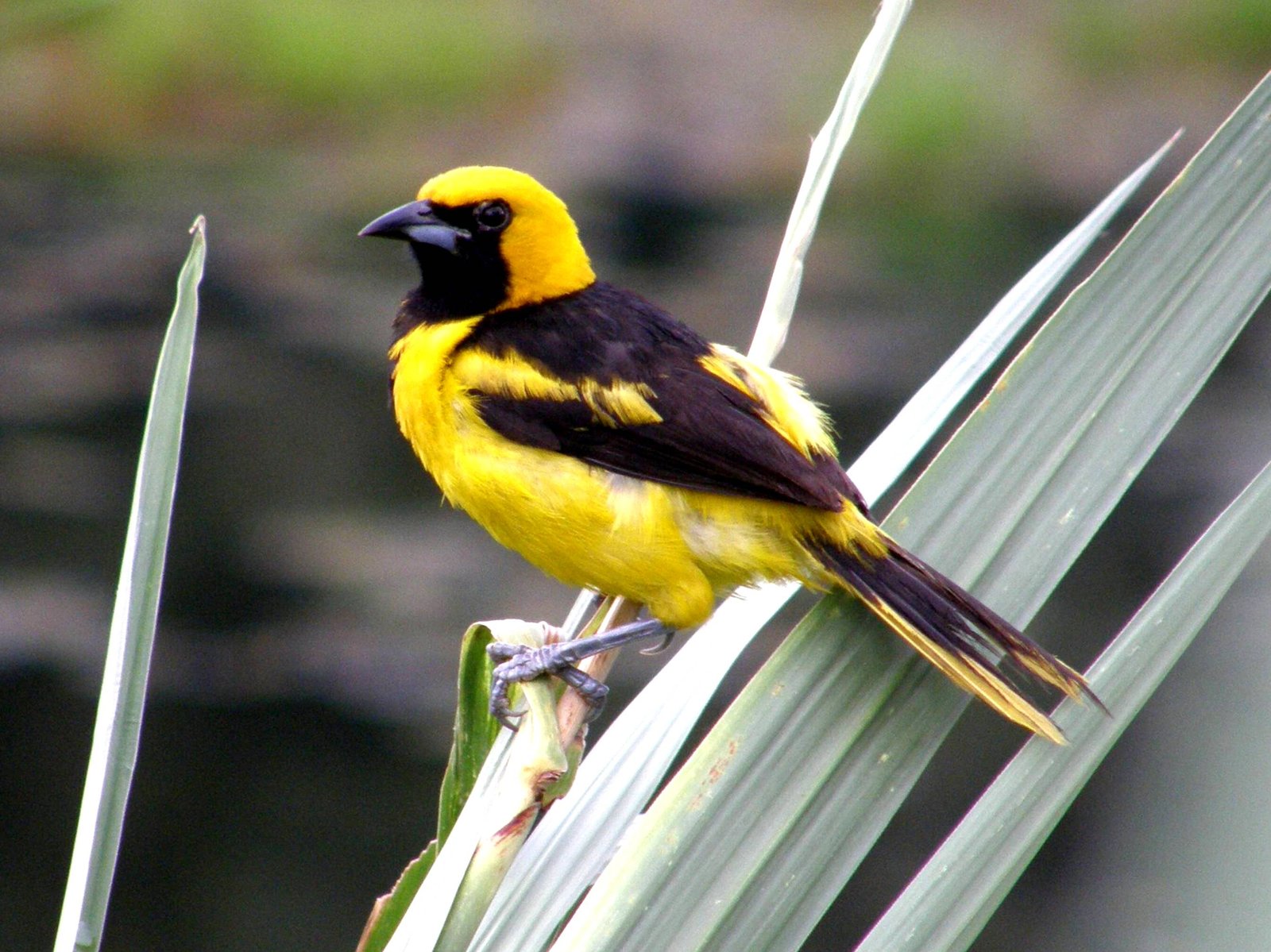
The Yellow-tailed Oriole is an oriole of dense, humid vegetation in the lowlands, from southern Mexico to north-western Peru. It is the only oriole in the guide area with distinct yellow in the outer tail feathers. Pairs often sing in duet from dense scrub near water.
Voice
The song is a series of rich, clear whistles in repeated phrases, often as a duet of male and female. Calls are a nasal chak and a dry chatter.
Recording: Paul Molina Abril — CC BY-NC-SA 4.0 · xeno-canto
Identification
21–23 cm, with a fairly long tail and a pointed black bill. The head, rump and underparts are bright yellow, with a black mask of lores, eye area, throat and upper breast. The back, wings and tail are black; the shoulder is yellow, and some birds show a narrow yellow bar across the wing. The outer tail feathers are largely yellow, which shows mainly in flight and from below. The sexes are alike. Juveniles are olive-yellow, with less black.
Confusion species
White-edged Oriole Icterus graceannae has a white wing panel and white instead of yellow in the tail. Orange-crowned Oriole Icterus auricapillus is smaller, with an orange crown and an all-black tail. Yellow-backed Oriole Icterus chrysater and Yellow Oriole Icterus nigrogularis have a yellow back.
Habitat
Dense, humid vegetation in the lowlands: riparian woodland, marsh edges, reedbeds with shrubs, forest edges, secondary woodland and plantations, also in the more humid parts of dry regions, mostly below 1000 m. Forages in pairs in mid-level vegetation for insects and fruit. The nest is a hanging, fairly shallow pouch.
Where the bird is most at home, classified by the vegetation units of the Andes and the west coast.


Range and movements
In Colombia in the Caribbean lowlands, the Magdalena and Cauca Valleys and the Pacific lowlands. In Ecuador in the western lowlands. In Peru in the north-west, south into La Libertad. Absent from Bolivia and the Galápagos. Outside the guide area from southern Mexico through Central America to north-western Venezuela.
- Resident
- dark = core range, pale = thinly spread
How and when to look
In the western lowlands, listen along rivers and marsh edges for the rich whistles of singing pairs; in flight the yellow outer tail feathers identify the species.
Conservation status
Least Concern. The species tolerates secondary vegetation well, but is locally trapped as a cage bird.
Scientific name
Icterus mesomelas | (Wagler, 1829)
Wagler described the species in 1829 as Ps[arocolius] mesomelas; because it was later moved to another genus, the author and year stand in brackets. The genus Icterus was introduced in 1760 by Brisson. The genus name comes from Greek ikteros, 'jaundice'; the icterus was a yellow bird (probably the Eurasian Golden Oriole) whose sight was believed to cure jaundice. The species name is Greek mesomelas, the name of a white gemstone with a black stripe, from mesos, 'middle', and melas, 'black'; possibly for the black centre of the otherwise yellow plumage. The specimen the first description was based on came from Chalcaltianges, Veracruz, Mexico.