All species › Passerines › New World blackbirds, troupials and allies › White-edged Oriole
White-edged Oriole | Icterus graceannae
Spiegeltroepiaal | Bolsero filiblanco | Corrupião-de-bordas-brancas
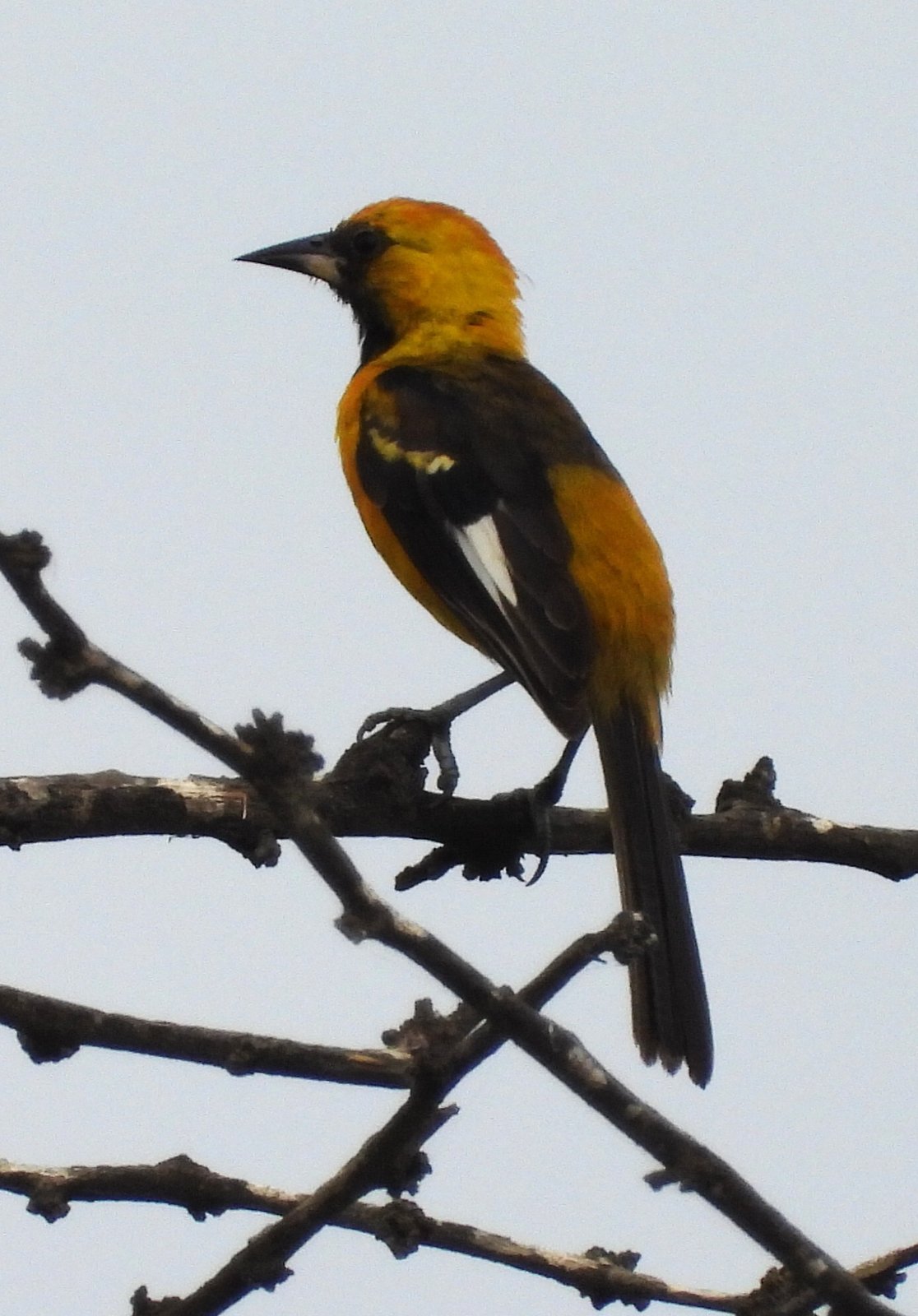
The White-edged Oriole is an oriole of the Tumbesian dry forest of south-western Ecuador and north-western Peru. Its name refers to the white panel on the folded wing, formed by the white edges of the secondaries. It lives in pairs or family groups in dry woodland and scrub.
Voice
The song is a series of clear, fairly short whistles, often interspersed with nasal notes. Calls are a nasal nyeh and a dry, rattling chatter.
Recording: Vanessa Luzuriaga — CC BY-NC-SA 4.0 · xeno-canto
Identification
20–21 cm, with a pointed black bill. The head and underparts are deep yellow to yellowish orange, with a black mask of lores, eye area, throat and upper breast. The back, wings and tail are black; the shoulder is yellow. The inner secondaries and tertials have broad white edges that form a white panel on the folded wing, and the outer tail feathers have white on the inner webs, visible from below. The sexes are alike. Juveniles are olive-yellow, with less black.
Confusion species
Yellow-tailed Oriole Icterus mesomelas, which shares its range, lacks the white wing panel and has yellow instead of white in the tail. Baltimore Oriole Icterus galbula, a rare winter visitor, has a black head and a white wingbar. Female Orchard Orioles Icterus spurius are much smaller and olive.
Habitat
Tumbesian dry forest, deciduous woodland, thorn scrub and riparian woodland in dry country, from sea level to roughly 1500 m. Forages in pairs in trees and shrubs for insects, fruit and nectar. The nest is a hanging pouch on a branch, often in a thorny tree.
Where the bird is most at home, classified by the vegetation units of the Andes and the west coast.


Range and movements
In Ecuador in the dry west, from Manabí and Guayas south to Loja and El Oro. In Peru in the north-west, in Tumbes, Piura, Lambayeque and into La Libertad, also in the dry Marañón Valley. Absent from Colombia, Bolivia and the Galápagos. Does not occur outside the guide area.
- Resident
- dark = core range, pale = thinly spread
How and when to look
In the dry forest of south-western Ecuador and north-western Peru, look for pairs in the treetops; check every yellow oriole for the white wing panel, which separates it from Yellow-tailed Oriole.
Conservation status
Least Concern. Tumbesian dry forest is under heavy pressure from logging, grazing and farming, but the species tolerates degraded woodland and scrub.
Scientific name
Icterus graceannae | Cassin, 1867
Cassin described the species in 1867 and placed it straight away in the genus where it still stands. The genus Icterus was introduced in 1760 by Brisson. The genus name comes from Greek ikteros, 'jaundice'; the icterus was a yellow bird (probably the Eurasian Golden Oriole) whose sight was believed to cure jaundice. The species name honours Grace Anna Lewis (1821–1912), American naturalist and teacher of natural history, a friend of John Cassin. The specimen the first description was based on came from Ecuador or Peru.