All species › Passerines › New World blackbirds, troupials and allies › Orange-crowned Oriole
Orange-crowned Oriole | Icterus auricapillus
Oranjekaptroepiaal | Turpial coroninaranja | Corrupião-de-coroa-laranja
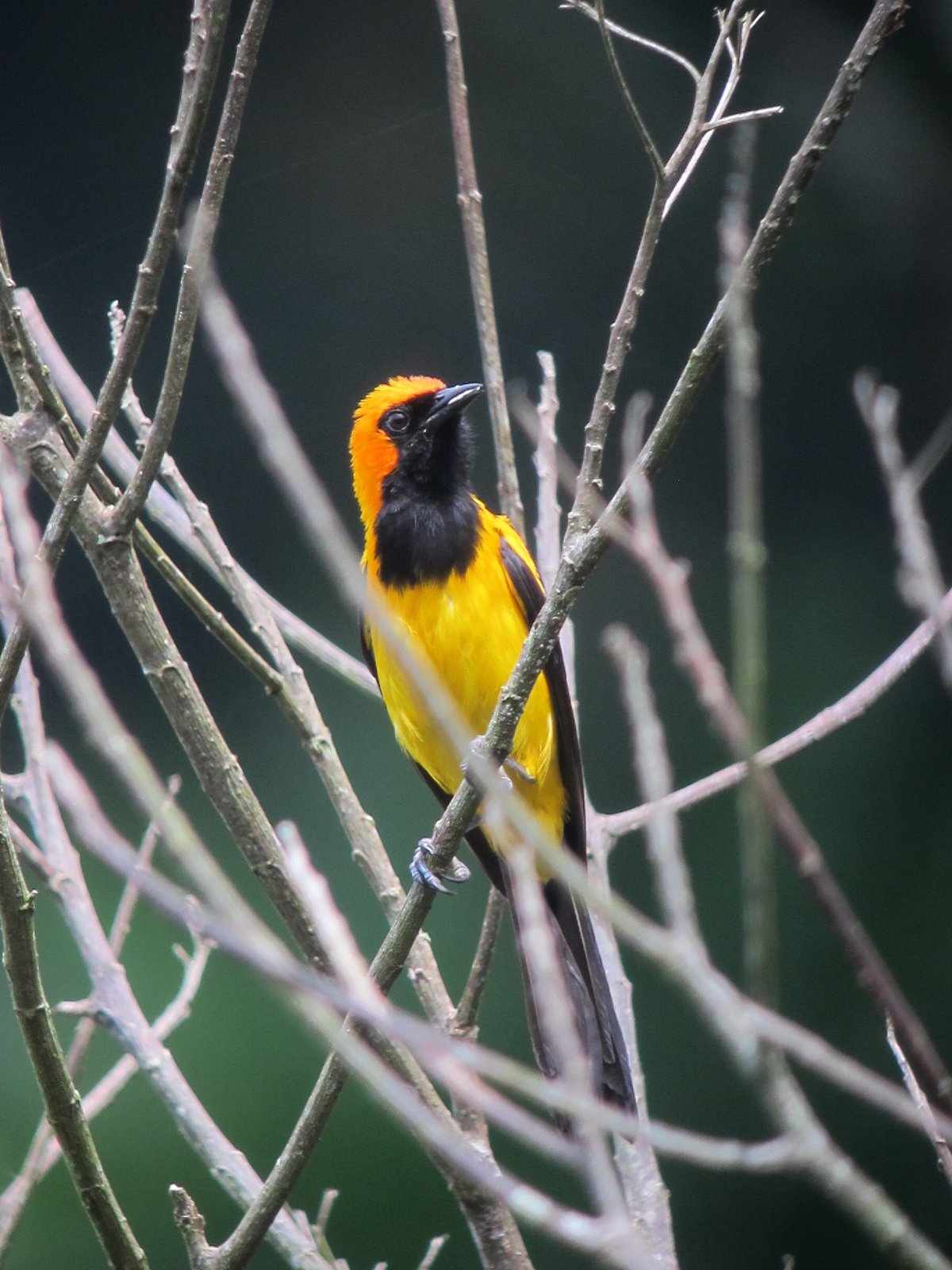
The Orange-crowned Oriole is a slim oriole of the lowlands of Panama, Colombia and Venezuela, with an orange crown that colours the head around the black mask. Male and female are nearly identical. It usually lives in pairs in the treetops of forest edges and open woodland.
Voice
The song is a series of clear, repeated whistles, shorter and faster than that of Yellow-tailed Oriole. Calls are a nasal chek and a dry chatter.
Recording: Rosa Elena Albornoz — CC0 1.0 · xeno-canto
Identification
18–20 cm, with a slim, slightly decurved black bill. The crown, nape and sides of the head are orange; the lores, eye area, throat and upper breast are black. The back, wings and tail are black, with a yellow shoulder patch and no white in the wing. The rump and underparts are yellow. The sexes are alike, the female sometimes slightly duller. Juveniles are olive-yellow, with little or no black on the throat.
Confusion species
Yellow-tailed Oriole Icterus mesomelas is larger, with a yellow head without orange and yellow in the outer tail feathers. Venezuelan Troupial Icterus icterus is larger, with a black head and a white wing patch. Yellow Oriole Icterus nigrogularis has a yellow back and white in the wing. Yellow-backed Oriole Icterus chrysater also has a yellow back.
Habitat
Forest edges, open and dry woodland, riparian woodland, gallery forest in the llanos and plantations with shade trees, mostly below 1000 m, locally higher. Forages in pairs in the treetops for insects, fruit and nectar. The nest is a short hanging pouch, often under a palm frond.
Where the bird is most at home, classified by the vegetation units of the Andes and the west coast.


Range and movements
In Colombia in the Caribbean lowlands, the Magdalena and Cauca Valleys, along the eastern foot of the Andes and in the llanos. Absent from Ecuador, Peru, Bolivia and the Galápagos. Outside the guide area in eastern Panama and northern Venezuela.
- Resident
- dark = core range, pale = thinly spread
How and when to look
In the Colombian lowlands search forest edges and trees along rivers; birds often sit in pairs high in a flowering tree and give themselves away by their whistles.
Conservation status
Least Concern. The species tolerates forest edges and country with scattered trees well.
Scientific name
Icterus auricapillus | Cassin, 1848
Cassin described the species in 1848 and placed it straight away in the genus where it still stands. The genus Icterus was introduced in 1760 by Brisson. The genus name comes from Greek ikteros, 'jaundice'; the icterus was a yellow bird (probably the Eurasian Golden Oriole) whose sight was believed to cure jaundice. The species name comes from Latin aurum, 'gold', and capillus, 'hair of the head', for the orange-yellow crown. The specimen the first description was based on came from Santa Marta, Colombia.