All species › Passerines › New World blackbirds, troupials and allies › Yellow-backed Oriole
Yellow-backed Oriole | Icterus chrysater
Geelrugtroepiaal | Bolsero dorso dorado | Corrupião-de-dorso-amarelo
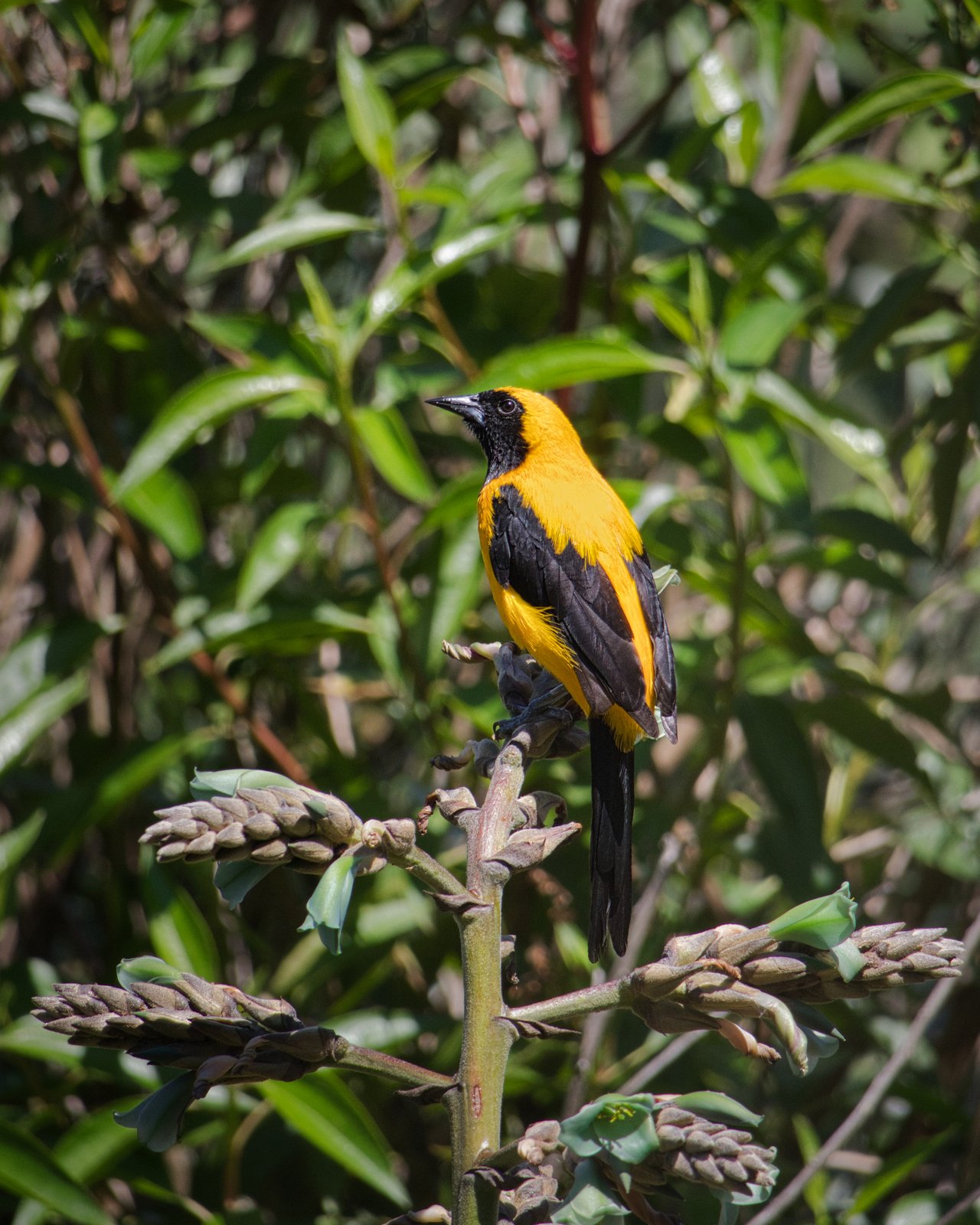
The Yellow-backed Oriole is the only oriole in the guide area with an entirely yellow back and no white in the wing. It ranges from Central America to northern South America and in the Colombian Andes climbs higher than most of its relatives. The nest is a long, hanging pouch at the end of a branch.
Voice
The song is a series of clear, somewhat hesitant whistles at varying pitch, often with pauses in between. Calls are a nasal nyeh and a dry chatter.
Recording: Sue Riffe — CC BY-NC-SA 4.0 · xeno-canto
Identification
21–23 cm, with a fairly long tail and a pointed black bill. The plumage is golden yellow, including the head, back and rump; the forehead, face, throat and upper breast form a black mask and bib. The wings and tail are entirely black, without white edges or wingbar. The sexes are alike, the female sometimes slightly duller. Juveniles are olive-yellow, with less black on the throat and face.
Confusion species
Yellow Oriole Icterus nigrogularis also has a yellow back, but has white in the wing and lives in the dry lowlands. Yellow-tailed Oriole Icterus mesomelas and Orange-crowned Oriole Icterus auricapillus have a black back. Baltimore Oriole Icterus galbula has a black head and back and a white wingbar.
Habitat
Forest edges, open woodland, clearings with scattered trees, coffee plantations and scrub, from the lowlands up to roughly 2700 m, in the guide area mainly on the slopes of the Andes. Forages in pairs or small groups in the treetops for insects, fruit and nectar.
Where the bird is most at home, classified by the vegetation units of the Andes and the west coast.


Range and movements
In Colombia in the three Andean ranges, the Sierra Nevada de Santa Marta, the Serranía de Perijá and locally the Caribbean lowlands. Absent from Ecuador, Peru, Bolivia and the Galápagos. Outside the guide area from southern Mexico to Nicaragua and in western Venezuela.
- Resident
- dark = core range, pale = thinly spread
How and when to look
In Colombia search forest edges and coffee and shade plantations on the middle slopes; the entirely yellow back and the black wings without white are visible even at a distance.
Conservation status
Least Concern. The species tolerates varied farmland with trees well.
Scientific name
Icterus chrysater | (Lesson, 1844)
Lesson described the species in 1844 as Xanthornus chrysater; because it was later moved to another genus, the author and year stand in brackets. The genus Icterus was introduced in 1760 by Brisson. The genus name comes from Greek ikteros, 'jaundice'; the icterus was a yellow bird (probably the Eurasian Golden Oriole) whose sight was believed to cure jaundice. The species name comes from Greek khrusos, 'gold', and Latin ater, 'black', for the yellow and black plumage. The specimen the first description was based on came from Mexico.