All species › Passerines › New World blackbirds, troupials and allies › Orchard Oriole
Orchard Oriole | Icterus spurius
Tuintroepiaal | Turpial castaño | Corrupião-dos-pomares
The Orchard Oriole is the smallest oriole of North America and one of the earliest migrants: many birds leave their breeding grounds as early as July. It winters from Mexico to northern South America. In the guide area it mainly reaches northern Colombia.
Voice
The call is a dry, short chek and a rapid, rattling chatter. The song, a fast, clear series of whistles, is rarely heard in winter.
Recording: Étienne Leroy — CC BY-NC-SA 4.0 · xeno-canto
Identification
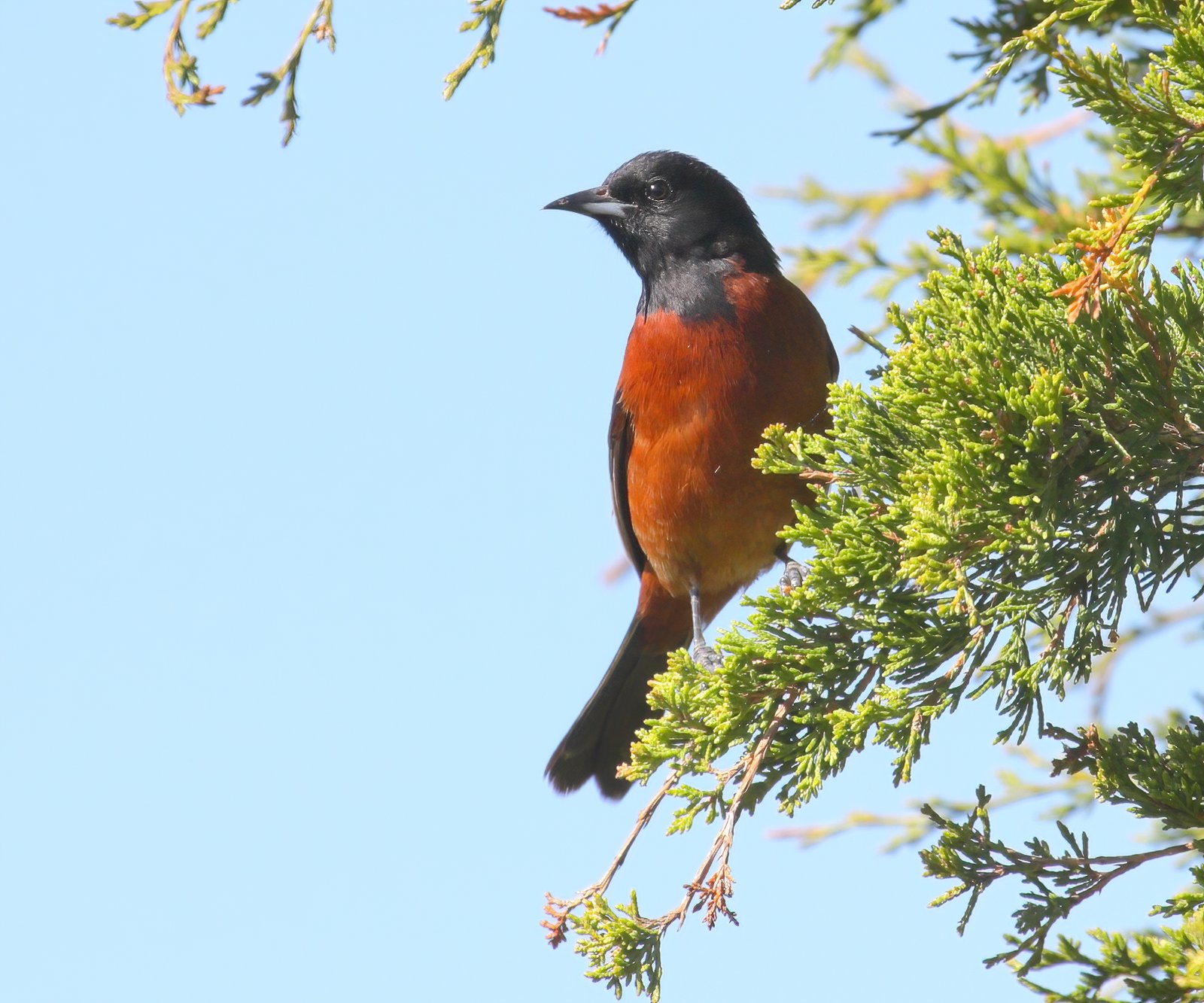
15–18 cm, small and fairly slim, with a thin, pointed, slightly decurved bill. The adult male has a black head, throat, mantle, wings and tail, and is otherwise deep chestnut on the breast, belly, shoulder and rump, with a narrow white wingbar. The female is olive-green above and greenish yellow below, with two white wingbars. The first-year male resembles the female but has a black throat and lores.
Confusion species
Baltimore Oriole Icterus galbula is larger; the male is orange instead of chestnut, and the female is more orange and greyer on the back. Females of other orioles in the guide area are larger, with a heavier bill. The female also resembles a female tanager of the genus Piranga, but that has a thicker bill and usually no distinct white wingbars.
Habitat
Semi-open country with trees: forest edges, scrub, gardens, parks, plantations and mangroves, mainly in the lowlands and lower slopes up to roughly 1500 m. Forages in small groups, often in flowering trees, for nectar, insects and fruit.
Where the bird is most at home, classified by the vegetation units of the Andes and the west coast.


Range and movements
In Colombia a winter visitor in the north, mainly in the Caribbean lowlands and the Magdalena Valley, scarcer further south. In Ecuador very rare, with at most a few records. Absent from Peru, Bolivia and the Galápagos. Outside the guide area it breeds in the eastern and central United States and in Mexico, and winters from Mexico to Panama and north-western Venezuela.
- Winter visitor (c. Oct–Mar)
- dark = core range, pale = thinly spread
How and when to look
In northern Colombia between October and March, search flowering trees in gardens and at forest edges; look for small orioles with two white wingbars among other nectar feeders.
Conservation status
Not evaluated in the taxonomy followed here. The species is widespread and numerous in North America; its numbers there have declined slightly in recent decades.
Scientific name
Icterus spurius | (Linnaeus, 1766)
Linnaeus described the species in 1766 as O[riolus] spurius; because it was later moved to another genus, the author and year stand in brackets. The genus Icterus was introduced in 1760 by Brisson. The genus name comes from Greek ikteros, 'jaundice'; the icterus was a yellow bird (probably the Eurasian Golden Oriole) whose sight was believed to cure jaundice. The species name is Latin spurius, 'illegitimate, bastard, spurious'; it goes back to the 'Basterd Baltimore-Bird' of Catesby (1731) and Icterus minor spurius of Brisson (1760). The specimen the first description was based on came from South Carolina, United States.