All species › Passerines › New World blackbirds, troupials and allies › Casqued Cacique
Casqued Cacique | Cacicus oseryi
Helmbuidelspreeuw | Cacique de casco | Japu-de-capacete
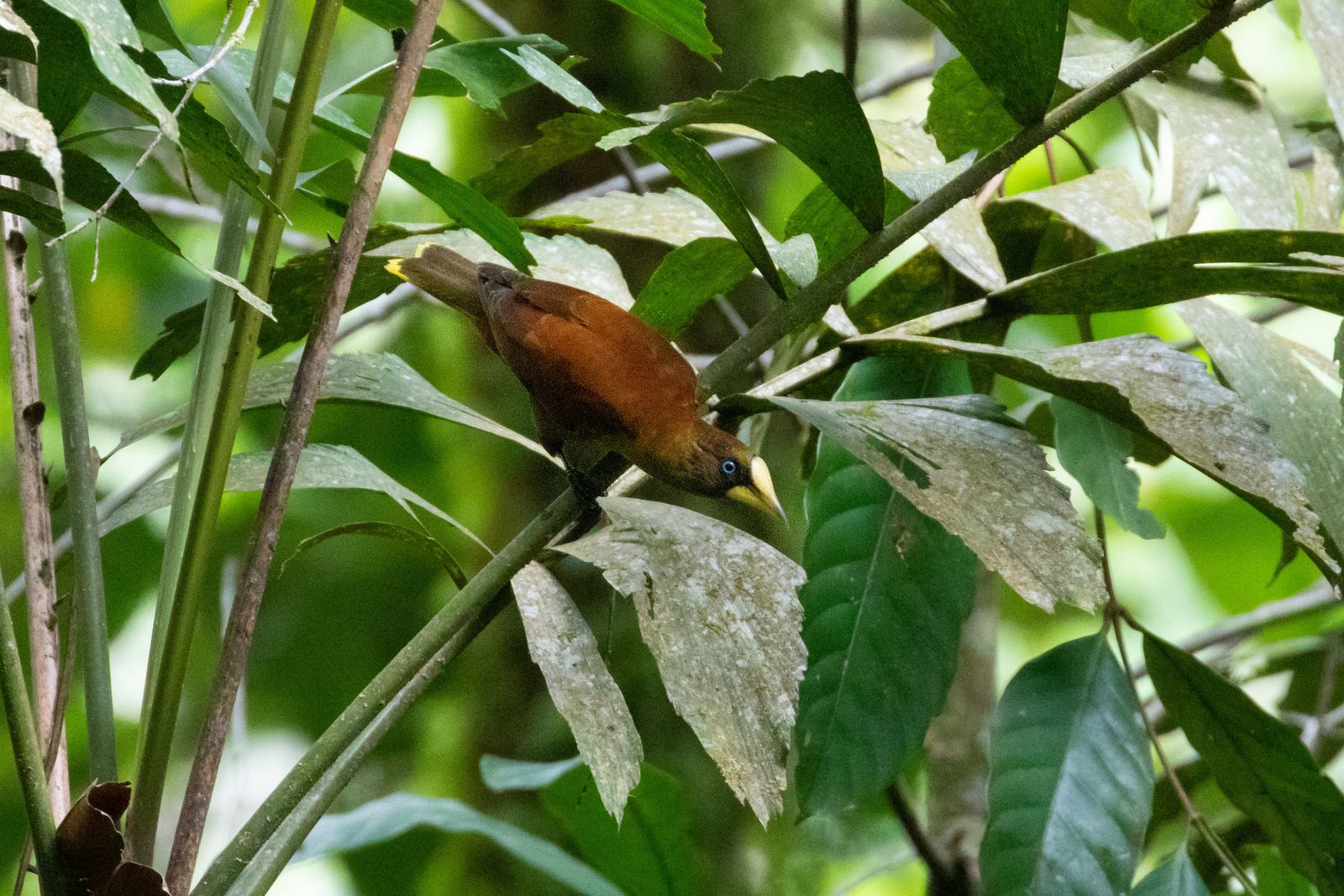
The Casqued Cacique is a large, rufous and olive-yellow icterid of western Amazonia, with a conspicuously broadened, flat frontal shield on its pale bill. It was long regarded as an oropendola and placed in a genus of its own. It lives in groups in the canopy and nests in small colonies of hanging pouch nests.
Voice
A varied repertoire of liquid, gurgling whistles and nasal, croaking sounds, often kept up for a long time at the colony. Also a sharp chak as a contact call.
Recording: JAYRSON ARAUJO DE OLIVEIRA — CC BY-NC-SA 4.0 · xeno-canto
Identification
29–35 cm; the male is larger than the female. The bill is pale yellowish green to ivory, with a broad, swollen shield at the base that extends onto the forehead. The eye is pale blue. The head, neck and breast are olive-yellow, and the back, wings, rump and belly chestnut. The tail is yellow with dark olive central feathers. The female is smaller and duller. Otherwise the sexes are alike.
Confusion species
Russet-backed Oropendola Psarocolius angustifrons is larger, with a dark bill without a broad shield and a dark eye. Green Oropendola Psarocolius viridis is greener, with a greenish bill with a red tip. Crested Oropendola Psarocolius decumanus is black with an ivory bill. Yellow-rumped Cacique Cacicus cela is black and yellow and smaller.
Habitat
Tall terra firme rainforest and, to a lesser extent, várzea forest in the lowlands, mostly below 600 m, locally into the foothills. Lives in small groups in the canopy and feeds on fruit, insects and nectar. Nests in small colonies of hanging pouch nests in a tall tree, often at a clearing or forest edge.
Where the bird is most at home, classified by the vegetation units of the Andes and the west coast.


Range and movements
In Colombia only in the far south, with few records. In Ecuador in the eastern lowlands. In Peru in the Amazonian lowlands over most of the country. In Bolivia in the far north-west. Absent from the Galápagos. Outside the guide area only in western Amazonian Brazil.
- Resident
- dark = core range, pale = thinly spread
How and when to look
In the eastern lowlands watch for small groups of rufous birds in the canopy that give themselves away by their gurgling calls; a canopy tower or high riverbank gives a view of the head and bill shield.
Conservation status
Least Concern. A species of undisturbed lowland forest, locally scarce; deforestation in western Amazonia is the main threat.
Scientific name
Cacicus oseryi | Deville, 1849 (GBIF: Psarocolius oseryi)
Deville described the species in 1849 and placed it straight away in the genus where it still stands. The genus Cacicus was introduced in 1799 by De Lacépède. The genus name comes from Spanish cacique, 'chief', a word from the Taíno language of the Caribbean. The species name honours Alexandre Victor Eugène, Vicomte Hulot d'Osery (1818–1846), a French explorer who collected in tropical America from 1843 to 1846. The specimen the first description was based on came from Pebas, Loreto, Peru.