All species › Passerines › New World blackbirds, troupials and allies › Red-rumped Cacique
Red-rumped Cacique | Cacicus haemorrhous
Roodstuitbuidelspreeuw | Cacique lomirrojo | Guaxe
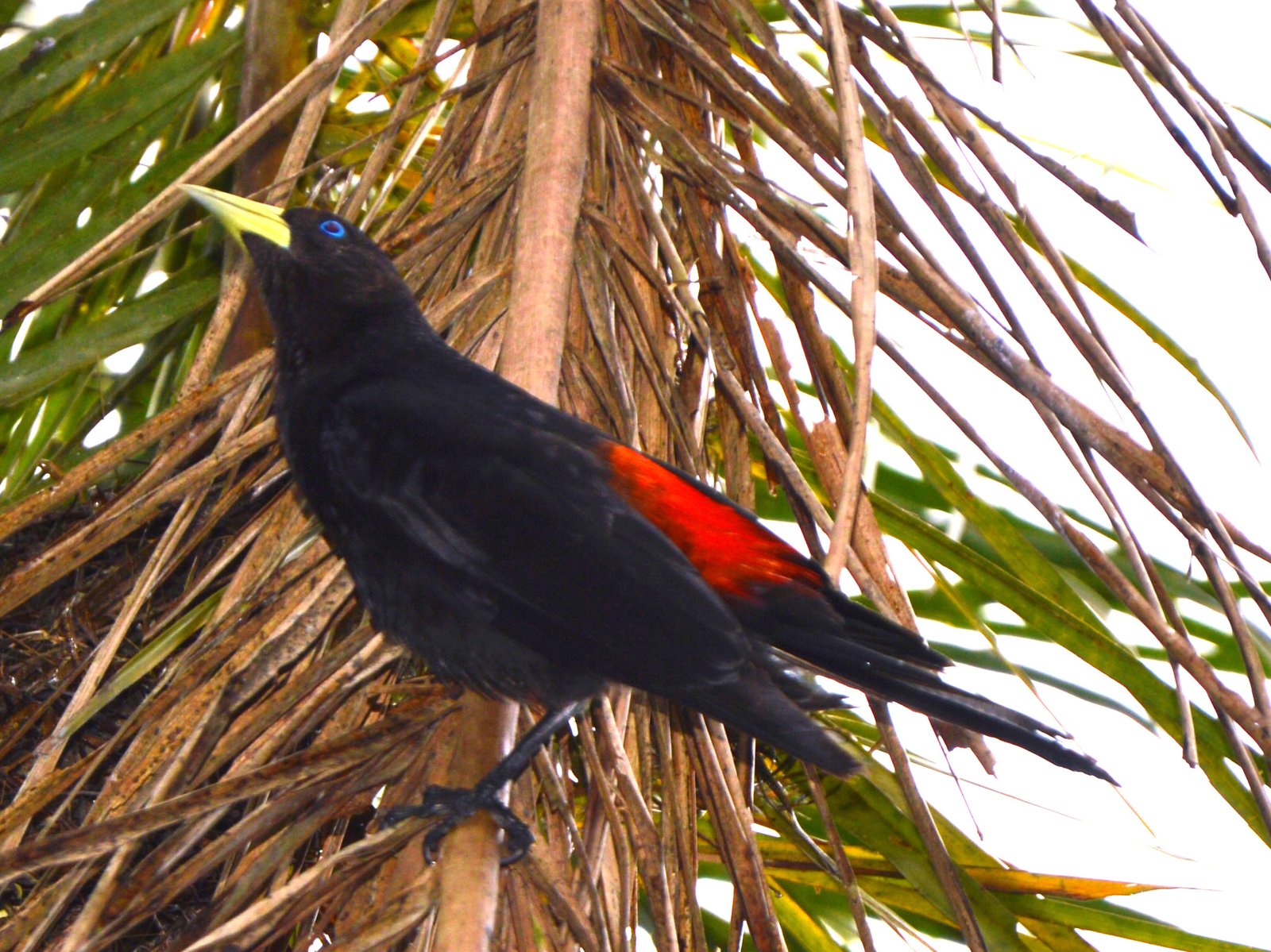
The Red-rumped Cacique is a glossy black cacique of the Amazonian lowlands, with a red rump that is mainly visible in flight and during display. It nests in colonies of long, hanging pouch nests, often in a single tree and regularly near wasp nests. In the guide area it is at the western edge of its range.
Voice
A varied repertoire of hoarse, grating and liquid notes, including a repeated chak and gurgling, nasal series at the colony. In flight a short, sharp keek.
Recording: Faustino Hollmann — CC BY-NC-SA 4.0 · xeno-canto
Identification
23–28 cm; the male is clearly larger than the female. The plumage is entirely black with a bluish gloss, except for the scarlet lower back and rump, which are largely covered by the wings at rest. The bill is long, pointed and ivory to pale greenish, and the eye is pale blue. The female is duller and smaller, with less gloss. Juveniles are duller black with a darker eye.
Confusion species
Yellow-rumped Cacique Cacicus cela has a yellow rump, a yellow wing patch and a yellow tail base. Scarlet-rumped Cacique Cacicus uropygialis also has a red rump, but is smaller, with a shorter tail, and lives mainly in montane forest and in the lowlands west of the Andes. Solitary Cacique Cacicus solitarius lacks red and has a dark eye. Crested Oropendola Psarocolius decumanus is larger, with a yellow tail.
Habitat
Tall terra firme forest, forest edges and the banks of rivers and clearings in the lowlands, mostly below 600 m. Forages in small groups in the canopy for insects, fruit and nectar. The colonies hang from an isolated tree or at the forest edge, often near wasp or ant nests.
Where the bird is most at home, classified by the vegetation units of the Andes and the west coast.


Range and movements
In Colombia in the Amazonian lowlands of the south-east. In Ecuador in the eastern lowlands, locally. In Peru in the north of Amazonia, locally further south. In Bolivia at most locally in the north. Absent from the Galápagos. Outside the guide area in Venezuela, the Guianas and Amazonian Brazil, and separately in the Atlantic Forest of south-eastern Brazil, Paraguay and north-eastern Argentina.
- Resident
- dark = core range, pale = thinly spread
How and when to look
In the eastern lowlands look for isolated trees with colonies of hanging pouch nests; the red rump shows when birds fly off or display with spread wings at the colony. Compare each colony carefully with those of Yellow-rumped Cacique.
Conservation status
Least Concern. In the guide area local and less numerous than Yellow-rumped Cacique; it depends on forest and suffers from deforestation.
Scientific name
Cacicus haemorrhous | (Linnaeus, 1766)
Linnaeus described the species in 1766 as O[riolus] haemorrhous; because it was later moved to another genus, the author and year stand in brackets. The genus Cacicus was introduced in 1799 by De Lacépède. The genus name comes from Spanish cacique, 'chief', a word from the Taíno language of the Caribbean. The species name comes from Greek haimorrhoos, 'bleeding', from haima, 'blood', for the red rump. The specimen the first description was based on came from Cayenne, French Guiana.