All species › Passerines › New World blackbirds, troupials and allies › Band-tailed Cacique
Band-tailed Cacique | Cacicus latirostris
Bandstaartbuidelspreeuw | Cacique colifajeado | Japu-de-rabo-verde
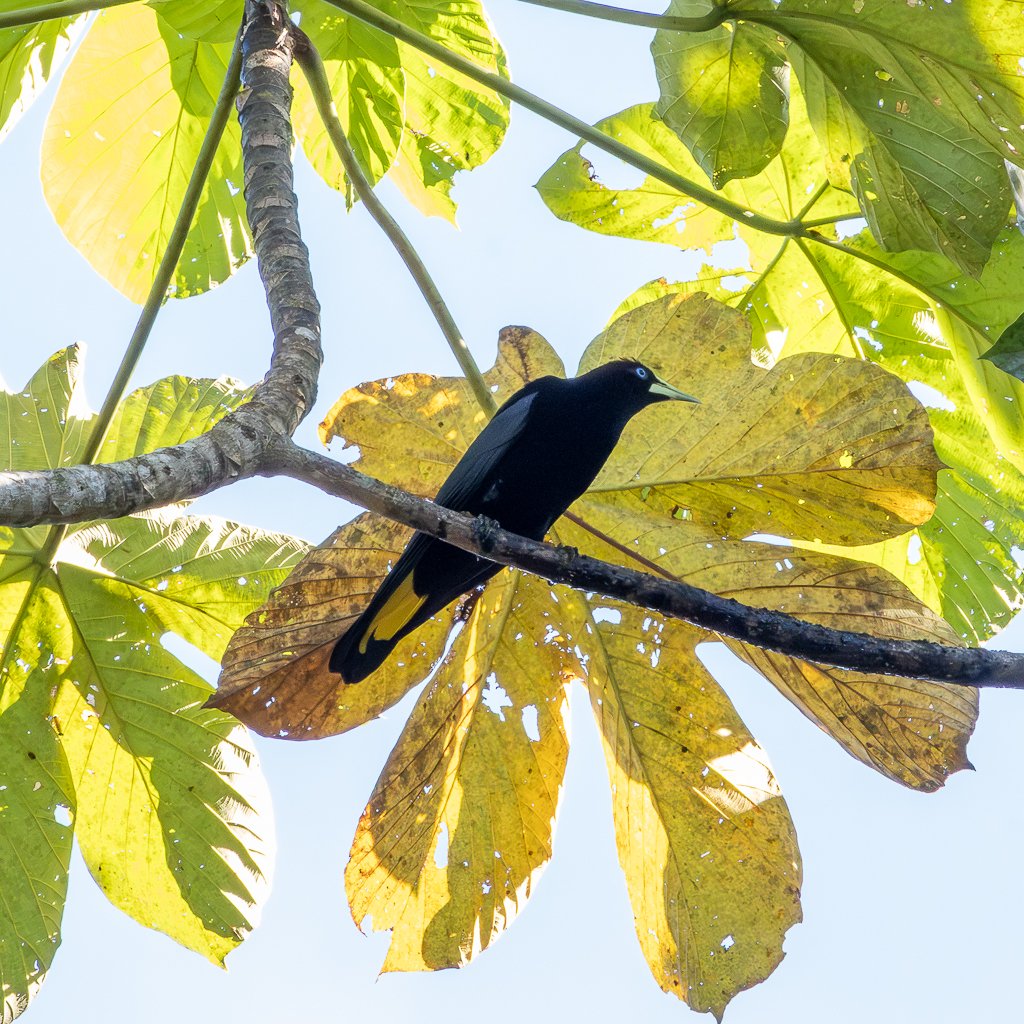
The Band-tailed Cacique is a large, oropendola-like cacique of river islands and flooded forest along the large rivers of western Amazonia. It was formerly placed in a genus of its own. It nests in colonies, often within or next to colonies of oropendolas.
Voice
Liquid, gurgling and bubbling song phrases, accompanied while singing by a bowing display, as in oropendolas. Also short, grating calls.
Recording: Rob Felix — CC BY-NC-SA 4.0 · xeno-canto
Identification
25–34 cm; the male is much larger than the female. Black, with a chestnut tinge on the head, neck and mantle. The bill is black, with a swollen, shield-like base on the forehead, largest in the male. The tail is mostly yellow from below, with black central feathers and a broad black terminal band, which gives the species its name. Juveniles are duller, with a smaller frontal shield.
Confusion species
Russet-backed Oropendola Psarocolius angustifrons is larger, olive-brown with a pale bill and a yellow tail without a black terminal band. Crested Oropendola Psarocolius decumanus is larger, with an ivory bill and a pale blue iris. Casqued Cacique Cacicus oseryi is olive-brown, with a yellow bill, and lives in terra firme forest at the foot of the Andes. Yellow-rumped Cacique Cacicus cela has a yellow rump and wing patch and a pale bill.
Habitat
River islands, várzea, river-edge forest and young growth along large rivers in the lowlands, mostly below 300 m. It forages in groups in the treetops for insects and fruit. It nests in colonies of hanging pouch nests, often in the same tree as oropendolas.
Where the bird is most at home, classified by the vegetation units of the Andes and the west coast.


Range and movements
In Colombia only in the far south-east, along the Amazon. In Ecuador very locally along the large rivers of the east. In Peru in the north-east, along the Amazon and the lower reaches of its large tributaries, south to the Ucayali. Absent from Bolivia and the Galápagos. Outside the guide area in western Brazilian Amazonia.
- Resident
- dark = core range, pale = thinly spread
How and when to look
From a boat along the banks of the Amazon and its large tributaries in north-eastern Peru, look for oropendola colonies on river islands; the Band-tailed Cacique often nests among them.
Conservation status
Least Concern. Its riverine habitat changes naturally all the time and is still largely intact.
Scientific name
Cacicus latirostris | Swainson, 1838 (GBIF: Ocyalus latirostris)
Swainson described the species in 1838 and placed it straight away in the genus where it still stands. The genus Cacicus was introduced in 1799 by De Lacépède. The genus name comes from Spanish cacique, 'chief', a word from the Taíno language of the Caribbean. The species name comes from Latin latus, 'broad', and rostrum, 'bill'. The specimen the first description was based on came from Peru.