All species › Passerines › New World blackbirds, troupials and allies › Mountain Cacique
Mountain Cacique | Cacicus chrysonotus
Geelstuitbergbuidelspreeuw | Cacique montañés | Cacique-montanhês
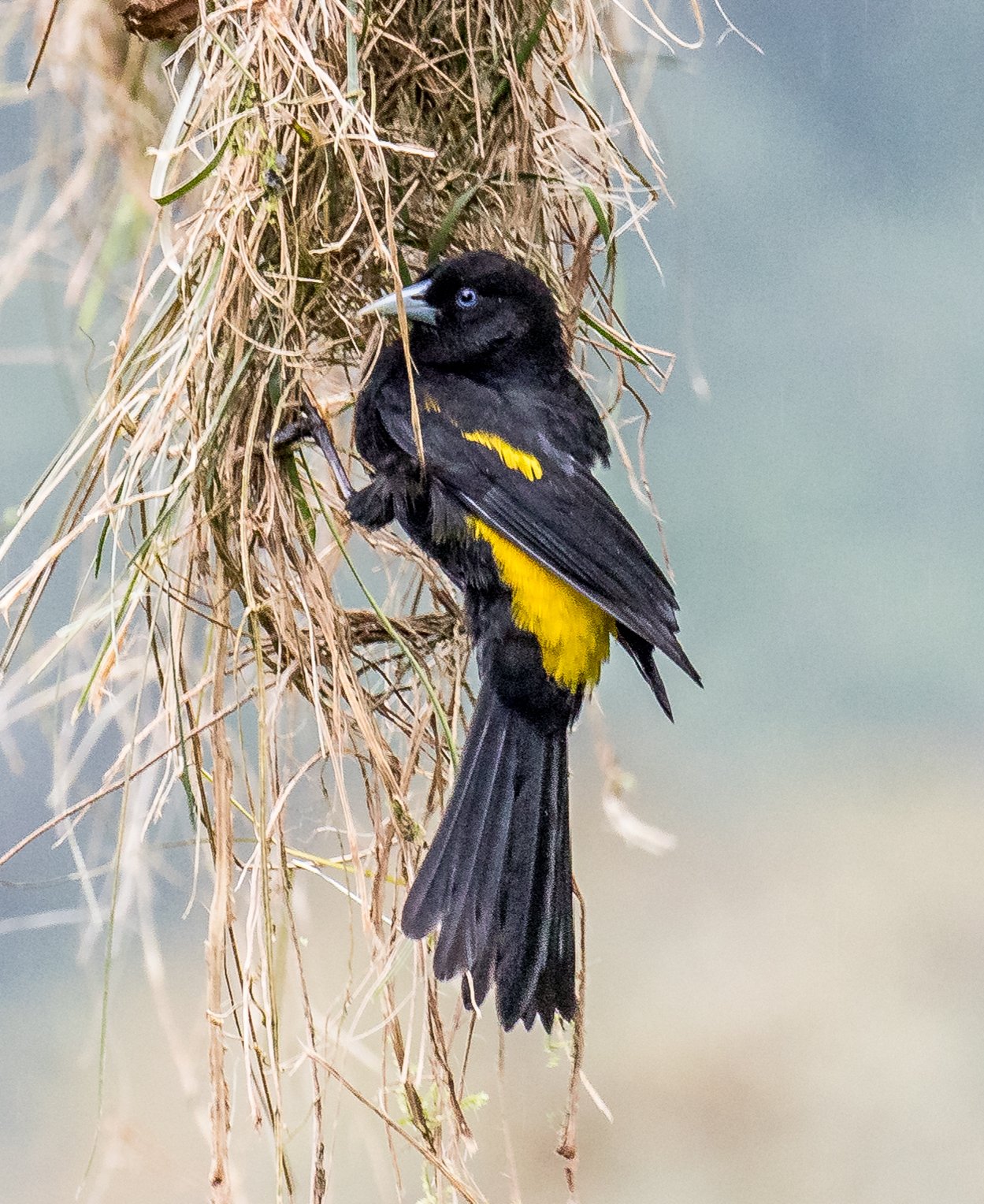
The Mountain Cacique is the cacique of the higher montane forest of the Andes, from Venezuela to Bolivia. Small groups move noisily through the canopy of cloud forest, often together with mixed flocks. Northern and southern birds differ in the amount of yellow on the wing and are sometimes treated as two species.
Voice
Loud, shrill whistles, often in series, and rasping and nasal calls. Groups call a great deal while foraging.
Recording: Jacob Wijpkema — CC BY-NC-SA 4.0 · xeno-canto
Identification
25–30 cm; the male is larger than the female. Glossy black, with a yellow rump. Birds of Colombia, Ecuador and northern Peru also have a yellow patch on the wing coverts; birds of southern Peru and Bolivia lack it or show at most a trace. The iris is pale blue, the bill long, pointed and ivory. The sexes are otherwise alike. Juveniles are duller, with a dark iris.
Confusion species
Scarlet-rumped Cacique Cacicus uropygialis has a red rump and usually lives lower. Yellow-rumped Cacique Cacicus cela also has yellow on the undertail coverts and lives in the lowlands. Golden-winged Cacique Cacicus chrysopterus in Bolivia is smaller, with a yellow wing patch, and lives lower. Red-bellied Grackle Hypopyrrhus pyrohypogaster in Colombia has a red belly and a black bill.
Habitat
Humid montane forest, cloud forest and forest edges, roughly between 1800 and 3200 m, locally lower. It forages in pairs or small groups in the canopy and middle levels, often with mixed flocks, searching moss, bromeliads and dead leaves for insects and also eating fruit. The nest is a long, hanging pouch, usually suspended singly.
Where the bird is most at home, classified by the vegetation units of the Andes and the west coast.


Range and movements
In Colombia in all three Andean ranges. In Ecuador in the Andes, mainly on the eastern slope. In Peru on the eastern slope of the Andes along the whole length of the country. In Bolivia in the Yungas of La Paz and Cochabamba. Absent from the Galápagos. Outside the guide area in western Venezuela.
- Resident
- dark = core range, pale = thinly spread
How and when to look
Search cloud forest along mountain roads on the eastern slope of the Andes for mixed flocks in the canopy; the caciques are usually noticed first by their loud whistles.
Conservation status
Least Concern. Clearance of montane forest locally reduces its habitat.
Scientific name
Cacicus chrysonotus | d'Orbigny, ACVMD & de Lafresnaye, 1838
D'Orbigny, ACVMD & de Lafresnaye described the species in 1838 and placed it straight away in the genus where it still stands. The genus Cacicus was introduced in 1799 by De Lacépède. The genus name comes from Spanish cacique, 'chief', a word from the Taíno language of the Caribbean. The species name comes from Greek khrusos, 'gold', and nōtos, 'back', for the yellow back. The specimen the first description was based on came from Yungas, Bolivia.