All species › Passerines › New World blackbirds, troupials and allies › Yellow-rumped Cacique
Yellow-rumped Cacique | Cacicus cela
Geelstuitbuidelspreeuw | Cacique lomiamarillo | Xexéu
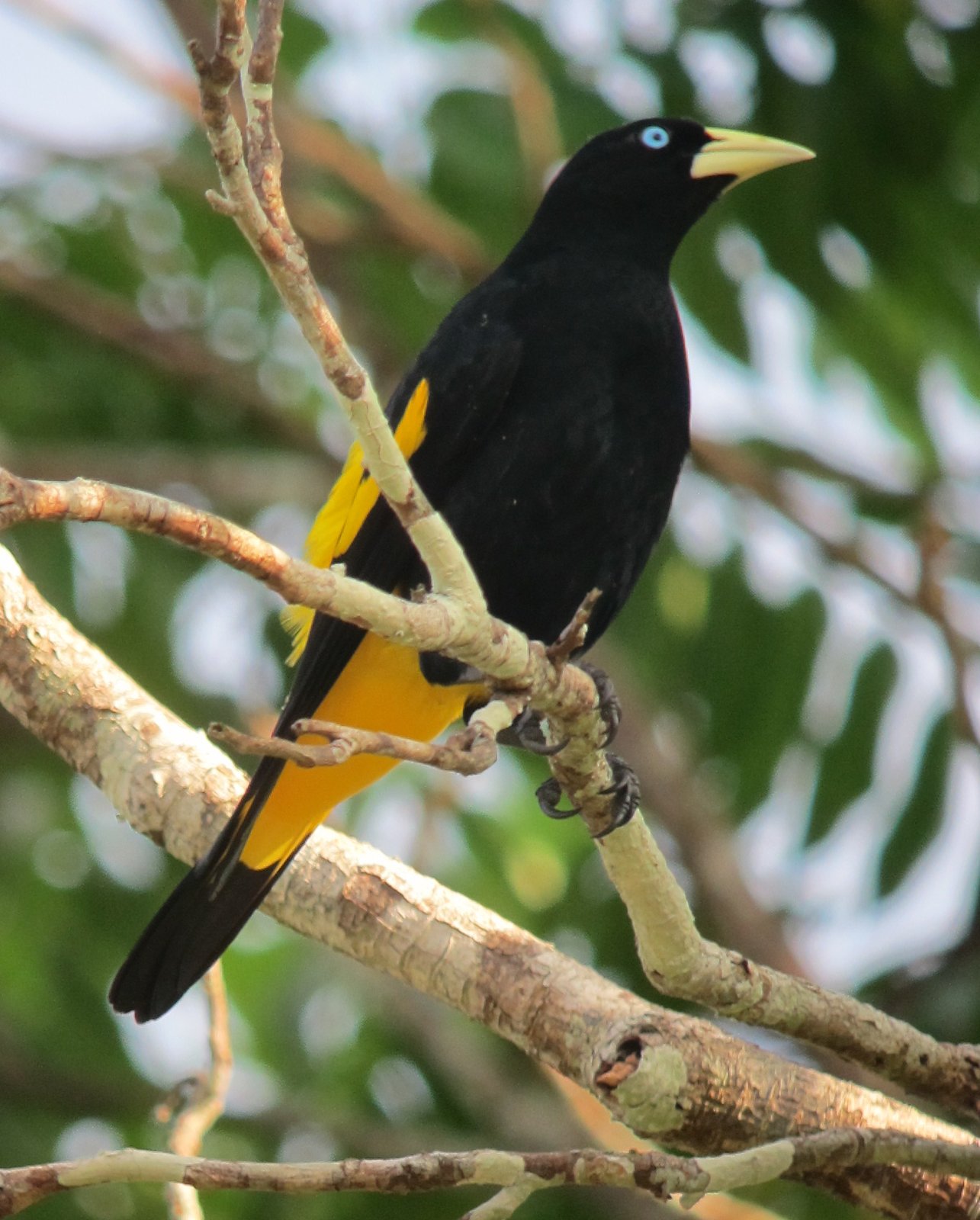
The Yellow-rumped Cacique is a black cacique with yellow on the wing, rump and tail base, and one of the most widespread caciques of the lowlands. It nests in noisy colonies of dozens of hanging nests in isolated trees, often next to wasp nests. Its song includes much mimicry of other birds and sounds.
Voice
Very varied: loud whistles, clucking, grating and rattling sounds, and much mimicry of other birds and of other sounds. Colonies are noisy almost continuously.
Recording: JAYRSON ARAUJO DE OLIVEIRA — CC BY-NC-SA 4.0 · xeno-canto
Identification
23–28 cm; the male is clearly larger than the female. Glossy black, with a large yellow patch on the wing coverts, a yellow rump and yellow on the undertail coverts and tail base. The iris is pale blue, the bill long, pointed and ivory. The female is duller and more brownish black. Juveniles are duller, with a dark iris.
Confusion species
Red-rumped Cacique Cacicus haemorrhous has a red rump and no yellow on the wing. Selva Cacique Cacicus koepckeae is smaller and has only a yellow rump, with no yellow on the wing or undertail coverts. Mountain Cacique Cacicus chrysonotus lacks yellow on the undertail coverts and lives in montane forest. Band-tailed Cacique Cacicus latirostris has a yellow tail with a black terminal band and no yellow rump.
Habitat
Forest edges, clearings with scattered trees, river-edge forest, várzea, river islands, plantations and villages in the lowlands, mostly below 1000 m. It forages in groups in the treetops for insects, fruit and nectar. It nests in colonies of hanging pouch nests in an isolated tree, often next to a wasp nest or over water.
Where the bird is most at home, classified by the vegetation units of the Andes and the west coast.


Range and movements
In Colombia in the lowlands of the north and east of the Andes. In Ecuador in the western lowlands and the Amazonian lowlands of the east. In Peru in the Amazonian lowlands and the far north-west. In Bolivia in the lowlands of the north and east. Absent from the Galápagos. Outside the guide area in Panama, Venezuela, the Guianas and Amazonian Brazil.
- Resident
- dark = core range, pale = thinly spread
How and when to look
Colonies hang in isolated trees by riverbanks, in clearings and in villages; from a boat or around a lodge in the Amazonian lowlands they are usually soon found by their noise.
Conservation status
Not evaluated in this taxonomic treatment. A common and widespread species that thrives in semi-open landscapes and near human settlement.
Scientific name
Cacicus cela | (Linnaeus, 1758)
Linnaeus described the species in 1758 as Parus Cela; because it was later moved to another genus, the author and year stand in brackets. The genus Cacicus was introduced in 1799 by De Lacépède. The genus name comes from Spanish cacique, 'chief', a word from the Taíno language of the Caribbean. The origin of the species name cela, given by Linnaeus, is uncertain; it may be a shortened form of Greek kelainos, 'black', although Linnaeus originally wrote it with a capital letter, as a noun. The specimen the first description was based on came from Suriname.