All species › Passerines › New World blackbirds, troupials and allies › Scarlet-rumped Cacique
Scarlet-rumped Cacique | Cacicus uropygialis
Grote bloedstuitbuidelspreeuw | Cacique lomiescarlata | Cacique-de-uropígio-escarlate
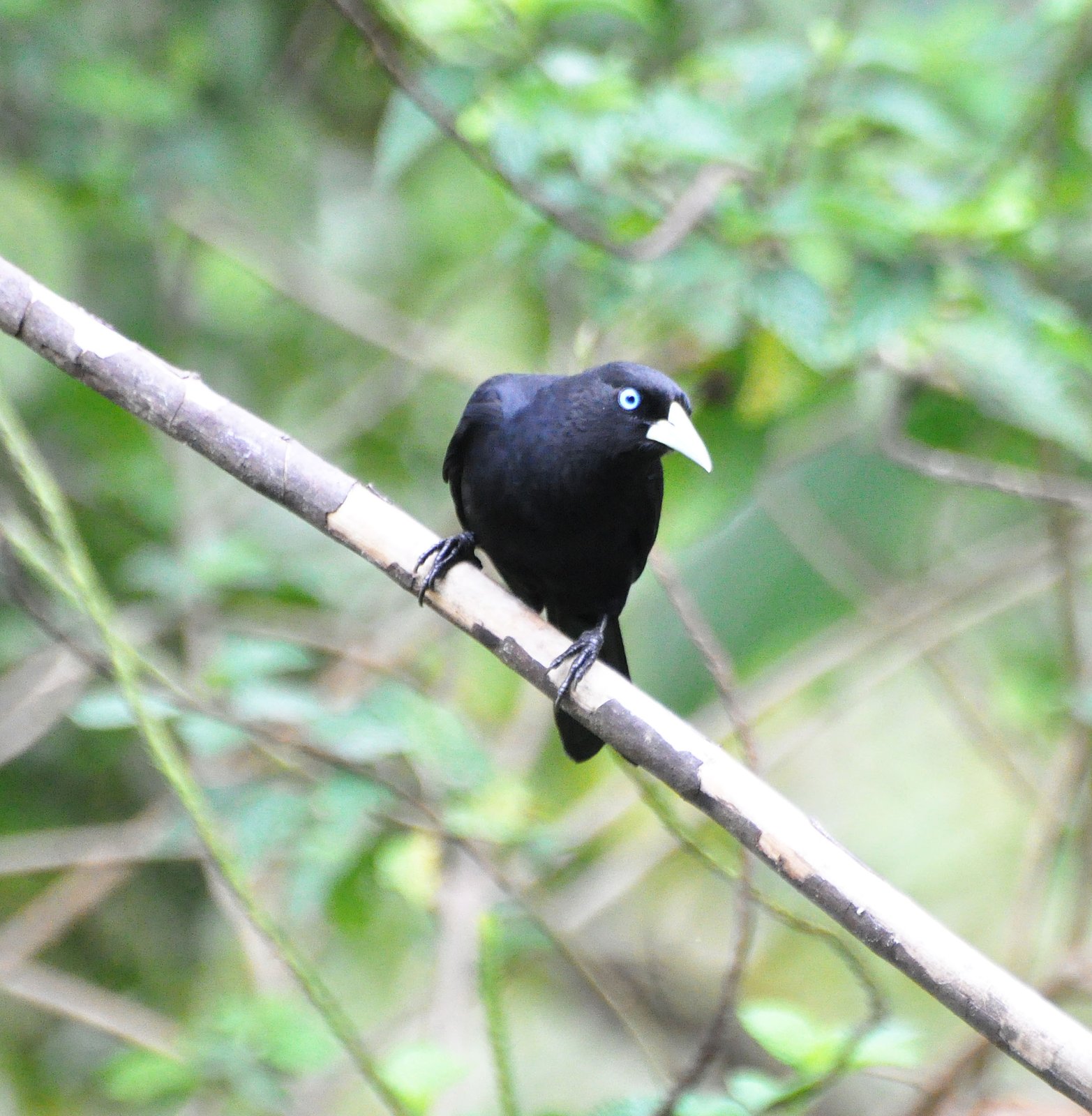
The Scarlet-rumped Cacique is a black cacique with a scarlet rump and a pale blue iris. As treated here, the species includes birds of the subtropical montane forest of the Andes, of the Pacific lowlands and of Central America; these groups are sometimes treated as separate species. They live in small groups in the canopy.
Voice
Loud, clear, liquid whistles, often repeated, and short nasal or grating calls. Groups call a great deal while foraging.
Recording: Paul Bourdin — CC BY-NC-SA 4.0 · xeno-canto
Identification
23–29 cm; the male is larger than the female, and Andean birds are larger than those of the Pacific lowlands. Glossy black, with a scarlet rump that is often covered by the wings in perched birds and is best seen in flight. The iris is pale blue, the bill long, pointed and pale greenish yellow. The sexes are otherwise alike. Juveniles are duller, with a dark iris.
Confusion species
Red-rumped Cacique Cacicus haemorrhous is larger, with a larger red rump that is also visible in perched birds, and lives in the Amazonian lowlands. Mountain Cacique Cacicus chrysonotus has a yellow rump and usually lives higher. Yellow-billed Cacique Amblycercus holosericeus is all black, with a yellow iris, and keeps low in dense thickets and bamboo.
Habitat
Humid montane forest and forest edges in the Andes, roughly between 1000 and 2500 m, and humid lowland and hill forest on the Pacific side, mostly below 1000 m. It forages in pairs or small groups in the canopy and middle levels, often with mixed flocks, searching leaves, dead leaves and epiphytes for insects and also eating fruit. The nest is a hanging pouch, singly or in small groups.
Where the bird is most at home, classified by the vegetation units of the Andes and the west coast.


Range and movements
In Colombia in the Andes and the Pacific lowlands. In Ecuador in the Andes and in the lowlands and foothills of the north-west. In Peru on the eastern slope of the Andes, from the north to the south. Absent from Bolivia and the Galápagos. Outside the guide area in western Venezuela and in Central America, from Honduras to Panama.
- Resident
- dark = core range, pale = thinly spread
How and when to look
In montane forest, look for groups of black caciques with pale bills moving through the canopy with mixed flocks; the red rump is best seen when a bird takes off.
Conservation status
Not evaluated in this taxonomic treatment. The groups treated elsewhere as separate species are each assessed as Least Concern. Deforestation in the Andes and the Chocó locally reduces its habitat.
Scientific name
Cacicus uropygialis | de Lafresnaye, 1843
De Lafresnaye described the species in 1843 and placed it straight away in the genus where it still stands. The genus Cacicus was introduced in 1799 by De Lacépède. The genus name comes from Spanish cacique, 'chief', a word from the Taíno language of the Caribbean. The species name comes from uropygium, 'rump', for the red rump. The specimen the first description was based on came from Bogotá, Colombia.