All species › Passerines › New World blackbirds, troupials and allies › Selva Cacique
Selva Cacique | Cacicus koepckeae
Loretobuidelspreeuw | Cacique de Koepcke | Cacique-da-selva
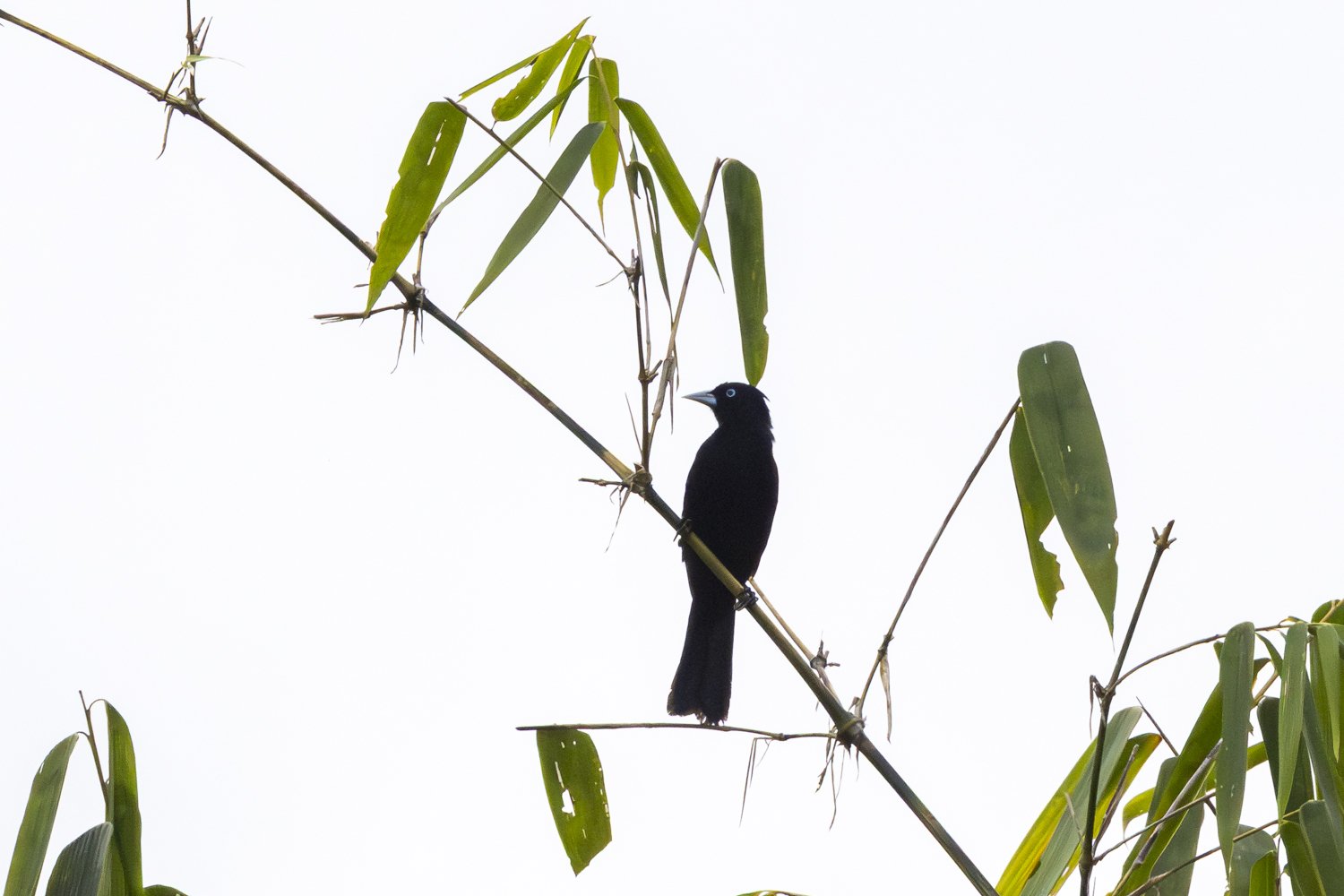
The Selva Cacique is a slender, black cacique with a yellow rump that occurs almost only in eastern Peru. The species was described only in 1965 and is known from just a small number of sites. It lives in dense vegetation along small rivers and streams in lowland forest.
Voice
Poorly described. Clear whistles and nasal calls, similar to those of related caciques.
Recording: Dante Buzzetti — CC BY-NC-SA 4.0 · xeno-canto
Identification
21–23 cm, slender and fairly long-tailed. Entirely black except for a yellow rump and yellow uppertail coverts; the wings and undertail coverts are black. The iris is bluish white, the bill pointed and pale. The sexes are nearly alike.
Confusion species
Yellow-rumped Cacique Cacicus cela is larger, also has a yellow wing patch and yellow at the tail base and on the undertail coverts, and nests in colonies in open places. Mountain Cacique Cacicus chrysonotus is larger and lives much higher, in montane forest. Ecuadorian Cacique Cacicus sclateri lacks a yellow rump and lives in north-eastern Peru.
Habitat
Dense vegetation along small rivers and streams in lowland rainforest and in the low foothills, roughly between 300 and 600 m. It forages in the middle and upper levels along the forest edge by the water, probably mainly for insects and fruit. Little is known about the nest.
Where the bird is most at home, classified by the vegetation units of the Andes and the west coast.


Range and movements
In the guide area only in Peru, in the east, with records from Ucayali, Cusco and Madre de Dios. Absent from Colombia, Ecuador and the Galápagos; not known from Bolivia. Outside the guide area in adjacent western Brazil (Acre).
How and when to look
In eastern Peru, scan from a boat or along stream banks in lowland forest for black caciques with a yellow rump, and check for the absence of yellow on the wings.
Conservation status
Near Threatened. The population is small and probably declining through forest clearance for agriculture; its remote habitat offers some protection.
Scientific name
Cacicus koepckeae | Lowery & O'Neill, 1965
Lowery & O'Neill described the species in 1965 and placed it straight away in the genus where it still stands. The genus Cacicus was introduced in 1799 by De Lacépède. The genus name comes from Spanish cacique, 'chief', a word from the Taíno language of the Caribbean. The species name honours Maria Koepcke (1924–1971), a German-Peruvian ornithologist who studied the birds of Peru. The specimen the first description was based on came from Balta, Ucayali, Peru.