All species › Waders, gulls and terns › Sandpipers and allies › Jameson's Snipe
Jameson's Snipe | Gallinago jamesoni
Andessnip | Becasina andina | Narceja-andina
Jameson's Snipe is a large, heavy snipe of the páramo and humid puna, from Colombia to Bolivia. It was formerly treated as one species with Fuegian Snipe Gallinago stricklandii of southern Chile and Argentina. At dusk it gives itself away with a display flight over the grassland around the treeline.
Voice
In the display flight at dusk and at night a repeated, harsh call and a humming or whooshing sound; on take-off a hoarse krrrt.
Recording: Juan Freile — CC BY-NC-SA 4.0 · xeno-canto
Identification
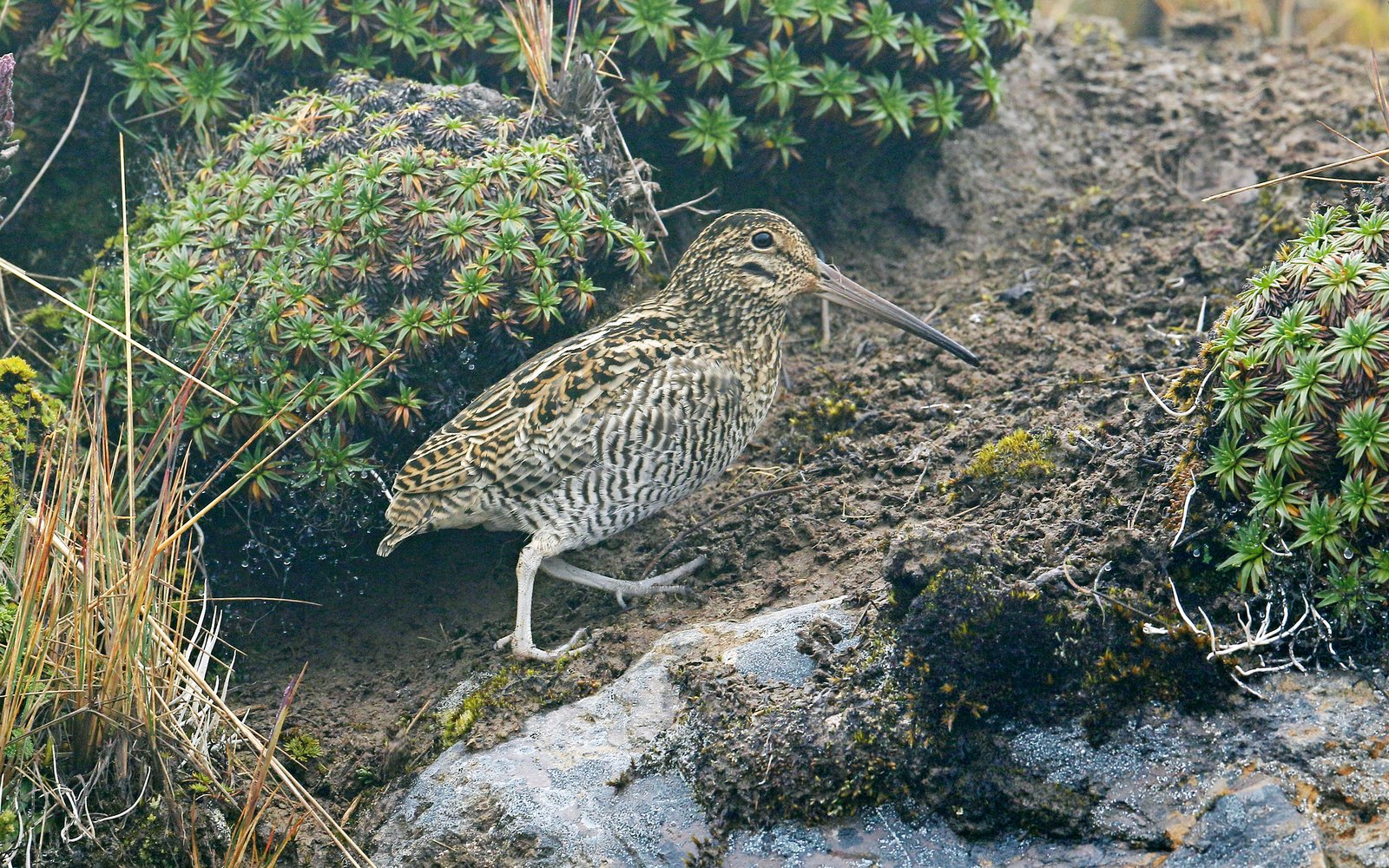
29–31 cm, stocky, with a long bill thick at the base and broad, rounded wings without a white trailing edge. The upperparts are dark brown with rufous and buff stripes and spots, and the head has a pale central crown-stripe and supercilium. The breast and flanks are barred and mottled brown, and the belly too is largely barred, without a clean white patch. The legs are greyish to greenish. The flight is rather slow, with little zigzagging. The sexes are alike.
Confusion species
Noble Snipe Gallinago nobilis partly shares the páramo in Colombia and Ecuador, but has a white belly, a warmer brown breast and a slimmer bill base. Puna Snipe Gallinago andina is smaller, with a white belly and yellow legs, and lives on the puna of Peru and Bolivia. Imperial Snipe Gallinago imperialis is dark rufous without pale stripes and lives in forest around the treeline. Wilson's Snipe Gallinago delicata is smaller, with a white belly and a narrow white trailing edge to the wing.
Habitat
Wet grassland, boggy patches and bofedales in páramo and humid puna, often at the treeline and in clearings in elfin forest, roughly between 2800 and 4300 m. It probes the soft, wet ground for worms and insect larvae, mainly at dusk. The nest is a scrape in a grass tussock on the ground.
Where the bird is most at home, classified by the vegetation units of the Andes and the west coast.


Range and movements
In Colombia in the páramo of the Central and Eastern Andes. In Ecuador in the páramo throughout the country. In Peru along the Andes, mainly on the eastern slope. In Bolivia in the western Andes, south to about Cochabamba. Absent from the Galápagos. Outside the guide area only in the Andes of western Venezuela.
- Resident
- dark = core range, pale = thinly spread
How and when to look
Visit wet páramo near the treeline at dusk, for example around the passes in the eastern Andes of Ecuador, and listen for the display flight over the grassland.
Conservation status
Least Concern. Habitat is lost locally through drainage, burning and grazing of the páramo.
Scientific name
Gallinago jamesoni | (Jardine & Bonaparte, 1855)
Jardine & Bonaparte described the species in 1855 as Xylocota jamesoni; because it was later moved to another genus, the author and year stand in brackets. The genus Gallinago was introduced in 1760 by Brisson. The genus name is New Latin for a woodcock or snipe, from Latin gallina, 'hen', with the suffix -ago, 'resembling'. The species name honours William Jameson (1796–1873), a Scottish botanist who lived and worked in Quito. The specimen the first description was based on came from Andes near Quito, Ecuador.