All species › Waders, gulls and terns › Sandpipers and allies › Giant Snipe
Giant Snipe | Gallinago undulata
Reuzensnip | Becasina gigante | Narcejão
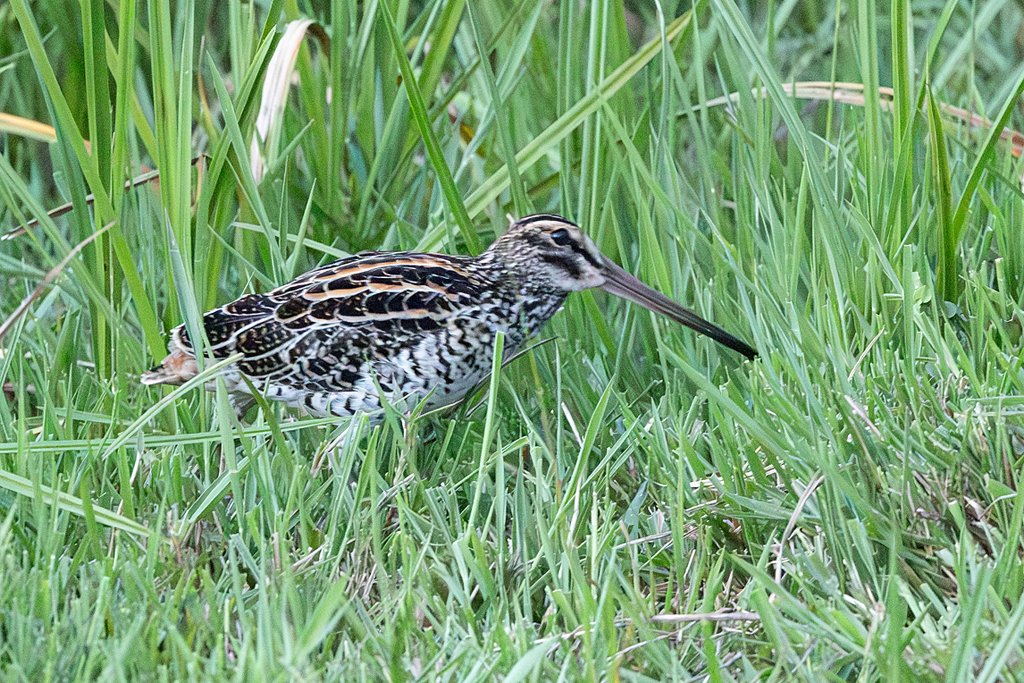
The Giant Snipe is the largest snipe in the world, a heavy, broad-winged bird of wet savannas and marshy grasslands in the lowlands. It is mainly active at night and by day flushes only when almost stepped on. In the guide area it is very local, with the northern subspecies in Colombia and the larger southern subspecies gigantea in Bolivia.
Voice
On take-off a hoarse kek-kek. In the nocturnal display flight a rasping, three-syllabled phrase, repeated constantly, especially at dusk and in moonlight.
Recording: Nunes D´Acosta — CC BY-NC-SA 4.0 · xeno-canto
Identification
38–47 cm, with a very long bill that is thick at the base; birds of the southern subspecies are clearly larger and heavier. The head has broad black and rufous stripes. The upperparts are barred and scaled black, rufous and buff, the breast and flanks are densely barred, and the centre of the belly is whitish. The wings are broad and rounded, with finely barred flight feathers. The flight is slow and heavy, not zigzagging. The sexes are alike.
Confusion species
Pantanal Snipe Gallinago paraguaiae and Wilson's Snipe Gallinago delicata are much smaller and slimmer, with plain dark flight feathers and a fast, zigzagging flight. Imperial Snipe Gallinago imperialis is smaller, dark rufous without pale stripes, and lives only in the Andes around the treeline.
Habitat
Tall, wet vegetation in marshes, flooded grasslands and damp savannas, sometimes also drier savanna and pasture; mainly in the lowlands, locally up to about 2200 m in the north. It feeds mainly at night, probing soft ground for worms and insect larvae and also taking frogs. The nest of the southern subspecies is on a hummock among marsh vegetation.
Where the bird is most at home, classified by the vegetation units of the Andes and the west coast.


Range and movements
In Colombia local and scarce in the llanos and savannas east of the Andes. In Peru only a few records from the savannas of the far south-east (Pampas del Heath). In Bolivia scarce in the savannas of the eastern lowlands. Absent from Ecuador and the Galápagos. Outside the guide area in Venezuela, the Guianas and northern Brazil, and with the southern subspecies in south-eastern Brazil, Paraguay and north-eastern Argentina.
- Resident
- dark = core range, pale = thinly spread
How and when to look
Drive or walk along wet savannas and marsh edges after dark and listen for the display call; by day the bird sometimes flushes right at your feet from tall grass.
Conservation status
Least Concern. The species has a large range, but is locally vulnerable to drainage and the conversion of wet savannas to pasture and cropland.
Scientific name
Gallinago undulata | (Boddaert, 1783)
Boddaert described the species in 1783 as Scolopax undulata; because it was later moved to another genus, the author and year stand in brackets. The genus Gallinago was introduced in 1760 by Brisson. The genus name is New Latin for a woodcock or snipe, from Latin gallina, 'hen', with the suffix -ago, 'resembling'. The species name is Latin undulatus, 'wavy', after the barred plumage. The specimen the first description was based on came from Cayenne, French Guiana.