All species › Waders, gulls and terns › Sandpipers and allies › Imperial Snipe
Imperial Snipe | Gallinago imperialis
Keizersnip | Becasina imperial | Narceja-imperial
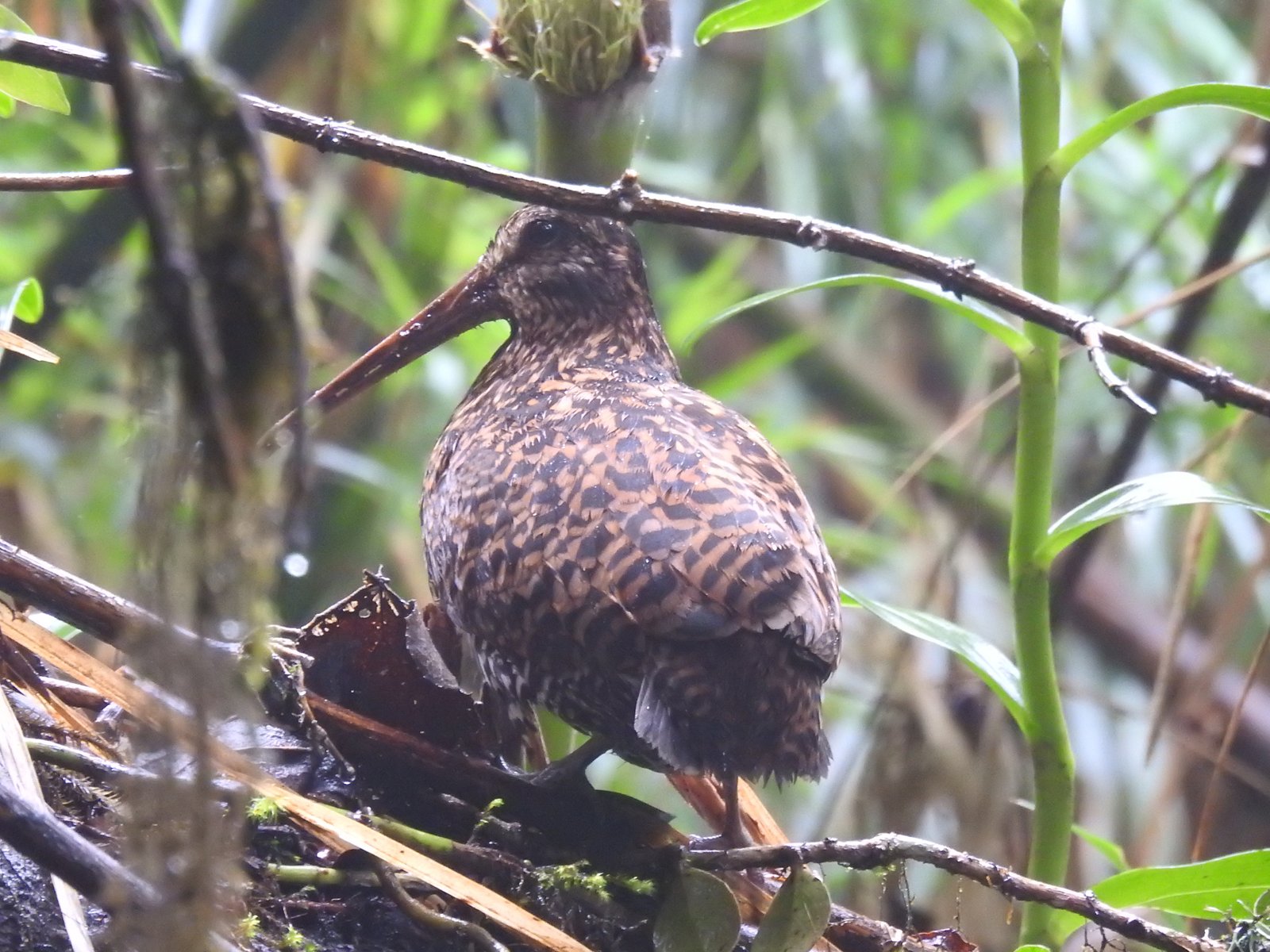
The Imperial Snipe is a large, dark snipe of the treeline in the Andes, more reminiscent of a woodcock than of a typical snipe. For a long time it was known only from a few old specimens and was rediscovered in Peru only in 1967. It lives very secretively and is mainly detected by its display flight at dusk.
Voice
At dusk and in the dark before dawn a loud, harsh series of notes that accelerates and slows again, given in a display flight high above the treeline; sometimes with a rattling sound.
Recording: Niels Krabbe — CC BY-SA 4.0 · xeno-canto
Identification
29–31 cm, with a long, slightly drooping bill, very broad, rounded wings and a short tail. The head and upperparts are dark rufous-chestnut barred with black, lacking the pale stripes that other snipes have on the head and back. The breast is mottled rufous and dark brown; the flanks, belly and undertail-coverts are densely barred dark brown on a whitish ground. At rest the tertials cover the primaries. Sexual differences and juvenile plumage are unknown.
Confusion species
Jameson's Snipe Gallinago jamesoni often lives in the same zone, but is paler greyish brown, with pale stripes on the head and back, and keeps to open páramo and grassland. Noble Snipe Gallinago nobilis is paler, with clear stripes on the head and back and a white belly. Giant Snipe Gallinago undulata is larger, with a striped head, and lives in the lowlands.
Habitat
The edge of cloud forest and elfin forest around the treeline, with wet clearings, small sphagnum bogs and bamboo-fringed glades, roughly between 2700 and 3700 m. It lives on the forest floor and in wet clearings, where it presumably probes soft ground for worms and insect larvae. Almost nothing is known about the nest.
Where the bird is most at home, classified by the vegetation units of the Andes and the west coast.


Range and movements
In Colombia known only from an old specimen from the Eastern Andes and very few later records. In Ecuador very local on both slopes of the Andes. In Peru scattered and local on the eastern slope, south to the region of Cusco. Not known with certainty from Bolivia. Absent from the Galápagos. It does not occur outside the guide area.
- Resident
- dark = core range, pale = thinly spread
How and when to look
Visit clearings in elfin forest near the treeline at dusk or before dawn, for example on passes on the eastern slope of the Andes, and listen for the display call above the forest.
Conservation status
Near Threatened. Its habitat is fragmented and locally degraded by clearing and burning at the treeline; owing to its secretive habits the population is poorly known.
Scientific name
Gallinago imperialis | Sclater & Salvin, 1869
Sclater & Salvin described the species in 1869 and placed it straight away in the genus where it still stands. The genus Gallinago was introduced in 1760 by Brisson. The genus name is New Latin for a woodcock or snipe, from Latin gallina, 'hen', with the suffix -ago, 'resembling'. The species name is Latin imperialis, 'imperial', after its size and striking plumage. The specimen the first description was based on came from Bogotá, Colombia.