All species › Waders, gulls and terns › Sandpipers and allies › Short-billed Dowitcher
Short-billed Dowitcher | Limnodromus griseus
Kleine grijze snip | Agujeta gris | Maçarico-de-costas-brancas
The Short-billed Dowitcher is a stocky shorebird with a long, straight bill that breeds in the taiga and bogs of Alaska and Canada. On the Pacific coast of Colombia, Ecuador and Peru it is a numerous winter visitor to mudflats and mangroves. Flocks feed close together, probing the mud with rapid vertical movements.
Voice
A soft, rippling tu-tu-tu, often in flight; flocks give a soft twittering.
Recording: Stanislas Wroza — CC BY-NC-SA 4.0 · xeno-canto
Identification
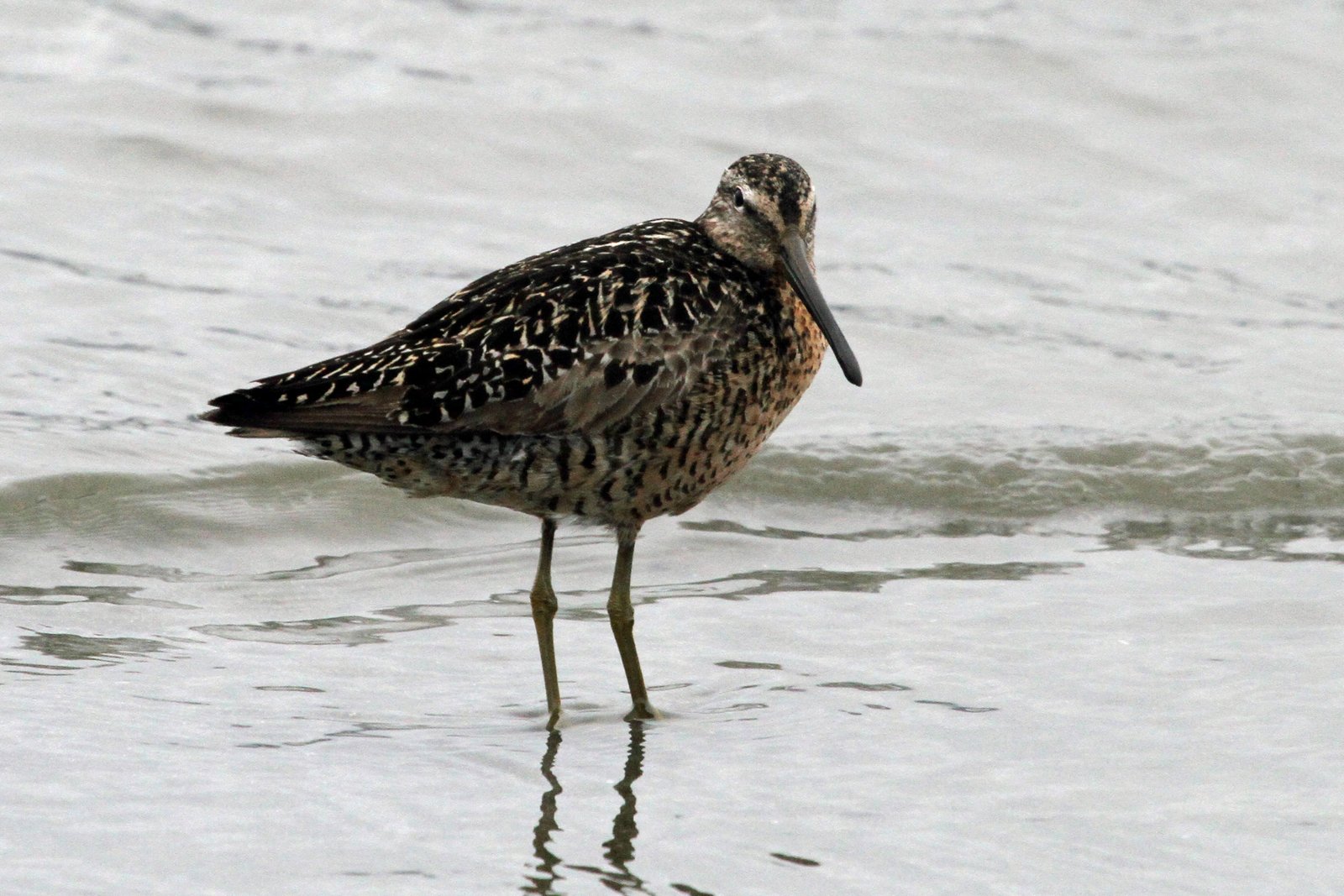
25–29 cm, with a long, straight, dark bill and rather short, greenish yellow legs. In non-breeding plumage grey on head, neck, breast and upperparts, with a pale supercilium, a dark eye-stripe and a white belly; the breast is often finely speckled. In breeding plumage orange-brown on neck and breast, with dark spots on the sides of the breast and a white belly; the upperparts are dark with rusty fringes. Juveniles have warm brown upperparts and tertials with rusty internal markings. In flight a white wedge runs from the rump up the back. The sexes are alike.
Confusion species
Long-billed Dowitcher Limnodromus scolopaceus is almost identical, but calls a high, sharp keek, has an entirely rufous belly in breeding plumage, and juveniles have plain grey tertials; that species mainly uses fresh water and is rare in the guide area. Red Knot Calidris canutus is stockier, with a much shorter bill. Hudsonian Godwit Limosa haemastica is larger and longer-legged, with a slightly upturned bill that is pink at the base.
Habitat
Mudflats, the muddy edges of mangroves, estuaries, lagoons, salt pans and shrimp ponds on the coast; rarely inland. It feeds in dense flocks, probing deep into mud for worms, small molluscs, crustaceans and insect larvae. It does not breed in the guide area.
Where the bird is most at home, classified by the vegetation units of the Andes and the west coast.


Range and movements
In Colombia a common winter visitor on the Pacific coast and scarcer on the Caribbean coast. In Ecuador numerous on the coast, especially around the Gulf of Guayaquil. In Peru along the whole coast, most numerous in the north and scarcer to the south. A rare visitor to the Galápagos. In Bolivia at most exceptional. Outside the guide area it breeds in Alaska and Canada and winters along the coasts from the United States to northern South America.
- Resident
- dark = core range, pale = thinly spread
How and when to look
At low tide on the mudflats and in the shrimp ponds around the Gulf of Guayaquil and near Tumbes, where flocks of hundreds feed from September to April.
Conservation status
Vulnerable. The population has declined steeply in recent decades; the causes are thought to be loss and disturbance of mudflats and coastal wetlands along the flyway and on the wintering grounds.
Scientific name
Limnodromus griseus | (Gmelin, 1789)
Gmelin described the species in 1789 as Scolopax grisea; because it was later moved to another genus, the author and year stand in brackets. The genus Limnodromus was introduced in 1833 by Wied-Neuwied. The genus name combines Greek limnē, 'marsh', with -dromos, 'runner'. The species name is Medieval Latin griseus, 'grey'. The specimen the first description was based on came from Long Island, New York, United States.