All species › Passerines › Tyrant flycatchers and allies › Johannes's Tody-Tyrant
Johannes's Tody-Tyrant | Hemitriccus iohannis
Johannes' todietiran | Titirijí de Johannes | Maria-peruviana
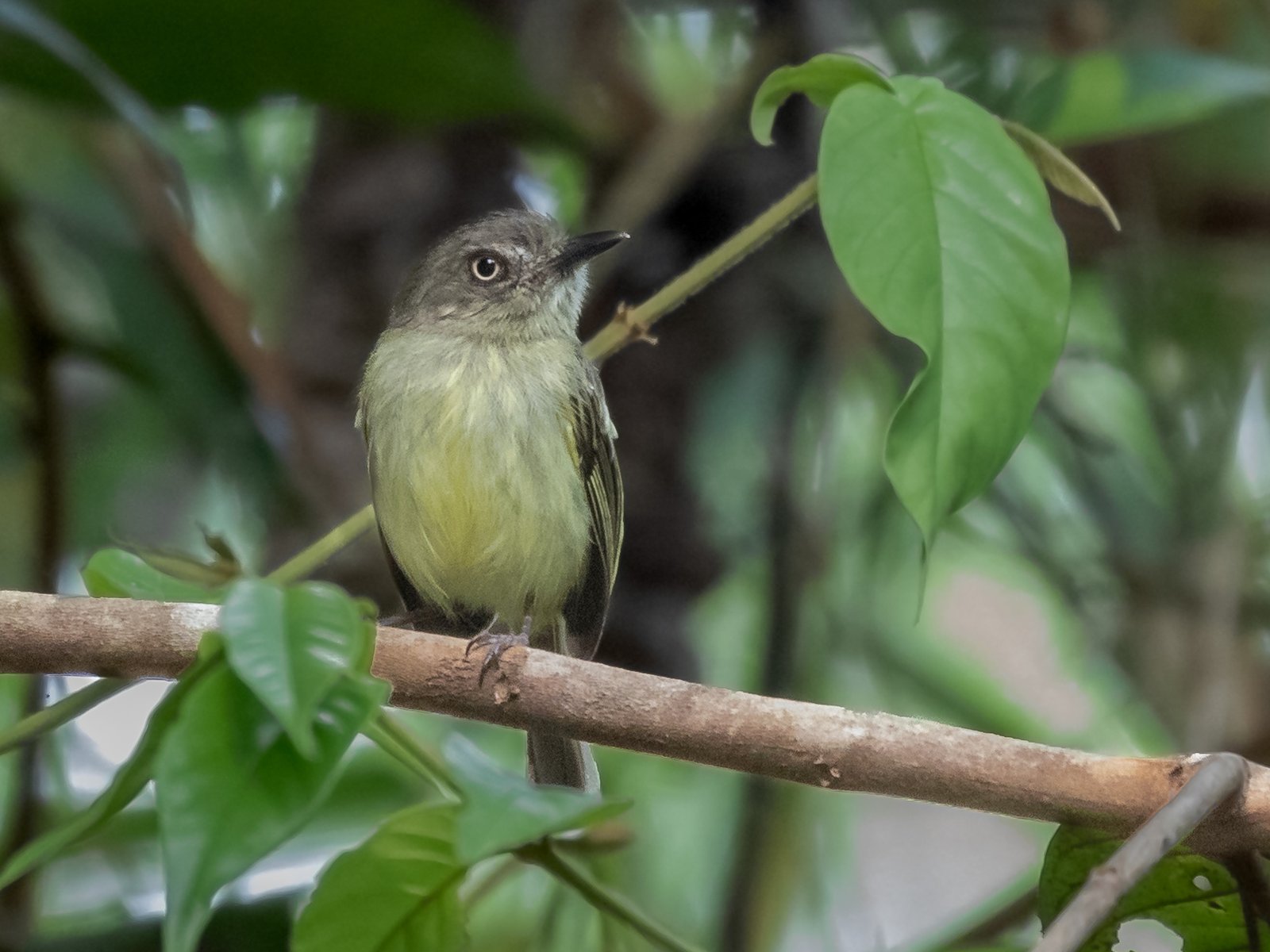
Johannes's Tody-Tyrant is a small olive-and-yellow tyrant of the river forests of western Amazonia. It lives in flooded forest, on river banks and in young growth on river islands. It closely resembles the Stripe-necked Tody-Tyrant, but lacks the white spectacles and the sharp throat streaks.
Voice
An accelerating series of dry, ticking notes ending in a short rattle.
Recording: JAYRSON ARAUJO DE OLIVEIRA — CC BY-NC-SA 4.0 · xeno-canto
Identification
10 cm, with a flat bill and a fairly short tail. The upperparts are olive-green, the wings dark with narrow yellow edgings and faint wing bars. The iris is pale. The sides of the head are greyish olive without distinct spectacles. The throat and breast are yellowish olive with faint dark streaks, the belly is yellow. The sexes are alike.
Confusion species
Stripe-necked Tody-Tyrant Hemitriccus striaticollis has white lores and eye-ring, a whiter throat with sharp black streaks, and lives mainly in scrub at forest edges. White-eyed Tody-Tyrant Hemitriccus zosterops and White-bellied Tody-Tyrant Hemitriccus griseipectus have distinct yellow wing bars and pale spectacles and live in terra firme forest. Common Tody-Flycatcher Todirostrum cinereum has a dark head and bright yellow underparts.
Habitat
Várzea and river forest, scrub and young growth on river islands and along banks, sometimes at the edge of swamp forest; in the lowlands. It forages alone or in pairs low to mid-level for insects, which it picks from leaves with short sallies.
Where the bird is most at home, classified by the vegetation units of the Andes and the west coast.


Range and movements
Colombia: in the extreme south, along the Amazon. Ecuador: very local in the east, along large rivers. Peru: scattered in the eastern lowlands along the large rivers. Bolivia: in the north (Pando, Beni, northern La Paz). Absent from the Galápagos. Outside the guide area in western Brazil.
- Resident
- dark = core range, pale = thinly spread
How and when to look
Search young growth on river islands in the Amazon near Iquitos or Leticia, or along rivers in Madre de Dios; listen for the accelerating ticking series.
Conservation status
Least Concern. The species lives in river forest, a habitat that is continually renewed by the natural dynamics of the rivers.
Scientific name
Hemitriccus iohannis | (Snethlage, HMMEE, 1907)
Snethlage, HMMEE described the species in 1907 as Euscarthmus iohannis; because it was later moved to another genus, the author and year stand in brackets. The genus Hemitriccus was introduced in 1860 by Cabanis & Heine. The genus name comes from Greek hēmi-, 'half, small', and trikkos, an unidentified small bird, used by ornithologists for tyrant flycatchers. The species name is the Latin genitive of Johannes (João) and honours João Baptista de Sá (d. 1909), Brazilian taxidermist and collector. The specimen the first description was based on came from Monte Verde, Rio Purus, Brazil.