All species › Passerines › Tyrant flycatchers and allies › Stripe-necked Tody-Tyrant
Stripe-necked Tody-Tyrant | Hemitriccus striaticollis
Streepnektodietiran | Titirijí gorjiestriado | Sebinho-rajado-amarelo
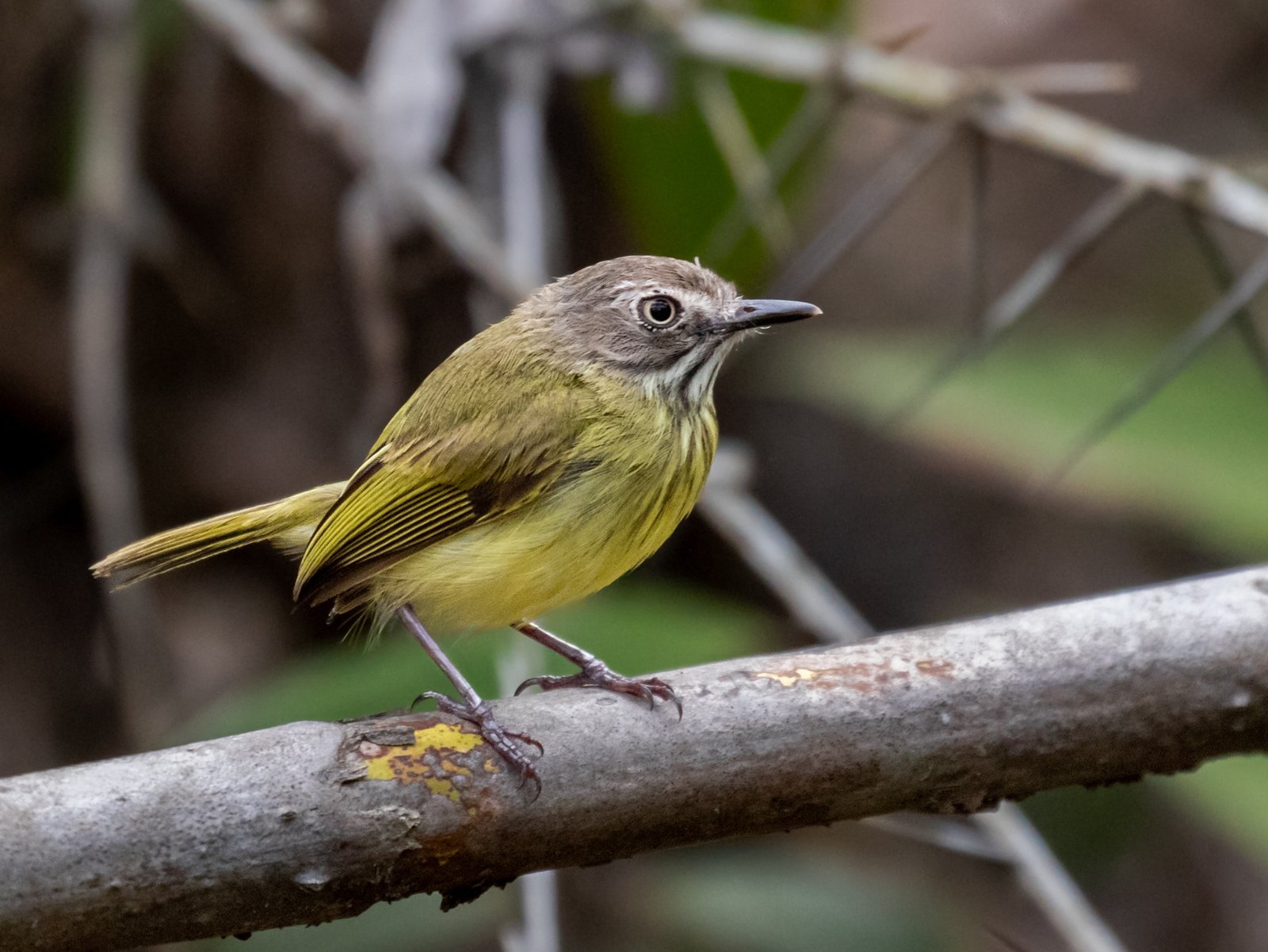
The Stripe-necked Tody-Tyrant is a small tyrant of scrub, forest edges and young growth. It has conspicuous white spectacles and a white-and-black streaked throat. In the guide area it occurs in several separate areas on the eastern side of the Andes.
Voice
A short series of sharp, dry notes, often doubled, and a short rattle.
Recording: JAYRSON ARAUJO DE OLIVEIRA — CC BY-NC-SA 4.0 · xeno-canto
Identification
10 cm, with a flat bill and a fairly short tail. The upperparts are olive-green, the wings dark with yellow edgings. The lores and eye-ring are white and form distinct spectacles. The throat and breast are white with sharp black streaks, the belly is pale yellow. The sexes are alike.
Confusion species
Johannes's Tody-Tyrant Hemitriccus iohannis has a yellowish olive throat with faint streaks and lacks the white spectacles; it lives in river forest. Pale-eyed Pygmy Tyrant Atalotriccus pilaris has a pale iris, pale wing bars and a less sharply streaked throat. Pearly-vented Tody-Tyrant Hemitriccus margaritaceiventer is drabber, with a white belly and a pale iris.
Habitat
Scrub at forest edges, young secondary forest, open woodland along rivers and plantations with trees, in the lowlands and foothills up to about 1500 m. It forages alone or in pairs low to mid-level for insects, which it picks from leaves with short sallies.
Where the bird is most at home, classified by the vegetation units of the Andes and the west coast.


Range and movements
Colombia: in the east, mainly along the foot of the Eastern Andes. Peru: on the eastern side of the Andes in the north and centre, including the Huallaga valley, and locally in the south-east. Bolivia: in the north and east. Absent from Ecuador and the Galápagos. Outside the guide area in Brazil.
- Resident
- dark = core range, pale = thinly spread
How and when to look
Search scrub and forest edges around Tarapoto or in the Huallaga valley; the white spectacles and streaked throat are visible when the bird perches at the edge of the scrub.
Conservation status
Least Concern. The species also uses secondary growth and tolerates forest disturbance.
Scientific name
Hemitriccus striaticollis | (de Lafresnaye, 1853)
De Lafresnaye described the species in 1853 as Todirostrum striaticolle; because it was later moved to another genus, the author and year stand in brackets. The genus Hemitriccus was introduced in 1860 by Cabanis & Heine. The genus name comes from Greek hēmi-, 'half, small', and trikkos, an unidentified small bird, used by ornithologists for tyrant flycatchers. The species name comes from Latin striatus, 'striped', and collum, 'neck'. The specimen the first description was based on came from Bahia, Brazil.