All species › Passerines › Ovenbirds and woodcreepers › Junin Canastero
Junin Canastero | Asthenes virgata
Juníncanastero | Canastero de Junín | Lenheiro-de-junín
The Junin Canastero is a heavily streaked canastero of humid bunchgrass puna in central and southern Peru. It occurs only in Peru. It was long treated as a subspecies of Many-striped Canastero; in central Peru the two meet and sometimes hybridise.
Voice
The song is a dry, accelerating and descending trill, sometimes slightly stuttering. Calls are a mewing note and a complaining alarm call.
Recording: Nick Athanas — CC BY-NC-SA 3.0 · xeno-canto
Identification
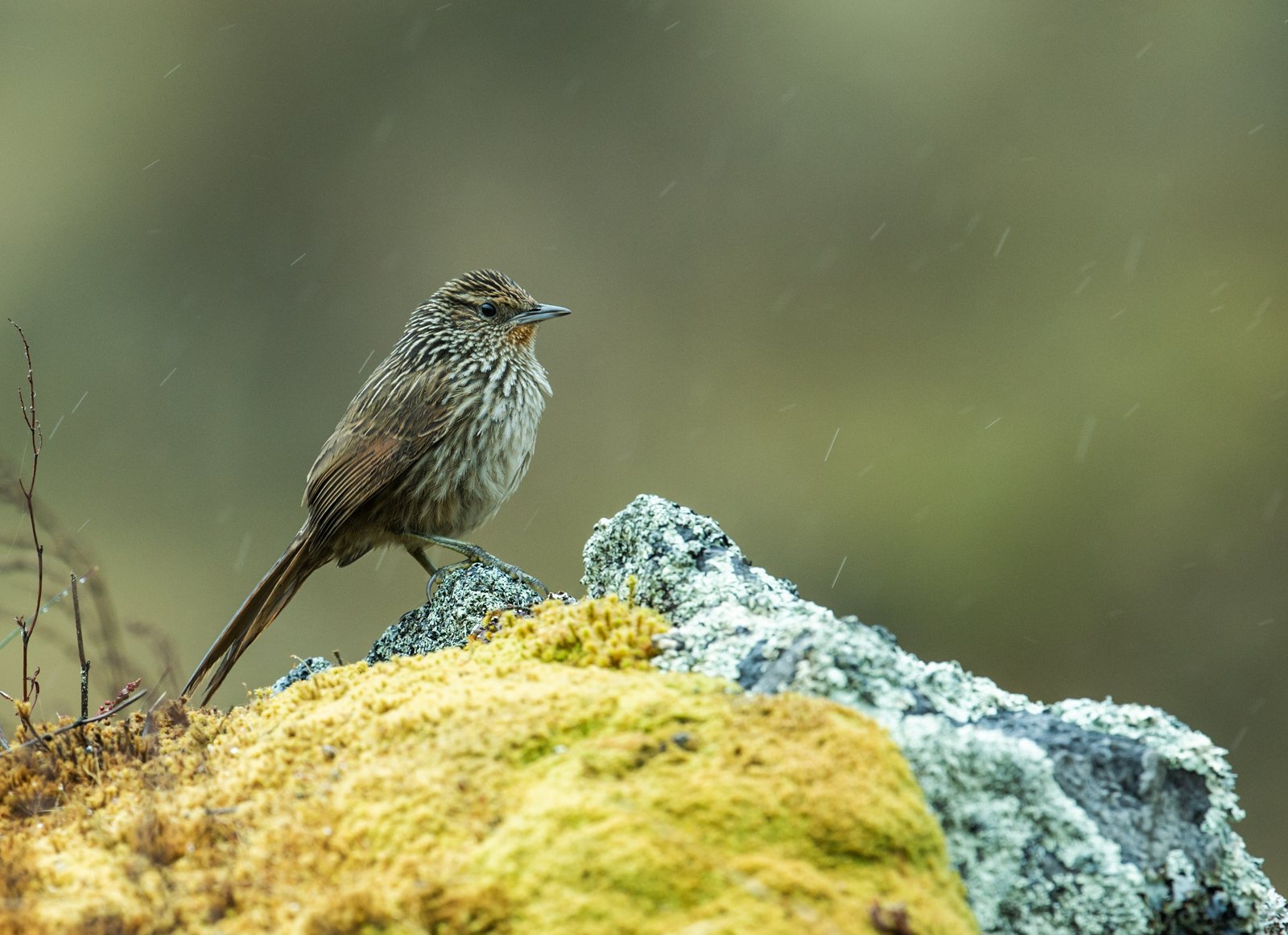
17–18 cm, with a thin, pointed bill and a long, graduated tail with pointed feathers. The crown is black with orange-brown streaks, the back is streaked black and buff, with a narrow buff supercilium. The wings show rufous edges to the flight feathers. The chin and throat have a small orange-rufous patch. The underparts are pale creamy brown with faint streaks on the breast; the undertail coverts are warm tawny. The sexes are alike.
Confusion species
Many-striped Canastero Asthenes flammulata is more heavily streaked below and lives mainly farther north; intermediates occur in the contact zone in central Peru. Scribble-tailed Canastero Asthenes maculicauda has a rufous forehead and a tail with irregular dark markings, and lives farther southeast. Streak-backed Canastero Asthenes wyatti has a less streaked crown and almost unstreaked, buffy underparts.
Habitat
Humid grassland with tall bunchgrass in the puna, sometimes with scattered shrubs or near Polylepis groves, also on rocky slopes with bunchgrass and no shrubs, roughly between 3300 and 4600 m. It forages for insects and other invertebrates low in and between the grass tussocks. The nest is a domed ball of grass, low in a tussock or shrub.
Where the bird is most at home, classified by the vegetation units of the Andes and the west coast.


Range and movements
Endemic to Peru: in the Andes where Junín, Pasco and Lima meet, and from Ayacucho through Apurímac and Cusco to just into Puno, with scattered records in between. Absent from Colombia, Ecuador, Bolivia and the Galápagos.
- Resident
- dark = core range, pale = thinly spread
How and when to look
Search tall bunchgrass on the puna in the morning, for example in the highlands of Junín and Cusco. The bird sings from the top of a tussock or shrub and then drops back into the vegetation.
Conservation status
Least Concern. The species has a limited range; overgrazing and burning of grassland can degrade its habitat locally.
Scientific name
Asthenes virgata | (Sclater, 1874)
Sclater described the species in 1874 as Synallaxis virgata; because it was later moved to another genus, the author and year stand in brackets. The genus Asthenes was introduced in 1853 by Reichenbach. The genus name comes from Ancient Greek asthenēs, 'insignificant', 'weak'. The species name comes from Latin virgatus, 'striped', for the streaked plumage. The specimen the first description was based on came from Junín, Peru.