All species › Woodpeckers and allies › Toucans › Keel-billed Toucan
Keel-billed Toucan | Ramphastos sulfuratus
Zwavelborsttoekan | Tucán pico canoa | Tucano-de-bico-quilhado
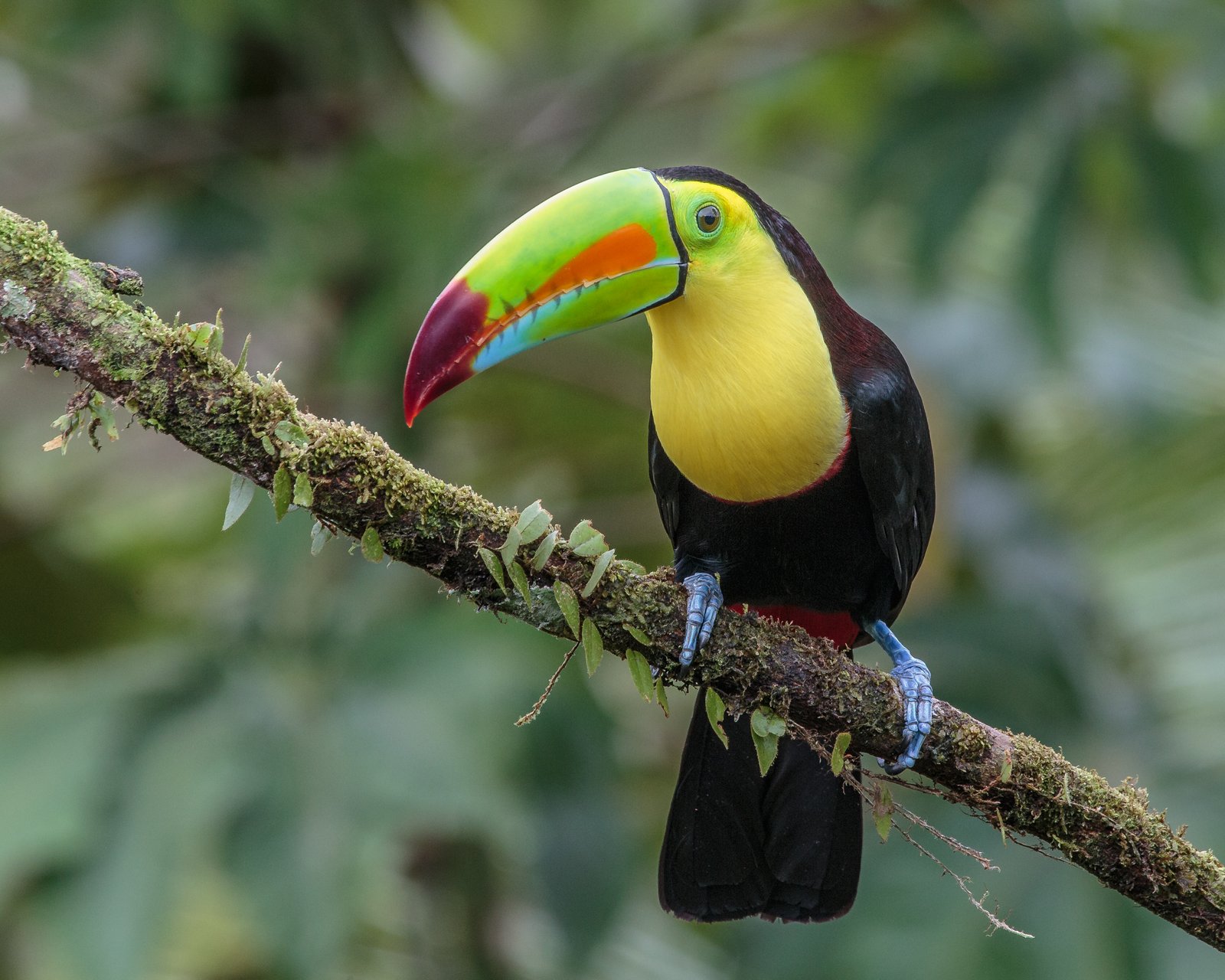
The Keel-billed Toucan is a Central American toucan that in the guide area reaches only northern and north-western Colombia. Its bill is multicoloured, green with orange, red and blue, and thus unlike that of any other toucan in the guide area. It lives in small groups in the canopy of humid lowland forest.
Voice
A dry, creaking, frog-like krreek-krreek-krreek, repeated at length, often by several birds together and from a high branch. Also bill-tapping and clattering.
Recording: Nick Talbot — CC BY-NC-SA 4.0 · xeno-canto
Identification
42–55 cm, about a third of which is bill. The plumage is mostly black, with a chestnut wash on the nape and upper back. Face, throat and breast are sulphur-yellow, bordered below by a narrow red band. The uppertail coverts are white, the undertail coverts red. The bare skin around the eye is yellow-green. The bill is mostly pale green, with an orange patch on the side of the upper mandible, a dark red tip and bluish tones on the lower mandible. The sexes are alike; juveniles have a shorter, duller bill.
Confusion species
Yellow-throated Toucan Ramphastos ambiguus is larger and has a diagonally two-toned bill, yellow above and chestnut at the base and below, and a yelping call instead of croaks. Choco Toucan Ramphastos brevis on the Pacific side has a yellow upper and a black lower mandible. Collared Aracari Pteroglossus torquatus is much smaller and slimmer, with a yellow belly with a black spot and a red-and-black band.
Habitat
Humid and semi-humid lowland forest, forest edges, secondary forest and semi-open country with scattered tall trees; mainly in the canopy, in the lowlands and on the lower slopes, usually below 1000 m. It lives in groups that fly one after another from tree to tree. It eats mainly fruit, but also insects, lizards, eggs and nestlings. It nests in a tree cavity.
Where the bird is most at home, classified by the vegetation units of the Andes and the west coast.


Range and movements
In Colombia only in the north-west and north: from the Panama border east through the Caribbean lowlands and into the Magdalena valley. Absent from Ecuador, Peru, Bolivia and the Galápagos. Outside the guide area from southern Mexico through Central America to Panama and in north-western Venezuela.
- Resident
- dark = core range, pale = thinly spread
How and when to look
Search forest remnants and semi-open country with tall trees in northern Colombia, for example in the lowlands around the Gulf of Urabá. Groups fly in single file with an undulating flight across open stretches and give themselves away by their creaking call.
Conservation status
Near Threatened. The species is declining through deforestation and is hunted and trapped for the cage-bird trade.
Scientific name
Ramphastos sulfuratus | Lesson, 1830
Lesson described the species in 1830 and placed it straight away in the genus where it still stands. The genus Ramphastos was introduced in 1758 by Linnaeus. The genus name comes from Greek rhamphēstēs, 'snouted, large-billed', from rhamphē, 'bill'. The species name sulfuratus is Latin for 'sulphur-coloured', after the yellow throat and breast. The specimen the first description was based on came from Mexico.