All species › Woodpeckers and allies › Toucans › White-throated Toucan
White-throated Toucan | Ramphastos tucanus
Roodsnaveltoekan | Tucán goliblanco | Tucano-de-papo-branco
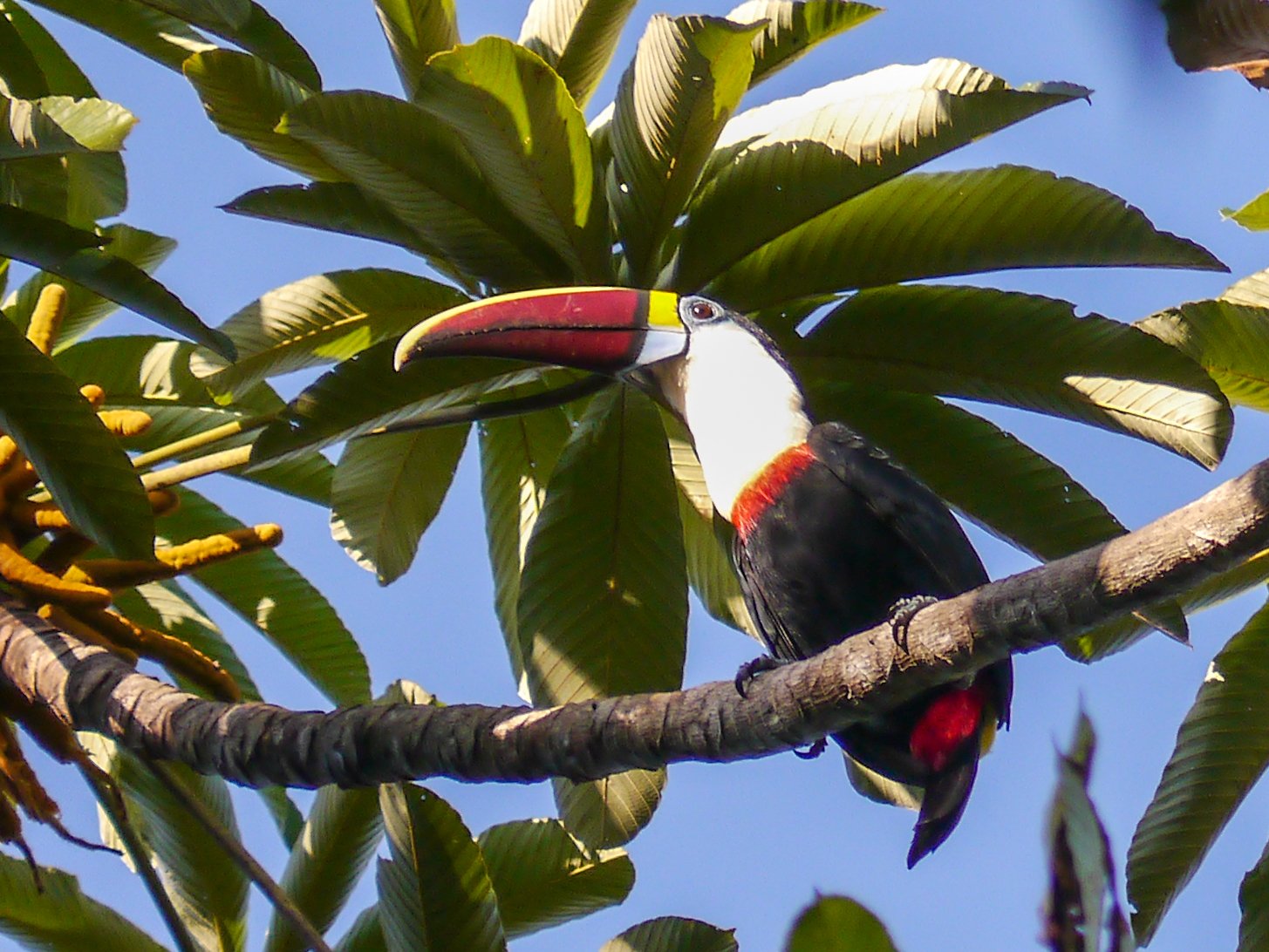
The White-throated Toucan is the largest toucan of the Amazonian lowlands in the guide area: black, with a white throat and breast and a very long bill. Its yelping call from the tops of tall trees is one of the characteristic sounds of the Amazon forest. In the guide area the form cuvieri occurs, with a black bill; the Dutch name ('red-billed toucan') refers to the nominate form of north-eastern South America, whose bill is largely reddish brown.
Voice
A loud, yelping call of one long and several shorter notes, like kee-yóh, kee-yo-yo, repeated at length from a high, open branch, mainly in the morning and evening; several birds often call together. Also dry bill-clattering.
Recording: JAYRSON ARAUJO DE OLIVEIRA — CC BY-NC-SA 4.0 · xeno-canto
Identification
53–61 cm, about a third of which is bill. The plumage is black, with a white throat and upper breast bordered below by a narrow red band. The uppertail coverts are yellow to orange-yellow, the undertail coverts red. The bill is black, with a narrow yellow ridge along the culmen and a narrow yellow to greenish band at the base. Bare pale blue skin surrounds the eye. The sexes are alike, but the female has a shorter bill. Juveniles are duller, with a shorter bill.
Confusion species
Channel-billed Toucan Ramphastos vitellinus in the guide area has the same white throat and black, yellow-ridged bill, but is smaller, with a shorter bill, red uppertail coverts and a croaking call instead of yelps; hybrids occur. Yellow-throated Toucan Ramphastos ambiguus on the east slope of the Andes has a yellow throat and breast and a yellow upper mandible. Toco Toucan Ramphastos toco in Bolivia has an orange bill with a black patch near the tip and lives in semi-open country.
Habitat
Tall humid lowland forest, both terra firme and várzea, forest edges, riverine forest and semi-open country with tall trees; mainly in the canopy. Usually below 1000 m, locally higher in the foothills. It lives in pairs or small groups. It eats mainly fruit, but also insects, small vertebrates and the eggs and young of other birds. It nests in a natural tree cavity.
Where the bird is most at home, classified by the vegetation units of the Andes and the west coast.


Range and movements
In Colombia in the lowlands east of the Andes, from the Orinoco region to Amazonia. In Ecuador in the eastern lowlands and foothills. In Peru throughout the Amazonian lowlands. In Bolivia in the northern and central lowlands, roughly south to northern Santa Cruz. Absent west of the Andes and from the Galápagos. Outside the guide area in Venezuela, the Guianas and Amazonian Brazil.
- Resident
- dark = core range, pale = thinly spread
How and when to look
Listen in the early morning along rivers and clearings in the Amazon forest for the yelping call, then scan the top of a tall, bare tree. From canopy towers at lodges in the lowlands of Ecuador and Peru the birds are often seen in the treetops.
Conservation status
Not Evaluated in this species limit. The species is still widespread, but numbers are declining through deforestation in Amazonia; it is also hunted for meat and feathers and trapped as a cage bird.
Scientific name
Ramphastos tucanus | Linnaeus, 1758
Linnaeus described the species in 1758 and placed it straight away in the genus where it still stands. He introduced the genus Ramphastos in that same work. The genus name comes from Greek rhamphēstēs, 'snouted, large-billed', from rhamphē, 'bill'. The species name tucanus comes from the Tupi word tukana, 'toucan', the source of the word toucan itself. The specimen the first description was based on came from Suriname.