All species › Woodpeckers and allies › Toucans › Yellow-throated Toucan
Yellow-throated Toucan | Ramphastos ambiguus
Zwartsnaveltoekan | Tucán pechigualdo | Tucano-de-papo-amarelo
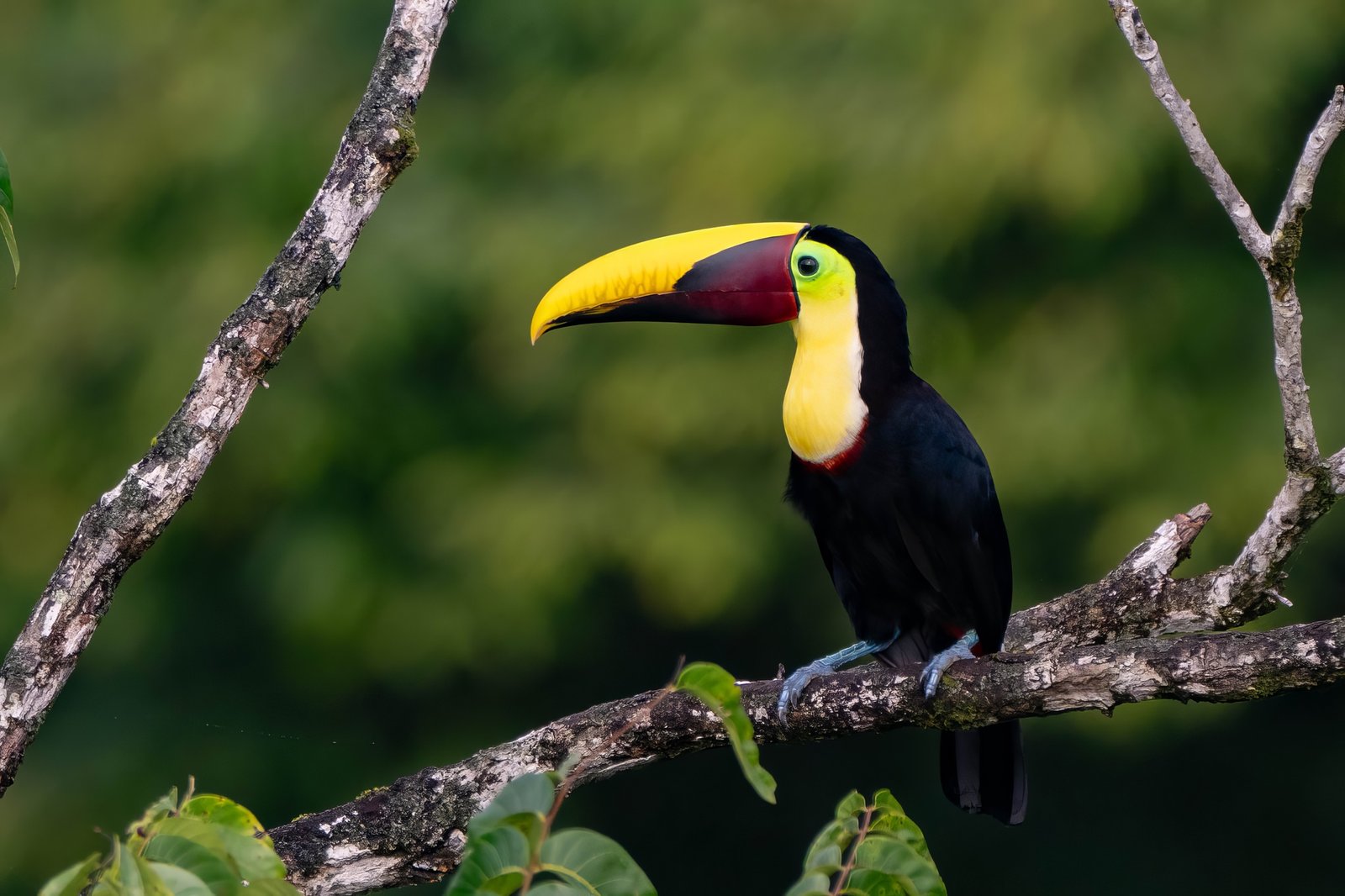
The Yellow-throated Toucan is one of the largest toucans in the guide area: black, with a bright yellow throat and breast and a huge two-toned bill. There are two clearly different forms. On the east slope of the Andes lives the form with a black lower mandible; in the Pacific lowlands of Colombia and Ecuador the form with a chestnut lower mandible, formerly treated as a separate species. Both give themselves away from afar with their loud, yelping call.
Voice
A loud, yelping call of one long and several short notes, repeated over and over, like kee-yeh, tedik-tedik, rendered in Spanish as Dios te dé. Calls mainly in the morning and evening from a high branch, swinging its head up and down with each call.
Recording: Juan Freile — CC BY-NC-SA 4.0 · xeno-canto
Identification
52–61 cm, much of it bill. The plumage is black, with a bright yellow throat and breast bordered below by a narrow white and a broader red band. The uppertail coverts are white, the undertail coverts red. The upper mandible is yellow; the lower mandible and a diagonal band across the base of the upper mandible are black in the east-slope form and chestnut in the western form. Bare greenish skin surrounds the eye. The sexes are alike, the female having a shorter bill. Juveniles are duller, with a smaller bill.
Confusion species
Choco Toucan Ramphastos brevis in the west closely resembles the eastern form, with a yellow upper and black lower mandible, but is smaller and has a croaking call; the western Yellow-throated Toucan differs from it in its chestnut lower mandible. In Amazonia, White-throated Toucan Ramphastos tucanus has a white throat and a dark bill, and Channel-billed Toucan Ramphastos vitellinus is smaller with a black bill and a croaking call. In northern Colombia, Keel-billed Toucan Ramphastos sulfuratus has a multicoloured bill with green, orange and red.
Habitat
Tall humid forest in the lowlands and on the lower slopes, mainly in the canopy and at forest edges, and also in semi-open country with tall trees, shade coffee and cacao. The eastern form lives mainly in foothill and lower montane forest on the east slope; the western form in Chocó rainforest and the humid forests of western Ecuador. It eats mainly fruit, but also insects, lizards, eggs and nestlings. It nests in a tree cavity.
Where the bird is most at home, classified by the vegetation units of the Andes and the west coast.


Range and movements
In Colombia on the Pacific side and in the north and centre of the country (western form) and on the east slope of the Andes (eastern form). In Ecuador in the western lowlands and foothills, and on the east slope of the Andes. In Peru on the east slope of the Andes south to about the centre of the country. Absent from Bolivia. Outside the guide area in Venezuela and, in the western form, from Honduras to Panama.
- Resident
- dark = core range, pale = thinly spread
How and when to look
Look for it at forest edges and along roads through foothill forest, where birds call early in the morning from the top of a tall, bare tree. A lower mandible that is black or chestnut settles the identification against Choco Toucan.
Conservation status
Still widespread, but declining through deforestation, especially in western Colombia and Ecuador, where much lowland forest has gone. Locally hunted and kept as a cage bird.
Scientific name
Ramphastos ambiguus | Swainson, 1823
Swainson described the species in 1823 and placed it straight away in the genus where it still stands. The genus Ramphastos was introduced in 1758 by Linnaeus. The genus name comes from Greek rhamphēstēs, 'snouted, large-billed', from rhamphē, 'bill'. The species name ambiguus is Latin for 'doubtful, uncertain' (from ambigere, 'to doubt'). The specimen the first description was based on came from Buenavista, Colombia.