All species › Woodpeckers and allies › Toucans › Toco Toucan
Toco Toucan | Ramphastos toco
Reuzentoekan | Tucán toco | Tucanuçu
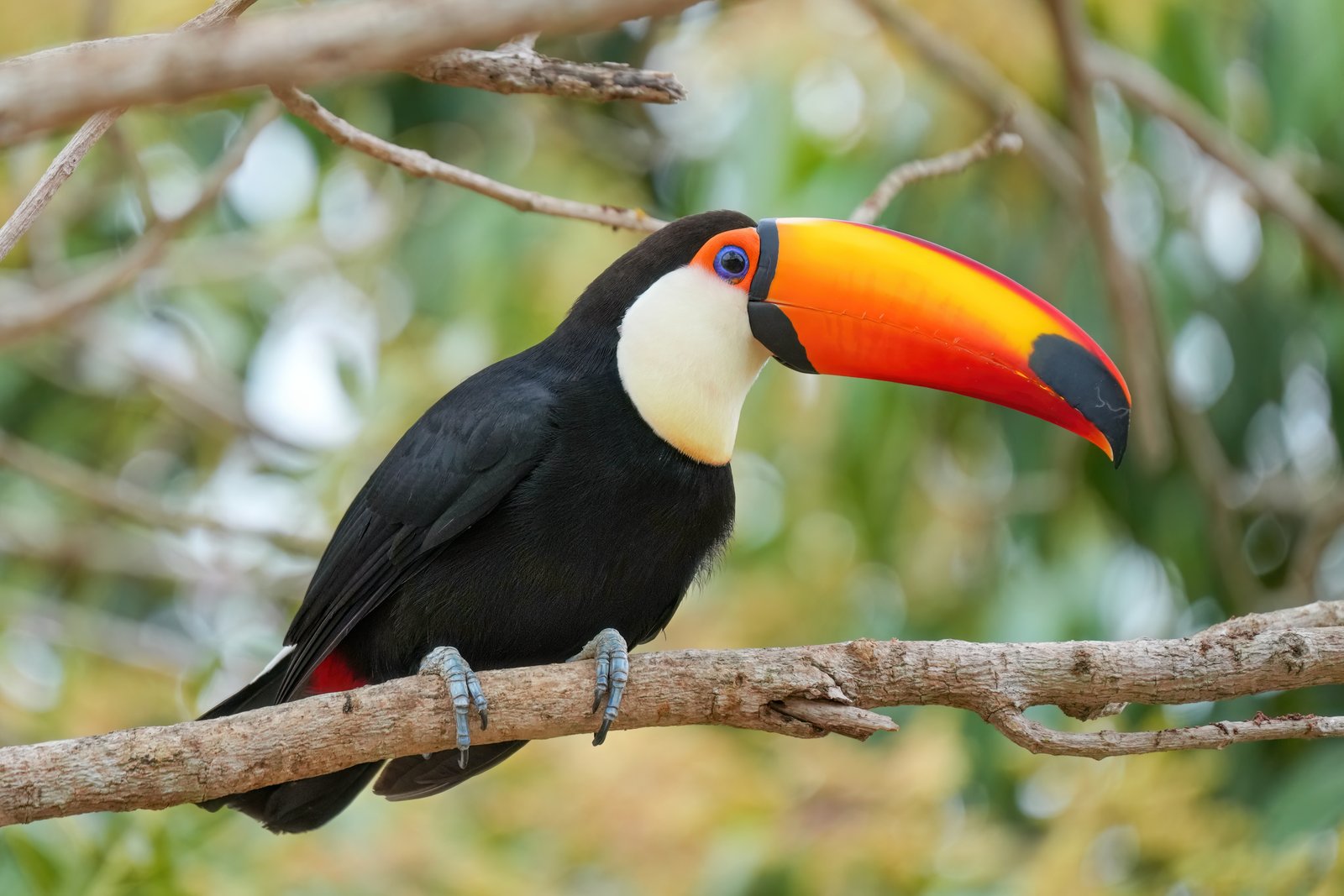
The Toco Toucan is the largest toucan, with an enormous orange bill. Unlike most toucans it is a bird of semi-open country: savanna with woodland patches, dry forest, riverine forest and even villages. In the guide area it occurs only in the lowlands of Bolivia and south-eastern Peru.
Voice
A deep, croaking grunt, often repeated in series, recalling a frog. Also dry, rattling sounds and bill-clattering.
Recording: Fabrício Grigolin — CC BY-NC-SA 4.0 · xeno-canto
Identification
55–61 cm, a large part of which is bill. The body is black, with a white throat and breast, sometimes washed yellowish, white uppertail coverts and red undertail coverts. The bill is bright orange-yellow with a red stripe along the upper edge and a large black oval patch near the tip. Around the eye is bare orange skin, surrounded by a blue ring. The sexes are alike; juveniles have a shorter, duller bill.
Confusion species
White-throated Toucan Ramphastos tucanus is smaller, with a mainly dark bill with a yellow upper edge. Channel-billed Toucan Ramphastos vitellinus is smaller, with a black bill and an orange-yellow throat. Both live mainly in closed forest. Aracaris such as Chestnut-eared Aracari Pteroglossus castanotis are much smaller and slimmer, with yellow underparts crossed by a red band.
Habitat
Savanna with woodland patches and gallery forest, cerrado, semi-deciduous dry forest, riverine forest, forest edges and plantations, and gardens in villages and towns; mainly in the lowlands. It eats mainly fruit, but also insects and eggs and young of other birds. It nests in a tree cavity or a hole in a termite mound.
Where the bird is most at home, classified by the vegetation units of the Andes and the west coast.


Range and movements
In Bolivia widespread in the lowlands of the Beni, Santa Cruz and the south-east, locally up into the foothills. In Peru only in the south-east, mainly in the savannas of the Pampas del Heath in Madre de Dios. Absent from Colombia, Ecuador and the Galápagos. Outside the guide area in much of Brazil, in Paraguay, north-eastern Argentina and locally in the Guianas.
- Resident
- dark = core range, pale = thinly spread
How and when to look
Around Santa Cruz de la Sierra and in the woodland patches and gallery forests of the Beni savanna, where birds fly with an undulating flight from one patch to the next and perch conspicuously on bare branches.
Conservation status
Least Concern. Locally hunted and trapped for the trade, but the species adapts well to landscapes altered by people.
Scientific name
Ramphastos toco | Müller, 1776
Müller described the species in 1776 and placed it straight away in the genus where it still stands. The genus Ramphastos was introduced in 1758 by Linnaeus. The genus name comes from Greek rhamphēstēs, 'snouted, large-billed', from rhamphē, 'bill'. The species name toco goes back to the Guaraní names tucá or tucán for a toucan, via the 'Toco' of d'Aubenton and Buffon. The specimen the first description was based on came from Cayenne, French Guiana.