All species › Woodpeckers and allies › Toucan-barbets › Toucan Barbet
Toucan Barbet | Semnornis ramphastinus
Toekanbaardvogel | Barbudo tucán | Capitão-tucano
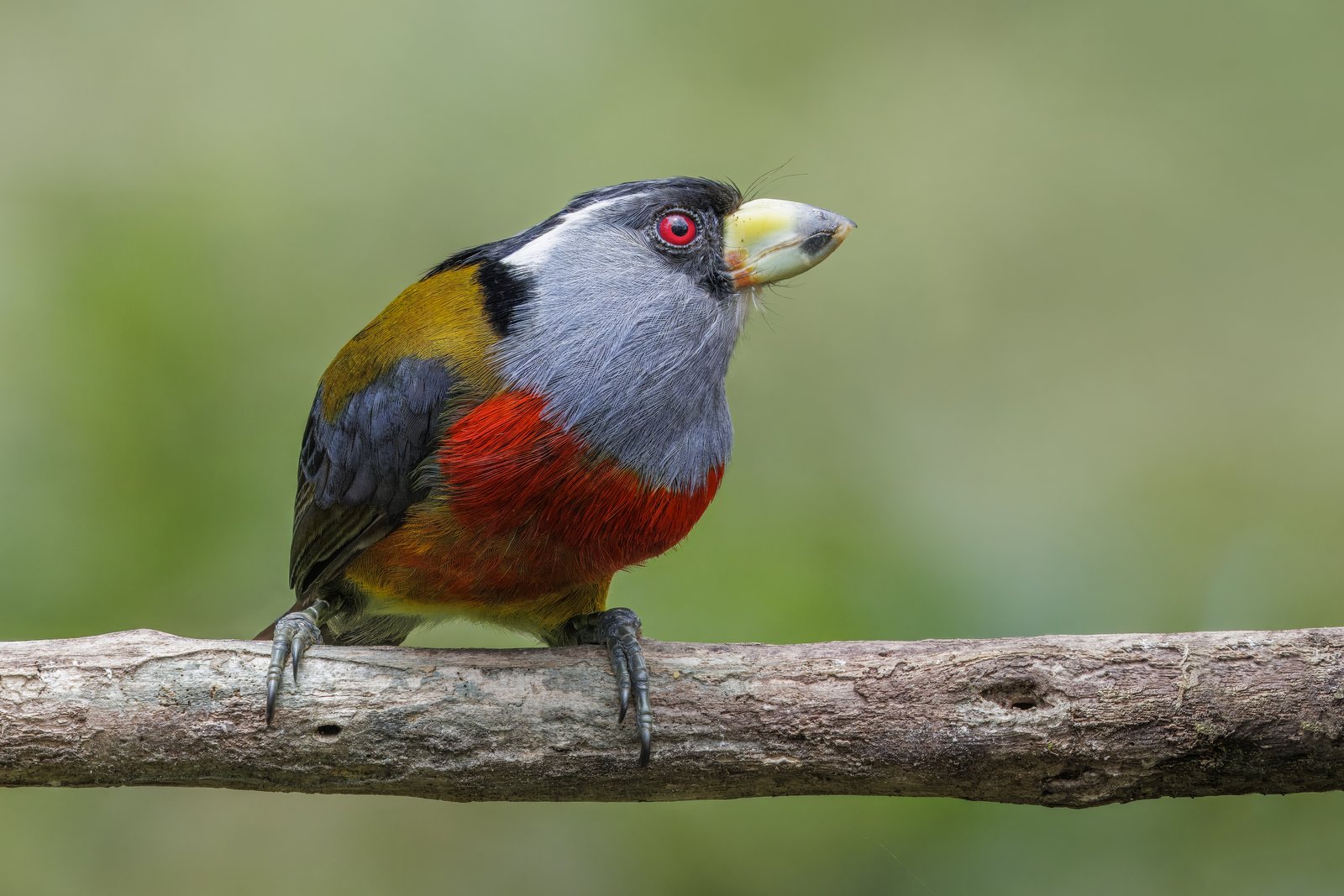
The Toucan Barbet is one of the two species of the family Semnornithidae and occurs only in the cloud forests on the Pacific slope of the Andes in Colombia and Ecuador. It has a thick, short bill and a multicoloured plumage of blue-grey, red, yellow and olive-brown. Pairs sing in duet and often breed with the help of earlier young.
Voice
A loud, resonant, honking kwonk-kwonk-kwonk, sung at length in duet by pairs or small groups, the partners alternating so quickly that it sounds like a single series. Also bill-snapping sounds.
Recording: José María Loaiza B. — CC BY-NC-SA 4.0 · xeno-canto
Identification
20 cm, stocky, with a heavy, short, pale grey to horn-coloured bill with a dark tip and a dark band. Crown and mask around the eye are black, with a white streak behind the eye; the eye is red. Cheeks, throat and breast are blue-grey, the centre of the breast and belly red, the flanks and lower belly yellow. The back is olive-brown, the rump yellow, wings and tail slaty grey. The male has a short black tuft of feathers on the nape, which the female lacks. Juveniles are duller.
Confusion species
Plate-billed Mountain Toucan Andigena laminirostris lives in the same forests and also has blue-grey underparts and yellow flanks, but is more than twice as long, with a long black-and-red bill and a yellow plate on the upper mandible. Red-headed Barbet Eubucco bourcierii is smaller and greener, with a slender, pale bill; the male has a red head, the female a blue-grey face.
Habitat
Humid montane forest, cloud forest and forest edges, also old secondary forest and semi-open country with scattered trees, roughly between 1000 and 2400 m, mostly above 1400 m. It feeds mainly on fruit, also on insects and other invertebrates. It nests in a cavity it excavates in soft, dead wood; young from earlier broods often help to feed the chicks.
Where the bird is most at home, classified by the vegetation units of the Andes and the west coast.


Range and movements
In Colombia on the western slope of the Western Cordillera in the south-west (subspecies caucae). In Ecuador on the western slope of the Andes, south to about the centre of the country. Absent from Peru, Bolivia and the Galápagos. The species does not occur outside the guide area.
- Resident
- dark = core range, pale = thinly spread
How and when to look
Around Mindo and Tandayapa in Ecuador, where birds visit banana feeders at lodges and reserves. The duet carries far and gives away groups in the canopy.
Conservation status
Near Threatened. Its range is small and threatened by deforestation for farming and cattle ranching; the species is also trapped for the cage-bird trade.
Scientific name
Semnornis ramphastinus | (Jardine, 1855)
Jardine described the species in 1855 as Tetragonops ramphastinus; because it was later moved to another genus, the author and year stand in brackets. The genus Semnornis was introduced in 1900 by Richmond. The genus name comes from Greek semnos, 'stately, august', and ornis, 'bird'; Richmond proposed it in 1899 to replace the preoccupied Tetragonops. The species name refers to the toucan genus Ramphastos, with Latin -inus, 'resembling', for the toucan-like bill and colours. The specimen the first description was based on came from Between Quito and Cayambe, Ecuador.