All species › Swifts › Hummingbirds › Koepcke's Hermit
Koepcke's Hermit | Phaethornis koepckeae
Koepckes heremietkolibrie | Ermitaño de Koepcke | Rabo-branco-de-koepcke
Koepcke's Hermit occurs only in Peru, in the foothills of the Andes and on the isolated ridges in front of them. The species was described in 1977 and is named after the ornithologist Maria Koepcke. It lives in the understorey of humid foothill forest.
Voice
The call is a sharp tsip. Males sing at leks with a repeated, high, squeaky note.
Recording: Dan Lane — CC BY-NC-SA 3.0 · xeno-canto
Identification
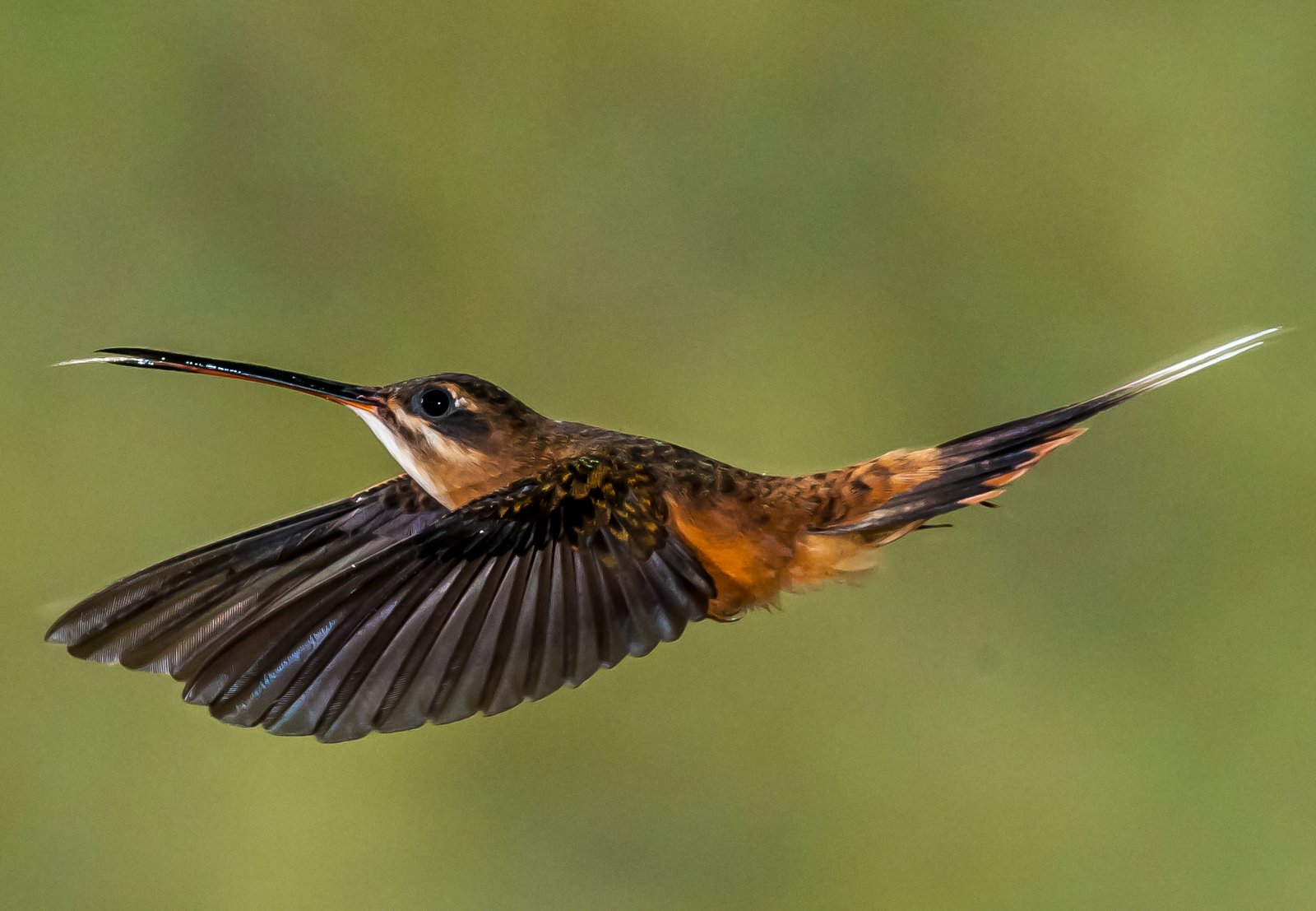
12–13 cm, with a long, almost straight bill with a red lower mandible. The upperparts are bronzy green, the rump rufous. The underparts are cinnamon to orange-brown. The face shows a dark mask between pale buff supercilium and malar stripes. The central tail feathers are elongated and white-tipped. The sexes are almost alike.
Confusion species
Needle-billed Hermit Phaethornis philippii also has rufous underparts and a straight bill, but a less sharply marked face, and lives in the lowlands. Tawny-bellied Hermit Phaethornis syrmatophorus has a strongly decurved bill and lives higher, in the north. Great-billed Hermit Phaethornis malaris is larger, with a decurved bill and paler, buff underparts.
Habitat
Understorey of humid foothill and lower montane forest, especially on the slopes of isolated ridges, roughly between 500 and 1300 m. It visits understorey flowers along a fixed route and also takes small insects. Little is known about its breeding.
Where the bird is most at home, classified by the vegetation units of the Andes and the west coast.


Range and movements
Only in Peru, in the centre of the country, on the eastern slope of the Andes and the isolated ridges in front of it, including the Cordillera Azul and the Serranía de Sira. Absent from Colombia, Ecuador and Bolivia and from the Galápagos. Does not occur outside the guide area.
- Resident
- dark = core range, pale = thinly spread
How and when to look
Search foothill forest on the lower eastern slope in central Peru and wait at flowering plants along forest trails. A hermit with cinnamon underparts and a straight bill at this elevation is likely to be this species.
Conservation status
Least Concern. The range is small, but lies partly in protected areas such as Cordillera Azul National Park and El Sira Communal Reserve.
Scientific name
Phaethornis koepckeae | Weske & Terborgh, 1977
Weske & Terborgh described the species in 1977 and placed it straight away in the genus where it still stands. The genus Phaethornis was introduced in 1827 by Swainson. The genus name combines Ancient Greek phaethōn, 'sun', with ornis, 'bird'. The species name honours Maria Koepcke (1924–1971), a German ornithologist who worked in Peru from 1949 to 1971 as an explorer and collector. The specimen the first description was based on came from Peru.