All species › Swifts › Hummingbirds › Tawny-bellied Hermit
Tawny-bellied Hermit | Phaethornis syrmatophorus
Taankleurige heremietkolibrie | Ermitaño ventrileonado | Rabo-branco-de-barriga-fulva
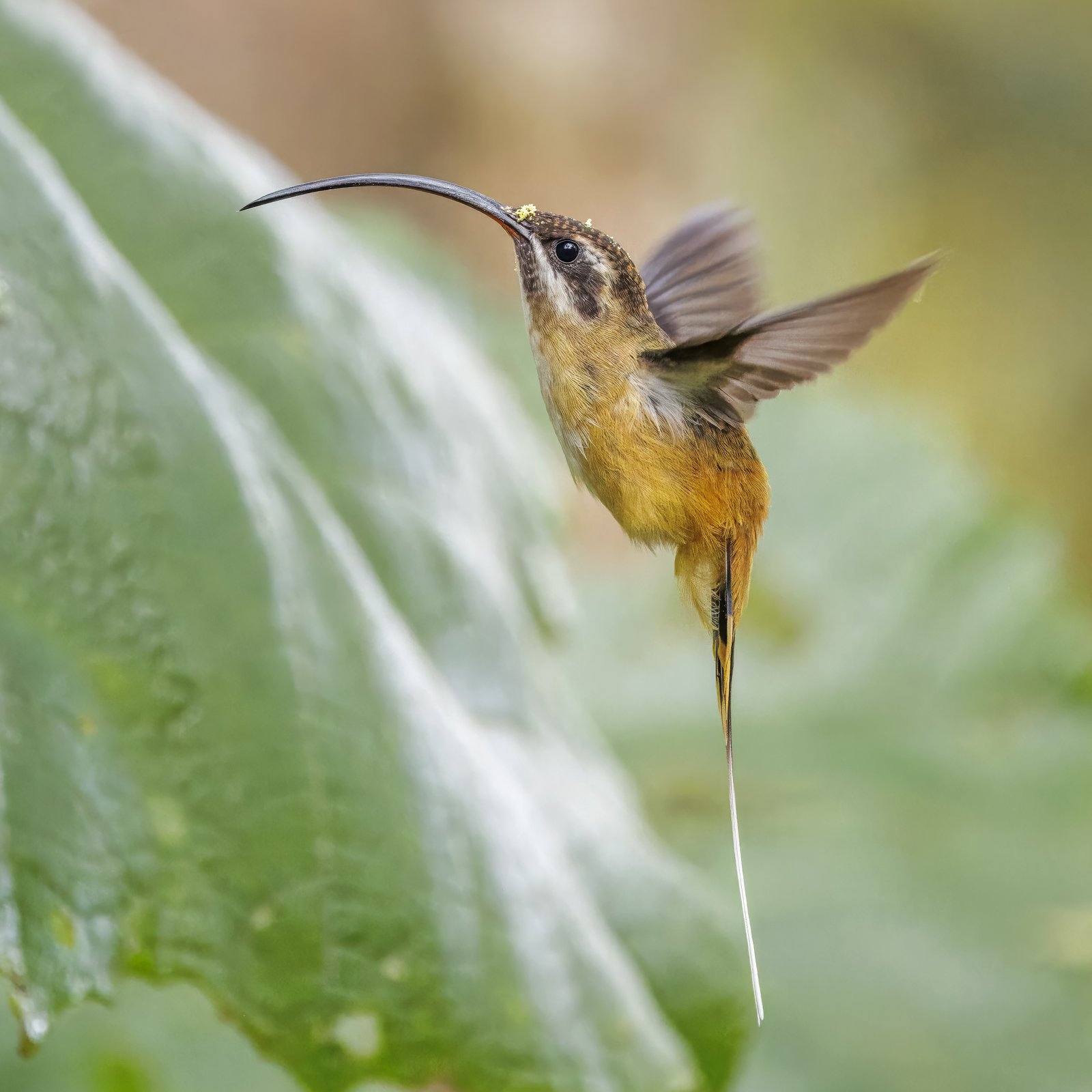
The Tawny-bellied Hermit is a hermit of the montane forest of the northern Andes, with warm buff to orange-brown underparts and rump. It lives higher than most other hermits, in montane and cloud forest to above 2000 m. Like its relatives it follows a fixed route past flowers in the understorey.
Voice
The call is a high, sharp tsip. Males sing at leks with a repeated, squeaky note.
Recording: Jonas Nilsson — CC BY-NC-SA 4.0 · xeno-canto
Identification
13–14 cm, with a long, strongly decurved bill. The upperparts are bronzy green, the rump and uppertail coverts orange-brown. The underparts are warm buff to tawny. The face shows a dark mask between buff supercilium and malar stripes. The tail is graduated, with elongated, white-tipped central feathers and buff tips to the outer feathers. The sexes are almost alike.
Confusion species
Green Hermit Phaethornis guy is darker green, with greyish-green rather than buff underparts and a green rump. Koepcke's Hermit Phaethornis koepckeae, in central Peru, also has rufous underparts, but an almost straight bill, and lives lower. Rufous-breasted Hermit Glaucis hirsutus of the lowlands has a rufous breast, but a rounded, rufous tail with a black band, without elongated central feathers.
Habitat
Understorey and edges of humid montane and cloud forest, mostly between about 900 and 2400 m. It visits flowers of Heliconia, gingers and epiphytes along a fixed route, and locally comes to feeders. The nest hangs from the underside of a leaf.
Where the bird is most at home, classified by the vegetation units of the Andes and the west coast.


Range and movements
In Colombia mainly in the Western and Central Cordilleras, and on the eastern slope of the Eastern Cordillera. In Ecuador on both slopes of the Andes. In Peru on the eastern slope in the north. From Bolivia only a few uncertain records. Absent from the Galápagos. Does not occur outside the guide area.
- Resident
- dark = core range, pale = thinly spread
How and when to look
At feeders and flowering plants at lodges in the cloud forest of the western slope of Ecuador, such as in the Tandayapa valley and around Mindo; a bird appears briefly and then vanishes again into the understorey.
Conservation status
Least Concern. Deforestation of montane forest reduces its habitat locally.
Scientific name
Phaethornis syrmatophorus | Gould, 1852
Gould described the species in 1852 and placed it straight away in the genus where it still stands. The genus Phaethornis was introduced in 1827 by Swainson. The genus name combines Ancient Greek phaethōn, 'sun', with ornis, 'bird'. The species name combines Greek surma, 'train (of a robe)', with -phoros, 'bearing', after the long tail. The specimen the first description was based on came from Western Ecuador.