All species › Swifts › Hummingbirds › Green Hermit
Green Hermit | Phaethornis guy
Groene heremietkolibrie | Ermitaño verde | Rabo-branco-verde
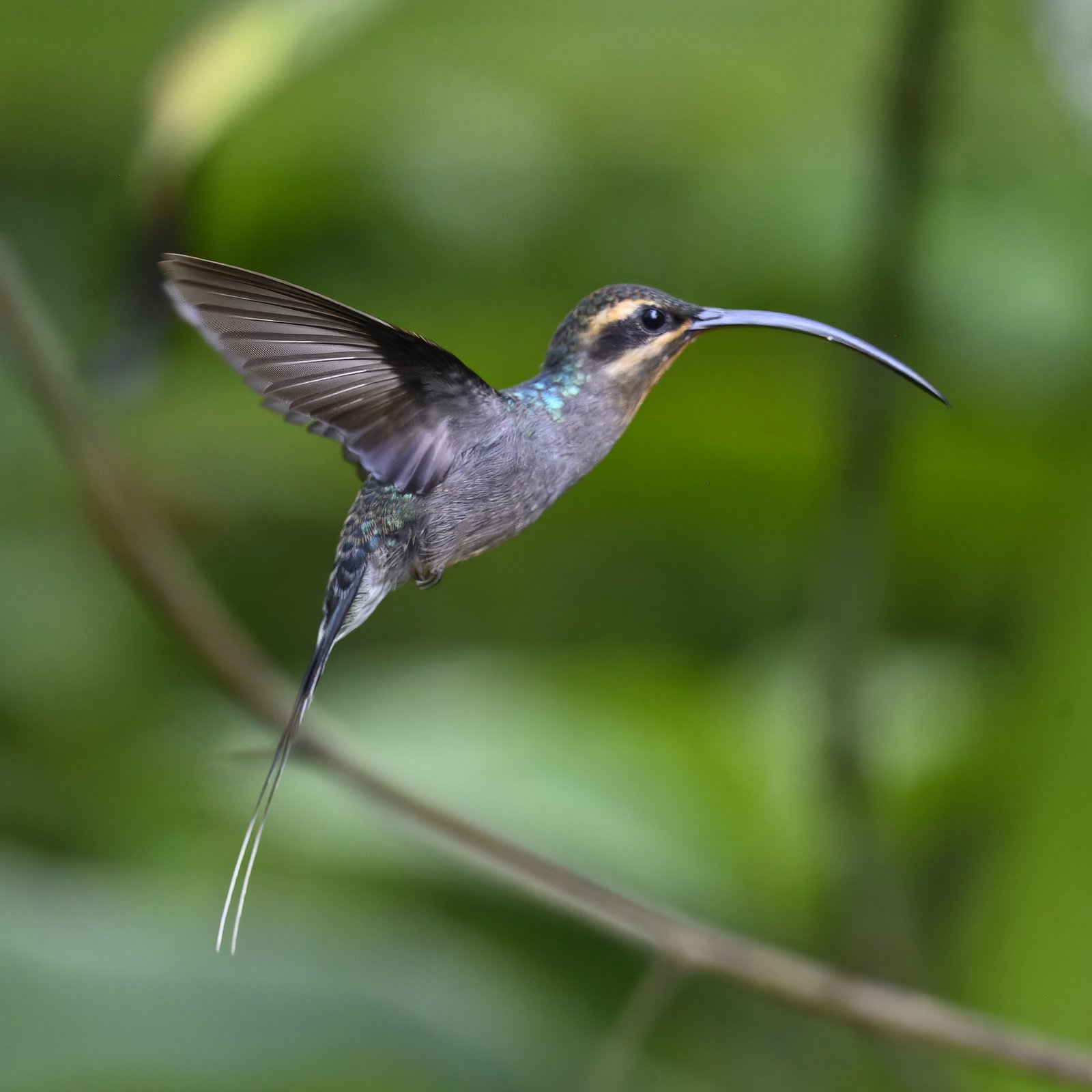
The Green Hermit is a large, dark green hermit of the lower mountain slopes. In the guide area it lives mainly on the eastern slope of the Andes, in the understorey of humid montane forest. It follows fixed routes past flowers, hovers briefly at a flower and immediately vanishes again into the understorey.
Voice
The call is a loud, sharp sweek, often in flight. Males sing at leks in the understorey with a repeated, forceful, squeaky note.
Recording: Scott Olmstead — CC BY-NC-SA 4.0 · xeno-canto
Identification
13–15 cm, with a long, decurved bill with a red lower mandible. The male is dark green, with a blue-green gloss on the underparts; the rump feathers have buff fringes. The facial stripes (supercilium, malar and throat stripe) are buff. The tail is dark, with elongated, white-tipped central feathers. The female is greyer below, with more distinct facial stripes and longer white tail tips.
Confusion species
Tawny-bellied Hermit Phaethornis syrmatophorus has a buff to orange-brown belly and rump. Great-billed Hermit Phaethornis malaris is browner above, paler and warmer below, and lives mainly in the lowlands. West of the Andes, White-whiskered Hermit Phaethornis yaruqui is smaller, with white rather than buff facial stripes.
Habitat
Understorey and edges of humid foothill and lower montane forest, especially in ravines and along streams, mostly between 500 and 2000 m. It visits flowers of Heliconia, gingers and other plants with long corolla tubes along a fixed route, and also takes small arthropods. The nest hangs from the underside of a leaf, often above a stream.
Where the bird is most at home, classified by the vegetation units of the Andes and the west coast.


Range and movements
In Colombia on the slopes of the Andes and in the Serranía de la Macarena. In Ecuador on the eastern slope of the Andes. In Peru on the eastern slope, south to Puno. In Bolivia at most a single record near the Peruvian border. Absent from the Galápagos. Outside the guide area from Costa Rica and Panama to northern Venezuela and Trinidad.
- Resident
- dark = core range, pale = thinly spread
How and when to look
At flowering Heliconia along forest edges and streams on the lower eastern slope, such as along the Manu road in Peru and at lodges on the eastern slope in Ecuador. It sometimes visits feeders, always briefly.
Conservation status
Least Concern. It depends on forest, but also uses forest edges and secondary forest.
Scientific name
Phaethornis guy | (Lesson, 1833)
Lesson described the species in 1833 as Trochilus Guy; because it was later moved to another genus, the author and year stand in brackets. The genus Phaethornis was introduced in 1827 by Swainson. The genus name combines Ancient Greek phaethōn, 'sun', with ornis, 'bird'. The species name honours J. Guy (fl. 1833), a French amateur collector. The specimen the first description was based on came from Venezuela.