All species › Swifts › Hummingbirds › White-whiskered Hermit
White-whiskered Hermit | Phaethornis yaruqui
Witsnorheremietkolibrie | Ermitaño bigotiblanco | Rabo-branco-de-bigode-branco
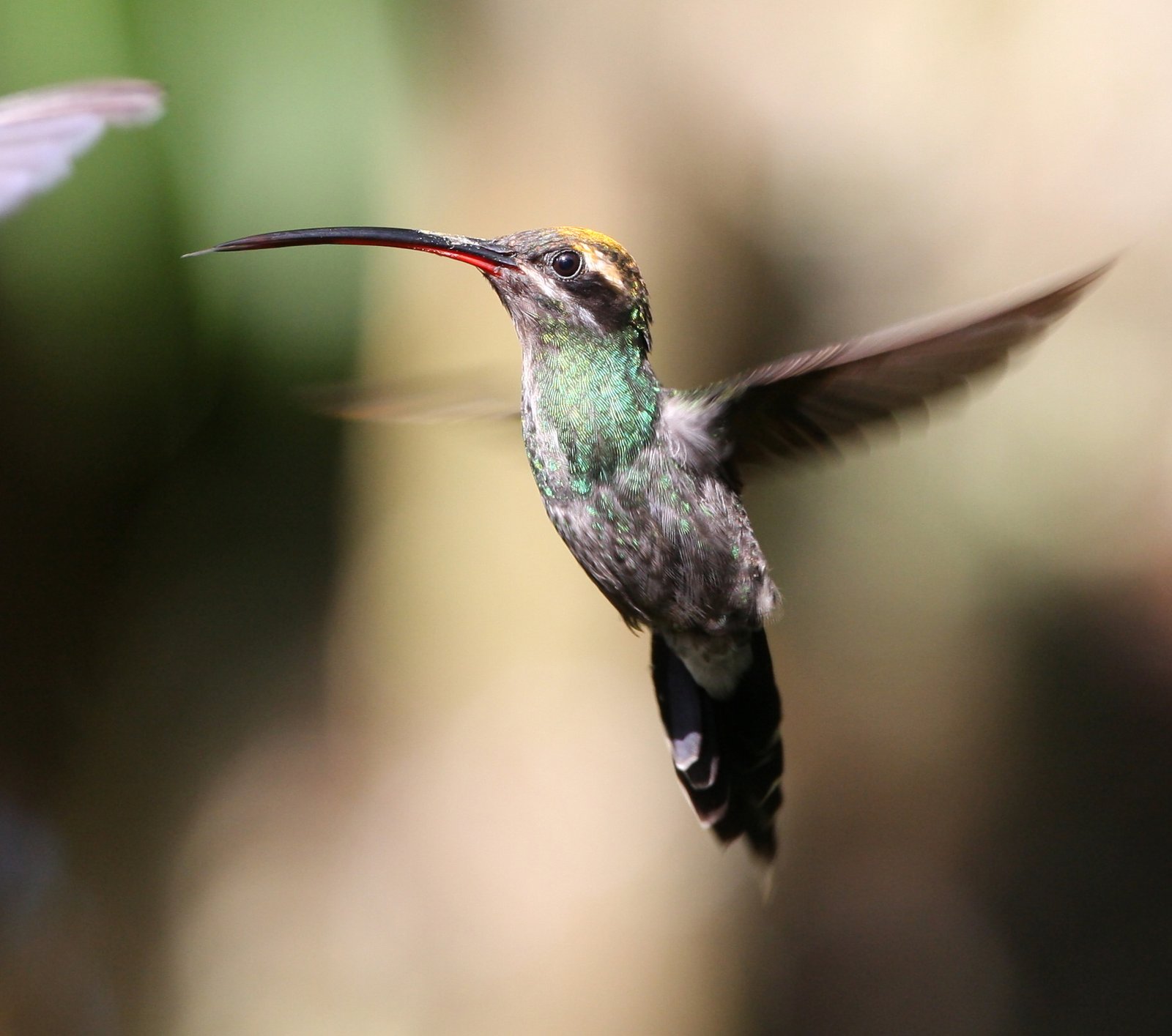
The White-whiskered Hermit is a dark hermit of the Chocó, the humid forest west of the Andes in Colombia and Ecuador. It lives in the understorey of lowland and foothill forest and occurs only in these two countries. The male is darker and greener than most other hermits.
Voice
The call is a sharp, high tsip, often in flight. Males sing at leks in the understorey with a rapidly repeated, squeaky note.
Recording: José María Loaiza B. — CC BY-NC-SA 4.0 · xeno-canto
Identification
12–13 cm, with a long, decurved bill; the lower mandible is red at the base. The upperparts are dark green, the underparts dark greyish green, with a blue-green gloss in the male. A narrow white supercilium, a broad white malar stripe and a white stripe down the centre of the throat. The central tail feathers are elongated and white-tipped, the other tail feathers blue-black. The female is duller, with greyer underparts.
Confusion species
Long-billed Hermit Phaethornis longirostris is larger and browner, with pale grey to buff underparts. Green Hermit Phaethornis guy is larger, with buff rather than white facial stripes, and usually lives higher on the slopes. Band-tailed Barbthroat Threnetes ruckeri has a rufous breast band and a tail with a white band, without elongated central feathers.
Habitat
Understorey of humid lowland and foothill forest, forest edges, secondary forest and shade plantations, from sea level to about 1500 m, locally higher. It visits mainly flowers of Heliconia and other plants with long corolla tubes, along a fixed route, and also takes small insects. The nest hangs from the underside of a leaf.
Where the bird is most at home, classified by the vegetation units of the Andes and the west coast.


Range and movements
In Colombia in the Pacific lowlands and on the western slope of the Western Cordillera, from the Chocó to Nariño. In Ecuador in the north-west and west, west of the Andes. Absent from Peru and Bolivia and from the Galápagos. Does not occur outside the guide area.
- Resident
- dark = core range, pale = thinly spread
How and when to look
Wait at flowering Heliconia and verbena hedges along forest edges in north-western Ecuador, such as around Milpe and Mashpi; there it also visits feeders. Inside the forest it is usually seen only as it flashes past.
Conservation status
Least Concern. Deforestation in western Colombia and Ecuador has greatly reduced its habitat locally, but it tolerates secondary forest.
Scientific name
Phaethornis yaruqui | (Bourcier, 1851)
Bourcier described the species in 1851 as Trochilus Yaruqui; because it was later moved to another genus, the author and year stand in brackets. The genus Phaethornis was introduced in 1827 by Swainson. The genus name combines Ancient Greek phaethōn, 'sun', with ornis, 'bird'. The species name refers to Yaruquí, a town near Quito in Ecuador. The specimen the first description was based on came from Yaruquí, Ecuador.