All species › Falcons › Falcons and caracaras › Laughing Falcon
Laughing Falcon | Herpetotheres cachinnans
Lachvalk | Halcón guaco | Acauã
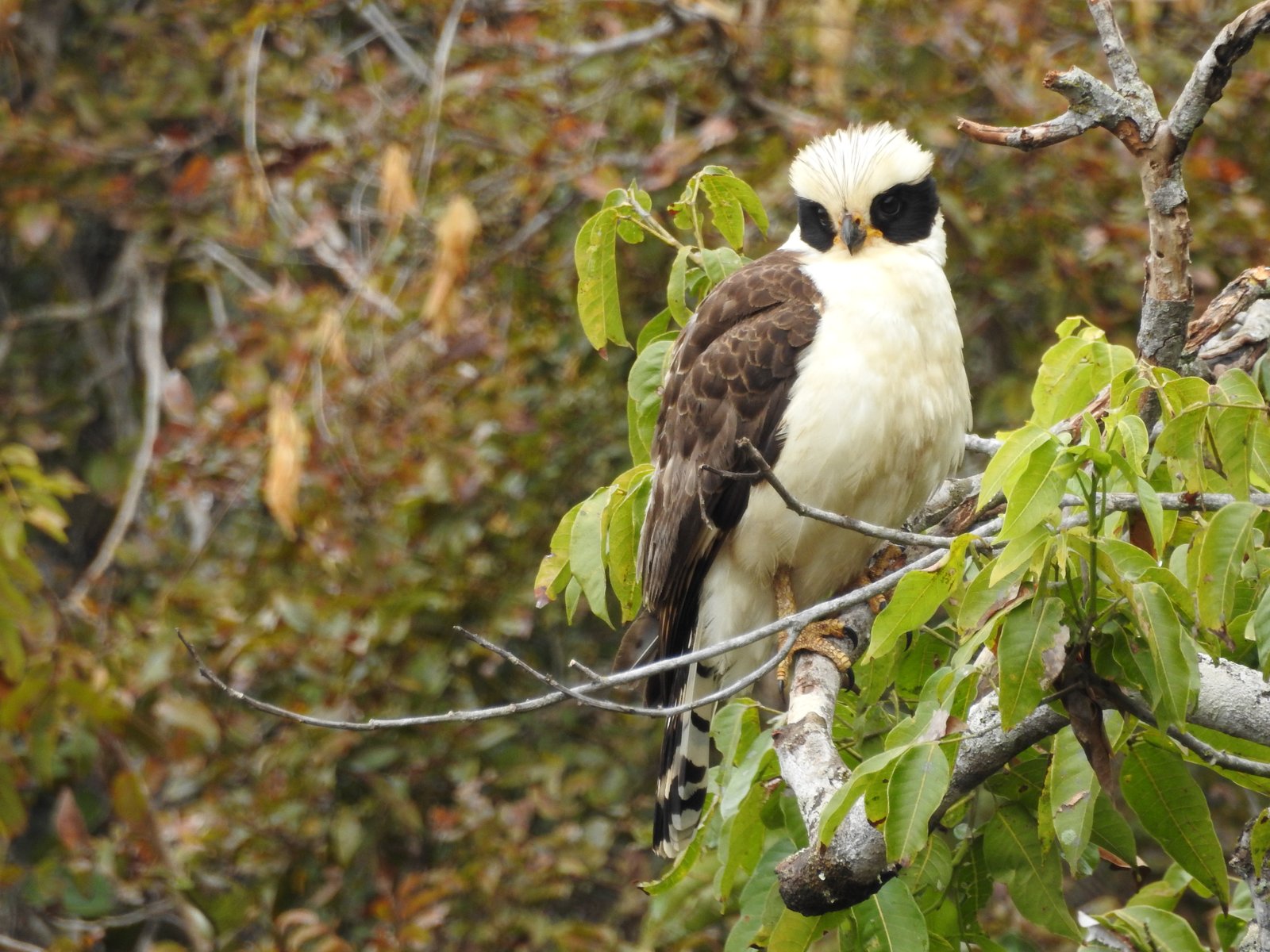
The Laughing Falcon is a stocky falcon with a large, creamy-white head and a broad black mask that joins around the nape. It specialises in catching snakes, which it watches for from an open perch. Its loud, rhythmic duets at dusk and dawn carry over long distances in the tropical lowlands.
Voice
Mainly at dusk and dawn a loud, long-lasting duet by pairs: a series of gwa-ko, gwa-ko that can continue for several minutes and gives the species its Spanish name. Also a repeated, laughing ha, ha, ha, which explains the English name.
Recording: Robson Silva e Silva — CC BY-NC-SA 4.0 · xeno-canto
Identification
46–56 cm, with a large head, short, rounded wings and a long tail. The head, neck and underparts are creamy white to pale buff; a broad black mask runs back from the eye and joins on the nape. The crown has fine dark streaks. The back and wings are dark blackish brown. The tail is black with narrow white bands and a white tip. In flight a pale, rufous patch shows at the base of the primaries. The bill is black, the legs yellowish. The sexes are alike; juveniles are similar, with a slightly paler, less sharply marked plumage.
Confusion species
With its black mask and pale head it is hardly confusable. Yellow-headed Caracara Daptrius chimachima also has a pale head and underparts, but lacks the black mask, shows a pale wing patch and is more often in open country and near cattle. The pale morph of Collared Forest Falcon Micrastur semitorquatus has a white collar, but a dark crown, a dark cheek crescent instead of a mask and longer legs, and lives hidden inside forest.
Habitat
Forest edge, open woodland, semi-open country with scattered trees, gallery forest, savanna and dry forest, also along rivers and in logged forest; mainly in the lowlands up to about 1500 m, locally higher. It sits upright for long periods on a bare branch or post and drops onto snakes, including venomous ones; it also takes lizards and small mammals. The nest is in a tree hollow, a rock cavity or an old nest of another bird; usually a single egg is laid.
Where the bird is most at home, classified by the vegetation units of the Andes and the west coast.


Range and movements
In Colombia in almost all lowlands, on both sides of the Andes. In Ecuador in the west, including the dry south-west, and in the Amazon basin. In Peru in the Amazon basin and in the north-west. In Bolivia in the northern and eastern lowlands. Absent from the Galápagos. Outside the guide area from Mexico to northern Argentina.
- Resident
- dark = core range, pale = thinly spread
How and when to look
Check bare branches and dead trees along forest edges and rivers; the bird often sits still for a long time. At sunrise and sunset its duet reveals its presence over a long distance.
Conservation status
Least Concern. Widespread and tolerant of semi-open, partly cleared country.
Scientific name
Herpetotheres cachinnans | (Linnaeus, 1758)
Linnaeus described the species in 1758 as Falco cachinnans; because it was later moved to another genus, the author and year stand in brackets. The genus Herpetotheres was introduced in 1817 by Vieillot. The genus name comes from Greek herpeton, 'reptile', and therizein, 'to mow down', after the bird's food. The species name is Latin cachinnans, 'laughing aloud', after the call. The specimen the first description was based on came from Suriname.