All species › Falcons › Falcons and caracaras › Crested Caracara
Crested Caracara | Caracara plancus
Kuifcaracara | Caracara quebrantahuesos | Carcará
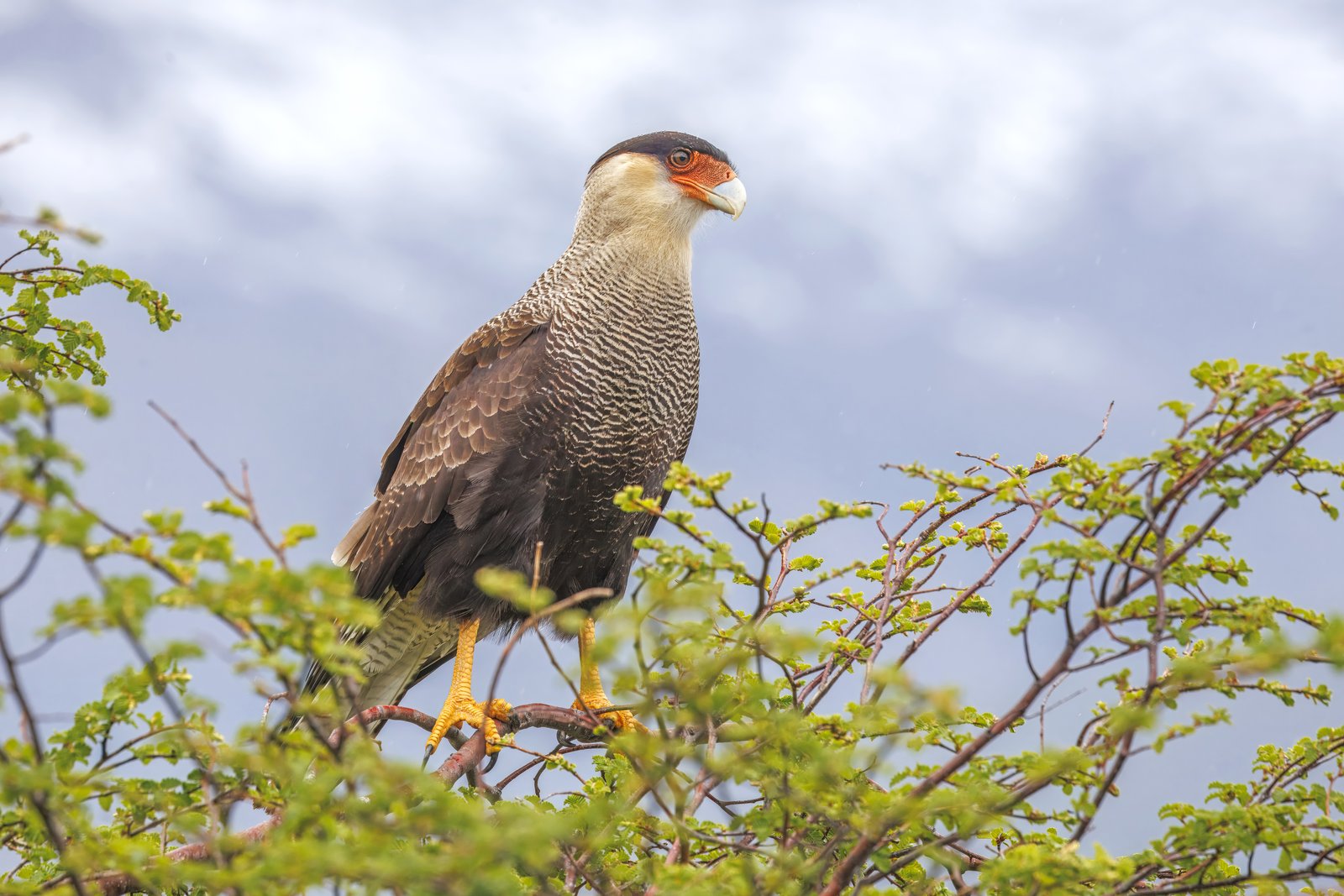
The Crested Caracara is a large, long-legged falcon of open country that spends much time walking on the ground and takes a broad diet, from carrion to insects. With its black cap, white neck and bare red to orange face it can often be recognised from far away in open landscape. It benefits from deforestation and cattle ranching and is spreading in Amazonia.
Voice
Usually silent. A dry, rattling call, krrrak-krrrak, given while throwing the head far back onto the nape.
Recording: Carlos Delgado JUMABITA — CC BY-NC-SA 4.0 · xeno-canto
Identification
50–60 cm, with long legs, a large head and a heavy, deep bill. The adult has a black cap with a short, flat crest, a bare red to orange-yellow face and a white to buff cheek, throat and neck. The back and breast are white or buff with dark bars; the belly, wings and thighs are blackish brown. The tail is white with fine dark bars and a broad black terminal band. In flight the white patches in the primaries stand out. Legs yellow. The sexes are alike. Juveniles are browner, with streaks instead of bars and a grey to pinkish face. Birds from the north of the guide area (form cheriway) have a blacker, less barred back than those from the south.
Confusion species
Yellow-headed Caracara Daptrius chimachima is much smaller, with a buff head and no black cap. Black Vulture Coragyps atratus also has white primary patches, but is all black with a bare grey head. Carunculated Caracara Daptrius carunculatus and Mountain Caracara Daptrius megalopterus live in the high mountains and are black and white without a barred breast.
Habitat
Open country with scattered trees: savannas, pastures, fields, dry forest and scrub, riverbanks and marsh edges, from the lowlands up to about 3000 m in dry Andean valleys. It forages on foot, eating carrion, insects, small vertebrates, and eggs and young of other birds; it also robs other raptors of their prey and follows fires and ploughing machinery. The nest is a large pile of sticks in a tree, palm or cactus.
Where the bird is most at home, classified by the vegetation units of the Andes and the west coast.


Range and movements
In Colombia widespread in open lowlands, especially in the Caribbean region, the Magdalena valley and the Llanos, and in dry valleys in the Andes. In Ecuador local, mainly in cleared land in the eastern lowlands and in a few dry valleys. In Peru mainly in savannas and cleared land in the eastern lowlands and locally in the north-west. In Bolivia widespread in the lowlands, the Chaco and the lower Andean valleys. Absent from the Galápagos. Outside the guide area from the southern United States to Tierra del Fuego.
- Resident
- dark = core range, pale = thinly spread
How and when to look
Search pastures and savannas, along roads and near cattle ranches; birds often sit on posts or walk among the cattle. In the Llanos of Colombia and the lowlands of Bolivia it is a regular sight.
Conservation status
Least Concern. The species is increasing locally as forest is converted to pasture; it is sometimes persecuted as a supposed predator of young livestock.
Scientific name
Caracara plancus | (Miller, 1777)
Miller described the species in 1777 as Falco Plancus; because it was later moved to another genus, the author and year stand in brackets. The genus Caracara was introduced in 1826 by Merrem. The genus name goes back to Old Tupi karakará, probably imitating the bird's call. The species name is Latin plancus, 'eagle'. The specimen the first description was based on came from Tierra del Fuego.