All species › Pelicans, herons and ibises › Herons, egrets and bitterns › Least Bittern
Least Bittern | Botaurus exilis
Amerikaans woudaapje | Avetorillo panamericano | Socoí-vermelho
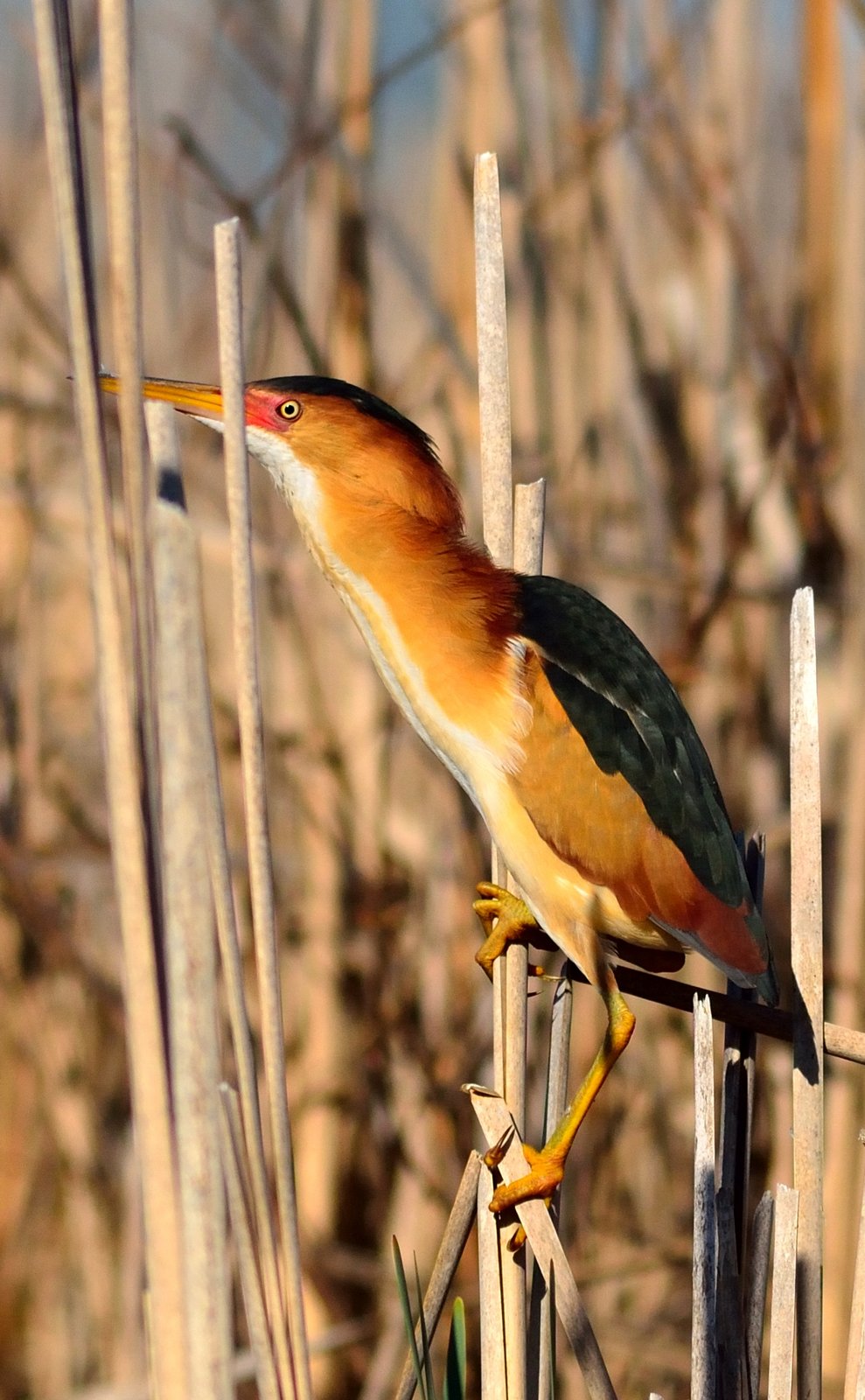
The Least Bittern is the smallest heron of the New World. It clambers through reeds and cattails with its long toes and usually stays hidden in dense vegetation. In the guide area several resident populations live, from the coastal marshes of Peru to the high plateau of Bogotá.
Voice
The male gives a soft, low, cooing coo-coo-coo; when alarmed a rapid, dry kek-kek-kek.
No recording with a suitable Creative Commons licence is available for this species yet.
Identification
28–36 cm, small and slim, with a pointed yellow bill. The male has a black crown and back, a buff to rufous head and neck and white underparts streaked buff. A large, pale buff patch shows on the wing, and the flight feathers are chestnut. The female has a dark brown crown and back with pale stripes along the edge. Juveniles resemble the female but are more heavily streaked. Birds of the Bogotá plateau are darker and warmer in colour.
Confusion species
Stripe-backed Bittern Botaurus involucris has a buff back with broad black longitudinal stripes and lacks the sharply defined pale wing patch. Zigzag Heron Zebrilus undulatus is dark with fine wavy lines and lives in forest. Juvenile Striated Herons Butorides striata are larger, with a streaked neck and no pale wing patch.
Habitat
Reed and cattail marshes, shores of lakes and lagoons with tall aquatic plants, coastal marshes and locally rice fields, mainly in the lowlands, but in Colombia also in the marshes of the Bogotá plateau at about 2600 m. It clambers through the vegetation and hunts small fish, frogs and insects. The nest is a small platform of plant stems, low in marsh vegetation.
Where the bird is most at home, classified by the vegetation units of the Andes and the west coast.


Range and movements
In Colombia in the lowlands of the Caribbean region, the Magdalena and Cauca valleys and on the Bogotá plateau. In Ecuador mainly in the western lowlands. In Peru in the coastal marshes and locally in the Amazonian lowlands. In Bolivia scarce in the lowlands. Absent from the Galápagos. Outside the guide area from North America to, locally, Paraguay, southern Brazil and northern Argentina.
How and when to look
Wait at the edge of a reed marsh, for example in the coastal marshes near Lima or the wetlands around Bogotá, for birds flying briefly over the reeds or clambering at the edge of open water, especially early in the morning.
Conservation status
Least Concern. Locally the species suffers from the loss of wetlands; the population on the Bogotá plateau is small and vulnerable to urbanisation.
Scientific name
Botaurus exilis | (Gmelin, 1789)
Gmelin described the species in 1789 as Ardea exilis; because it was later moved to another genus, the author and year stand in brackets. The genus Botaurus was introduced in 1819 by Stephens. The genus name is Medieval Latin for a bittern, combining Latin bos, 'ox', and taurus, 'bull', after the booming call. The species name is Latin exilis, 'small, slender'. The specimen the first description was based on came from Jamaica.