All species › Pelicans, herons and ibises › Herons, egrets and bitterns › Stripe-backed Bittern
Stripe-backed Bittern | Botaurus involucris
Gestreepte woudaap | Avetorillo listado | Socoí-amarelo
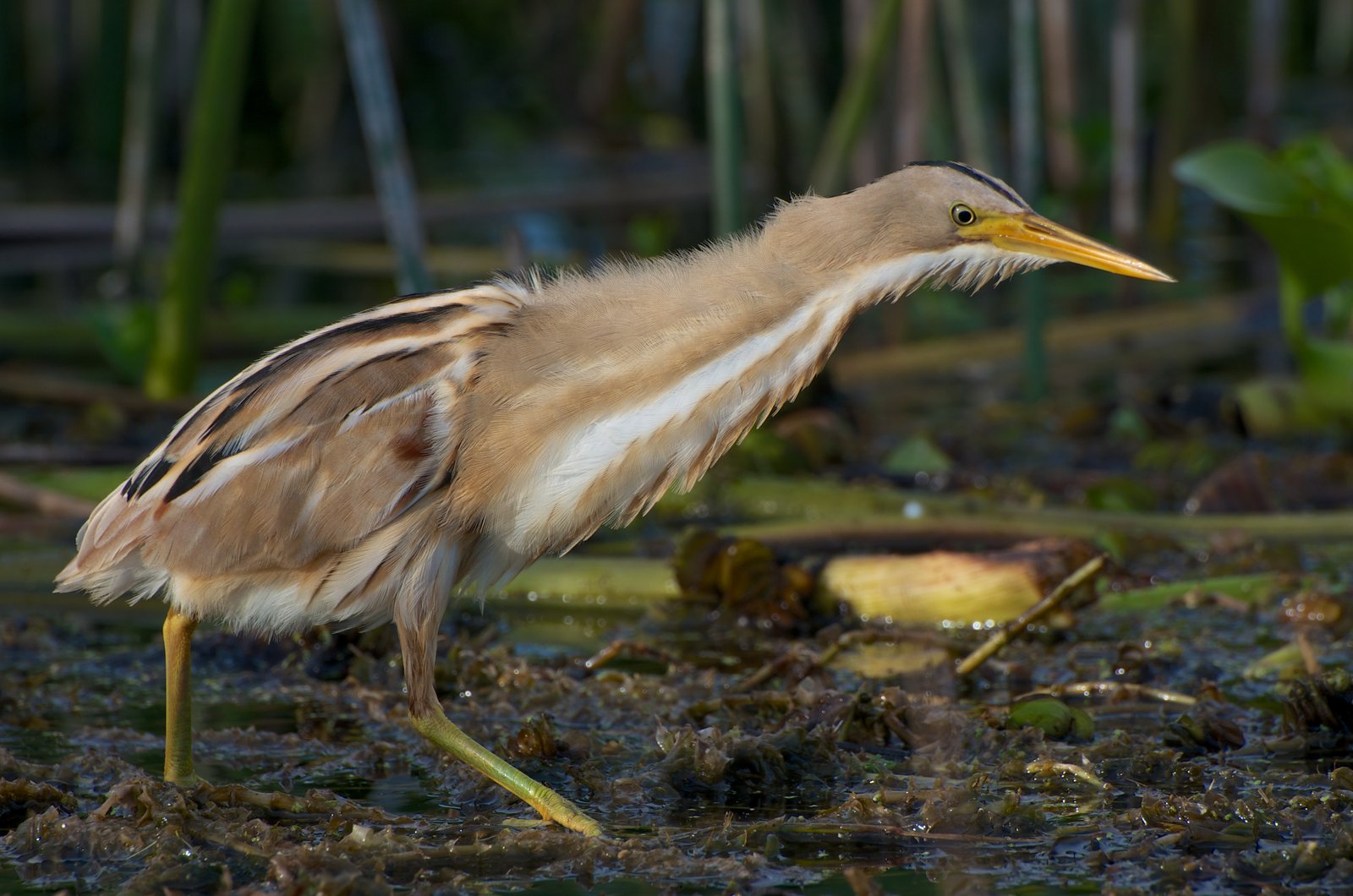
The Stripe-backed Bittern is a small, buff bittern of reed and rush marshes. It lives hidden in dense marsh vegetation and, like other small bitterns, freezes in an upright posture with the bill pointing up when alarmed. In the guide area it is local and scarce.
Voice
Usually silent. A series of low, husky or grunting notes, mainly at dusk; when alarmed a short, hoarse call.
No recording with a suitable Creative Commons licence is available for this species yet.
Identification
30–33 cm, small, with a fairly long, pointed yellow bill. The crown is black, the neck buff to rufous with a pale throat stripe. The back is buff with broad black longitudinal stripes edged pale, which give the species its name. The wing coverts are paler buff; the flight feathers are dark grey with rufous tips. The legs are greenish yellow. Juveniles are duller and more heavily streaked. The sexes are nearly alike.
Confusion species
Least Bittern Botaurus exilis has a plain black (male) or brown (female) back without black stripes and a more sharply defined pale wing patch. Zigzag Heron Zebrilus undulatus is dark with fine wavy lines and lives in forest. Pinnated Bittern Botaurus pinnatus is much larger.
Habitat
Reed, cattail and rush marshes, lake shores with tall aquatic plants, flooded savanna grassland and locally rice fields, in the lowlands. It clambers through the vegetation and hunts small fish, frogs and insects. The nest is low in marsh vegetation.
Where the bird is most at home, classified by the vegetation units of the Andes and the west coast.


Range and movements
In Colombia mainly in the llanos in the east of the country. In Bolivia in the lowlands of the north and east. Only a few scattered records are known from Ecuador and Peru. Absent from the Galápagos. Outside the guide area in Venezuela, Trinidad and the Guianas, and in southern South America from Paraguay and southern Brazil to Argentina and central Chile.
How and when to look
In the llanos or the Bolivian savannas, watch for birds flying low over the reeds or sitting at the edge of open water, especially in the early morning and at dusk.
Conservation status
Least Concern. Locally the species suffers from marsh drainage and the burning of marsh vegetation.
Scientific name
Botaurus involucris | (Vieillot, 1823)
Vieillot described the species in 1823 as Ardea involucris; because it was later moved to another genus, the author and year stand in brackets. The genus Botaurus was introduced in 1819 by Stephens. The genus name is Medieval Latin for a bittern, combining Latin bos, 'ox', and taurus, 'bull', after the booming call. The species name comes from Latin involucrum, 'wrapper, covering' (from involvere, 'to wrap, to cover'); the name is based on de Azara's 'Garza varia'. The specimen the first description was based on came from Paraguay.