All species › Passerines › Tyrant flycatchers and allies › Lemon-browed Flycatcher
Lemon-browed Flycatcher | Conopias cinchoneti
Geelringtiran | Bienteveo cejiamarillo | Bem-te-vi-de-sobrancelha-limão
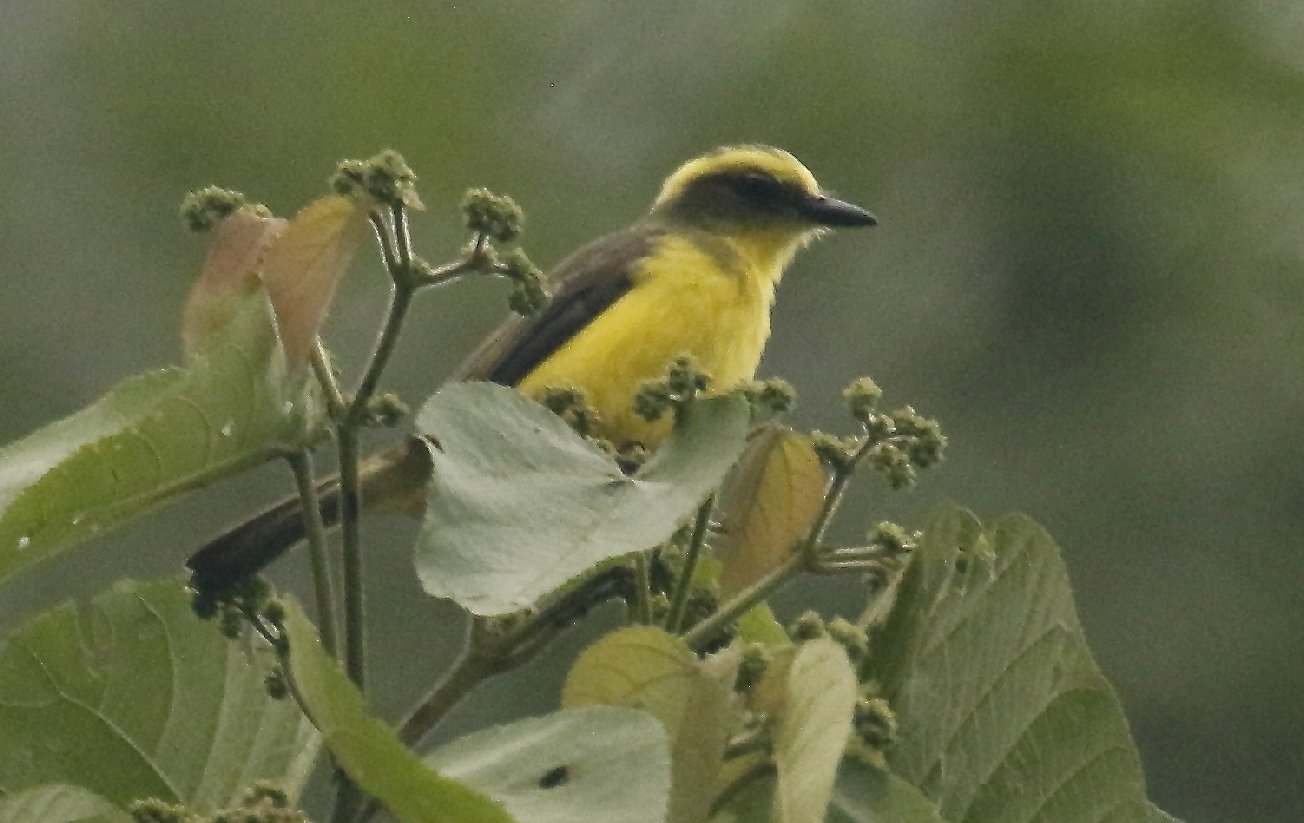
The Lemon-browed Flycatcher is a canopy flycatcher of lower montane forest on the slopes of the Andes. A lemon-yellow supercilium that runs around the dark crown gives it its name. It lives in pairs or small, noisy groups, often in mixed flocks with tanagers.
Voice
A high, rapid, trilled series, roughly tee-ee-ee-ee-ee, often repeated; the birds of a group frequently call together. Also short, high calls.
Recording: Daan van der Hoeven — CC BY-NC-SA 4.0 · xeno-canto
Identification
16 cm. A medium-sized flycatcher with a short black bill. The crown is dark olive-grey, surrounded by a broad lemon-yellow supercilium that almost meets on the nape; the sides of the head are dark. The upperparts are olive-green, wings and tail darker with olive edges. Throat and underparts are yellow. There is no crown patch. Sexes alike.
Confusion species
Golden-crowned Flycatcher Myiodynastes chrysocephalus is larger, with a heavier bill, a dark malar stripe, a pale throat and a faintly streaked breast. Rusty-margined Flycatcher Myiozetetes cayanensis and Social Flycatcher Myiozetetes similis have a white supercilium and a white throat and usually live lower, in semi-open country. Three-striped Flycatcher Conopias trivirgatus of the Amazonian lowlands has a white supercilium and an olive breast.
Habitat
Canopy and edges of humid lower montane forest and the lowest zone of cloud forest, also tall secondary growth and semi-open country with scattered trees, mainly between 1000 and 2000 m. It catches insects from open branches in the canopy and also eats fruit. Little is known about the nest.
Where the bird is most at home, classified by the vegetation units of the Andes and the west coast.


Range and movements
Colombia: locally in all three Andean ranges. Ecuador: mainly on the east slope of the Andes, locally on the west slope. Peru: on the east slope of the Andes south to the south of the country. Bolivia: not regular; only a few reports. Absent from the Galápagos. Outside the guide area in the Andes of western Venezuela.
- Resident
- dark = core range, pale = thinly spread
How and when to look
Search the east slope of the Andes in Ecuador or Peru, along roads through montane forest between 1200 and 1800 m. Groups often perch on open branches high in the canopy and give their high, trilled call.
Conservation status
Least Concern. The species depends on forest; clearing of lower montane forest locally reduces its habitat.
Scientific name
Conopias cinchoneti | (Tschudi, 1844)
Tschudi described the species in 1844 as T[yrannus] cinchoneti; because it was later moved to another genus, the author and year stand in brackets. The genus Conopias was introduced in 1860 by Cabanis & Heine. The genus name comes from Greek kōnōps, 'gnat', and piazō, 'to seize', roughly 'gnat-catcher'. Refers to the cinchona forests (Cinchona) on the Andean slopes, the species' habitat. The Latin suffix -etum means 'place of'. The specimen the first description was based on came from Junín, Peru.