All species › Passerines › Tyrant flycatchers and allies › Three-striped Flycatcher
Three-striped Flycatcher | Conopias trivirgatus
Driestreeptiran | Bienteveo trilistado | Bem-te-vi-pequeno
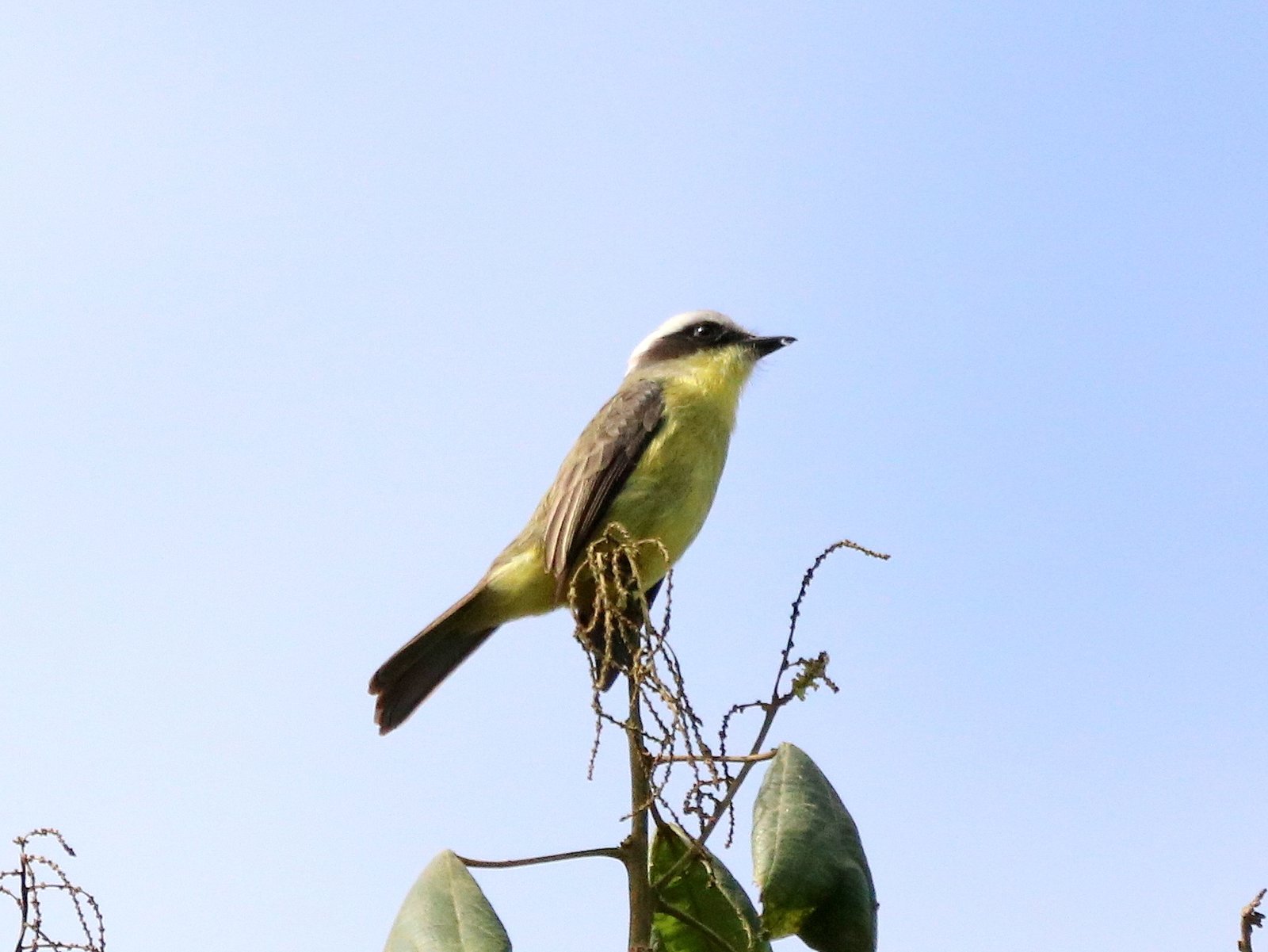
The Three-striped Flycatcher is a small, kiskadee-like flycatcher with two widely separated ranges: one in the western Amazon basin and one in south-eastern Brazil, Paraguay and north-eastern Argentina. In the guide area it is a local species of the canopy along rivers and lakes in the lowlands. It lives in pairs or small groups.
Voice
Rapid series of nasal, chattering notes, roughly chee-chee-chee-chee, often given together by the birds of a pair or group.
Recording: Glauko Corrêa da Silva — CC BY-NC-SA 4.0 · xeno-canto
Identification
15 cm. A small flycatcher with a short black bill. Crown and sides of the head are blackish, with a long white supercilium that extends onto the nape; the throat is white. The upperparts are olive-brown, wings and tail darker. The underparts are yellow, with an olive wash across the breast. There is no crown patch. Sexes alike.
Confusion species
Social Flycatcher Myiozetetes similis is larger, with a shorter white supercilium, a greener back, a usually concealed orange-red crown patch and no olive wash on the breast. Dusky-chested Flycatcher Myiozetetes luteiventris has a dark head without a white supercilium and a dark, streaked breast. Lesser Kiskadee Philohydor lictor has a much longer, slender bill. White-ringed Flycatcher Conopias albovittatus has a greener back and a bright yellow breast without an olive wash, and in the guide area occurs only west of the Andes.
Habitat
Canopy and edges of várzea, riverine forest and forest along oxbow lakes, locally also terra firme forest edges; in the guide area below about 400 m. It catches insects from a perch in the canopy and also eats small fruits. Little is known about breeding in the guide area.
Where the bird is most at home, classified by the vegetation units of the Andes and the west coast.


Range and movements
Colombia: no confirmed records. Ecuador: very rare and local in the eastern lowlands. Peru: locally in the north-east (Loreto) and in the south-east (Madre de Dios). Bolivia: locally in the northern and eastern lowlands. Absent from the Galápagos. Outside the guide area in western Amazonian Brazil and, as a separate population, in south-eastern Brazil, eastern Paraguay and north-eastern Argentina.
- Resident
- dark = core range, pale = thinly spread
How and when to look
Search the canopy along lakes and side rivers in the lowlands of Loreto or Madre de Dios, for example from a boat or a canopy tower. It often perches on open branches in the crown and gives its chattering call.
Conservation status
Least Concern. Local and scarce in the guide area, but the overall range is large.
Scientific name
Conopias trivirgatus | (Wied-Neuwied, 1831)
Wied-Neuwied described the species in 1831 as M[uscicapa] trivirgata; because it was later moved to another genus, the author and year stand in brackets. The genus Conopias was introduced in 1860 by Cabanis & Heine. The genus name comes from Greek kōnōps, 'gnat', and piazō, 'to seize', roughly 'gnat-catcher'. Latin tri-, 'three', and virgatus, 'striped': with three stripes on the head. The specimen the first description was based on came from Bahia, Brazil.