All species › Passerines › Tyrant flycatchers and allies › White-ringed Flycatcher
White-ringed Flycatcher | Conopias albovittatus
Witringtiran | Mosquero aureola | Bem-te-vi-da-copa
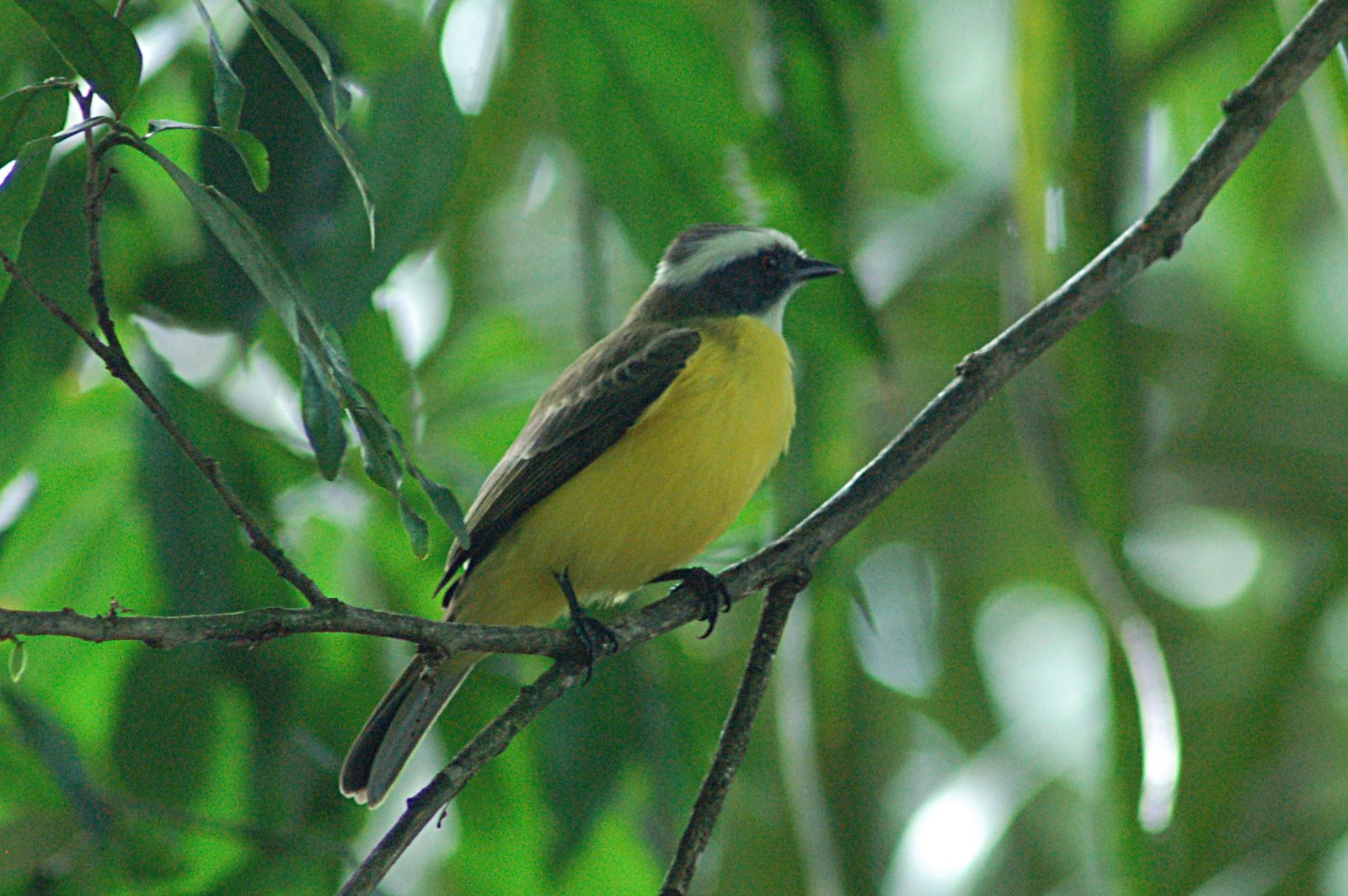
The White-ringed Flycatcher is a small flycatcher of the canopy of humid lowland forest, named after the white supercilium that runs as a ring around the nape. Two forms occur in the guide area: one with a white throat in the Chocó lowlands and one with a yellow throat east of the Andes, often treated as a separate species (Conopias parvus). It lives in pairs or small groups high in the trees.
Voice
A loud, rapid, rolling trill trrrrr-ee or kree-e-e-e, often by several birds at once, high in the canopy.
Recording: Patricio Mena Valenzuela — CC BY-NC-SA 4.0 · xeno-canto
Identification
16–17 cm. A small, compact flycatcher with a fairly short black bill. The crown and cheeks are blackish, with a concealed yellow crown patch; a broad white supercilium begins at the bill and closes around the nape into a ring. Back, wings and tail are olive-green. The throat is white in the west and yellow in the east, the rest of the underparts bright yellow. Sexes alike.
Confusion species
Social Flycatcher Myiozetetes similis lives lower, has a red crown patch, a white throat and a supercilium that does not close around the nape. Three-striped Flycatcher Conopias trivirgatus in the Amazon region is duller, with an olive-brown back and a less contrasting head. Lemon-browed Flycatcher Conopias cinchoneti of the Andean slopes has a yellow supercilium. Rusty-margined Flycatcher Myiozetetes cayanensis has rufous edges to the flight feathers.
Habitat
Canopy and edges of humid lowland forest, in the west in Chocó rainforest, in the east in terra firme and várzea forest, mostly below 800 m. It forages high in the trees for insects, often in mixed flocks, and also eats fruit. As far as known it nests in tree cavities.
Where the bird is most at home, classified by the vegetation units of the Andes and the west coast.


Range and movements
Colombia: in the Pacific lowlands of the Chocó and locally in the south-east. Ecuador: in the north-western lowlands and in the eastern lowlands. Peru: in the north-east of the Amazonian lowlands. Bolivia: no certain records. Absent from the Galápagos. Outside the guide area from Honduras to Panama, and (yellow-throated form) in southern Venezuela, the Guianas and northern Brazil.
- Resident
- dark = core range, pale = thinly spread
How and when to look
Listen for the rolling trill high in the canopy of lowland forest; a canopy tower or a clearing with a view of the treetops helps to see the bird.
Conservation status
Least Concern. Fairly common, but in the Chocó locally dependent on undisturbed lowland forest.
Scientific name
Conopias albovittatus | (Lawrence, 1862)
Lawrence described the species in 1862 as Pitangus albovittatus; because it was later moved to another genus, the author and year stand in brackets. The genus Conopias was introduced in 1860 by Cabanis & Heine. The genus name comes from Greek kōnōps, 'gnat', and piazō, 'to seize', roughly 'gnat-catcher'. Latin albus, 'white', and vittatus, 'banded': white-banded, after the white band around the head. The specimen the first description was based on came from Isthmus of Panama.