All species › Passerines › Shrike-babblers, Erpornis and vireos › Lesser Greenlet
Lesser Greenlet | Pachysylvia decurtata
Kleine vireo | Verdillo menor | Vite-vite-pequeno
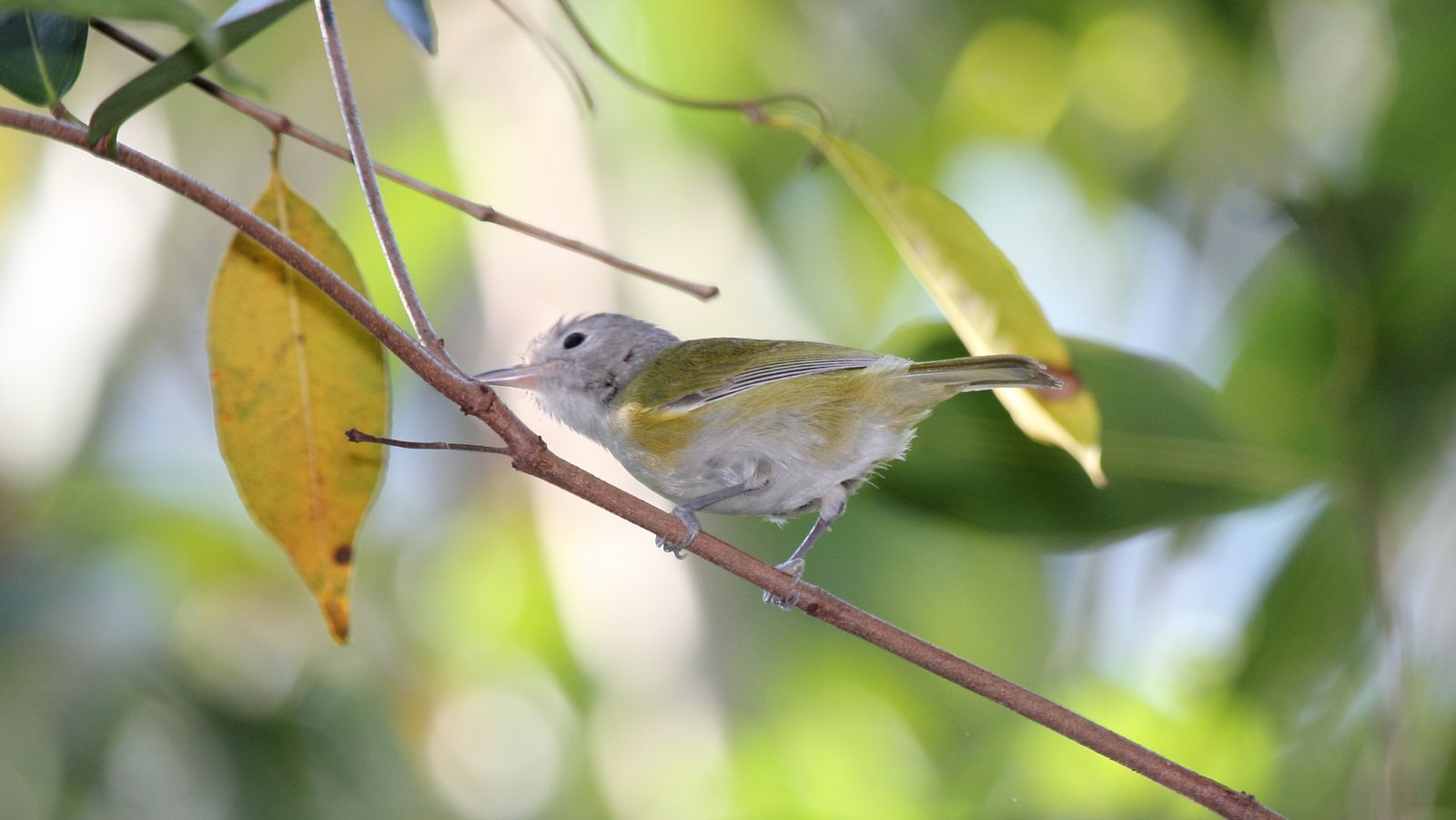
The Lesser Greenlet is one of the smallest vireos, a stocky, short-tailed bird of the canopy of humid and semi-humid forest west of the Andes. Its constantly repeated short song phrase is a familiar sound in the lowlands of western Colombia and western Ecuador.
Voice
A short, quick, clear phrase, such as chiweeweet, repeated over and over at short intervals. Also gives a nasal nyeh.
Recording: Juan Freile — CC BY-NC-SA 4.0 · xeno-canto
Identification
10.5 cm, stocky, with a short tail and a short, fairly thick bill. The upperparts are olive-green, the head slightly greyer, with a distinct white eye-ring. The eye is dark. The underparts are whitish, with a yellow wash on the flanks and undertail coverts. The sexes are alike.
Confusion species
Golden-fronted Greenlet Pachysylvia aurantiifrons of northern Colombia has a golden-yellow forehead, yellower underparts and no white eye-ring. Rufous-naped Greenlet Pachysylvia semibrunnea has a rufous crown and hindneck. Scrub Greenlet Hylophilus flavipes has a pale eye and a pale bill and lives in dry scrub.
Habitat
Canopy and edges of humid and semi-humid forest, tall secondary forest, forest edges and shade plantations, from sea level to about 1200 m, locally higher. It actively searches the foliage for insects, often in mixed flocks. The nest is a small, suspended cup in a twig fork.
Where the bird is most at home, classified by the vegetation units of the Andes and the west coast.


Range and movements
Colombia: on the Pacific slope, in the north and in the Magdalena and Cauca valleys. Ecuador: in the western lowlands and western foothills, south to El Oro and Loja. Peru: only in the far north-west, in Tumbes. Absent from Bolivia and the Galápagos. Outside the guide area from southern Mexico through Central America.
- Resident
- dark = core range, pale = thinly spread
How and when to look
At forest edges and in shade coffee in western Ecuador or the Colombian lowlands, listen for the repeated phrase and search the high foliage for a small, active bird with a white eye-ring.
Conservation status
Least Concern. Common; it tolerates secondary forest and shade plantations.
Scientific name
Pachysylvia decurtata | (Bonaparte, 1838) (GBIF: Hylophilus decurtatus)
Bonaparte described the species in 1838 as Sylvicola decurtata; because it was later moved to another genus, the author and year stand in brackets. The genus Pachysylvia was introduced in 1850 by Bonaparte. The genus name comes from Greek pakhus, 'large, stout', and Sylvia, the warbler genus. The species name comes from Latin decurtatus, 'shortened, cut short', probably for the short tail. The specimen the first description was based on came from Guatemala.