All species › Passerines › Shrike-babblers, Erpornis and vireos › Ochre-crowned Greenlet
Ochre-crowned Greenlet | Tunchiornis ochraceiceps
Okerkapvireo | Verdillo ocre | Vite-vite-uirapuru
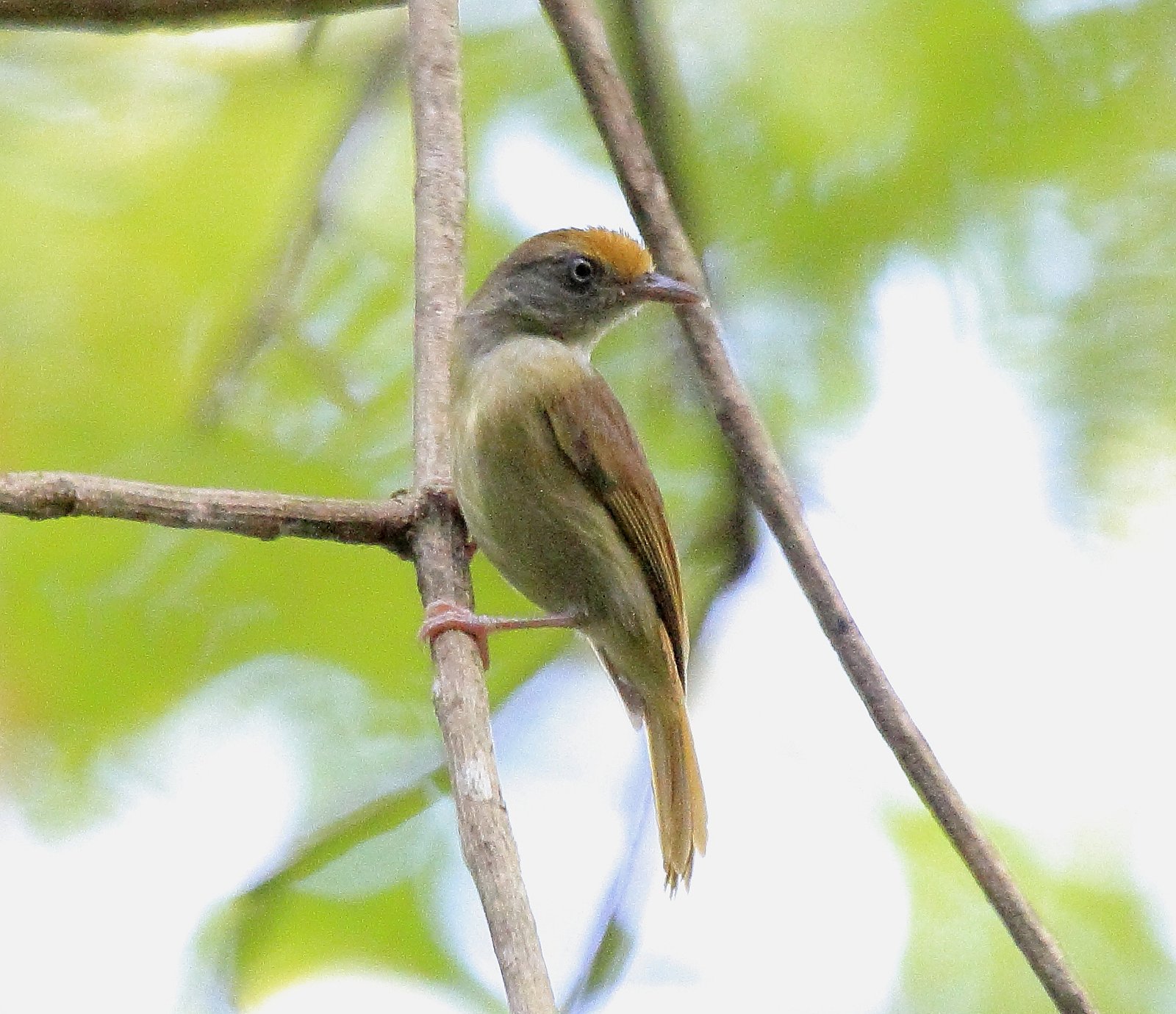
The Ochre-crowned Greenlet is a small, brownish greenlet of the understorey of humid lowland forest, with an ochre-brown forehead and a pale eye. Unlike most vireos it lives low in the forest, as a regular member of understorey mixed flocks.
Voice
Song: a single, drawn-out, rising whistle, repeated at intervals. Call: a nasal, scolding nyeh, often heard in mixed flocks.
Recording: david thorns — CC BY-NC-SA 4.0 · xeno-canto
Identification
11.5 cm, with a fairly long, thin bill. The forehead and forecrown are ochre-brown, merging into an olive-brown back; the wings and tail are warmer rufous-brown. The eye is pale grey to whitish. The throat is greyish white, the breast and flanks ochraceous olive and the belly paler. The sexes are alike. The tone of the head and underparts differs somewhat between populations west and east of the Andes.
Confusion species
Dusky-capped Greenlet Pachysylvia hypoxantha lives in the canopy and has a dark eye and yellow underparts. Females of antwrens of the genera Myrmotherula and Epinecrophylla have a dark eye, often wing bars and no ochre-brown forehead. Rufous-naped Greenlet Pachysylvia semibrunnea has a rufous crown and hindneck and lives higher, in foothill forest.
Habitat
Understorey and lower mid-storey of humid lowland and foothill forest, both terra firme and várzea, up to about 1200 m. It searches the foliage for insects, usually in mixed flocks with antwrens and antshrikes. The nest is a small, suspended cup in a fork low in the vegetation.
Where the bird is most at home, classified by the vegetation units of the Andes and the west coast.


Range and movements
Colombia: on the Pacific slope, in the northern lowlands and in Amazonia in the south-east. Ecuador: in the western and eastern lowlands. Peru: in the Amazonian lowlands east of the Andes. Bolivia: in the northern lowlands. Absent from the Galápagos. Outside the guide area from southern Mexico through Central America and in Venezuela, the Guianas and Amazonian Brazil.
- Resident
- dark = core range, pale = thinly spread
How and when to look
Look for mixed flocks in the understorey of undisturbed lowland forest; the nasal scolding call is often the first sign. The bird moves quickly from leaf to leaf.
Conservation status
Not Evaluated in its current circumscription. Widespread over a large area, but dependent on undisturbed forest.
Scientific name
Tunchiornis ochraceiceps | (Sclater, 1860) (GBIF: Hylophilus ochraceiceps)
Sclater described the species in 1860 as Hylophilus ochraceiceps; because it was later moved to another genus, the author and year stand in brackets. The genus Tunchiornis was introduced in 2014 by Slager & Klicka. The genus name combines El Tunche, the whistling guardian spirit of the forest in Peruvian mythology, with Greek ornis, ornithos, 'bird'. The species name comes from New Latin ochraceus, 'ochraceous', and -ceps, '-capped': 'ochre-capped'. The specimen the first description was based on came from Playa Vicente, Veracruz, Mexico.