All species › Parrots › African and New World parrots › Lilac-tailed Parrotlet
Lilac-tailed Parrotlet | Touit batavicus
Zevenkleurenpapegaai | Cotorrita sietecolores | Apuim-de-cauda-lilás
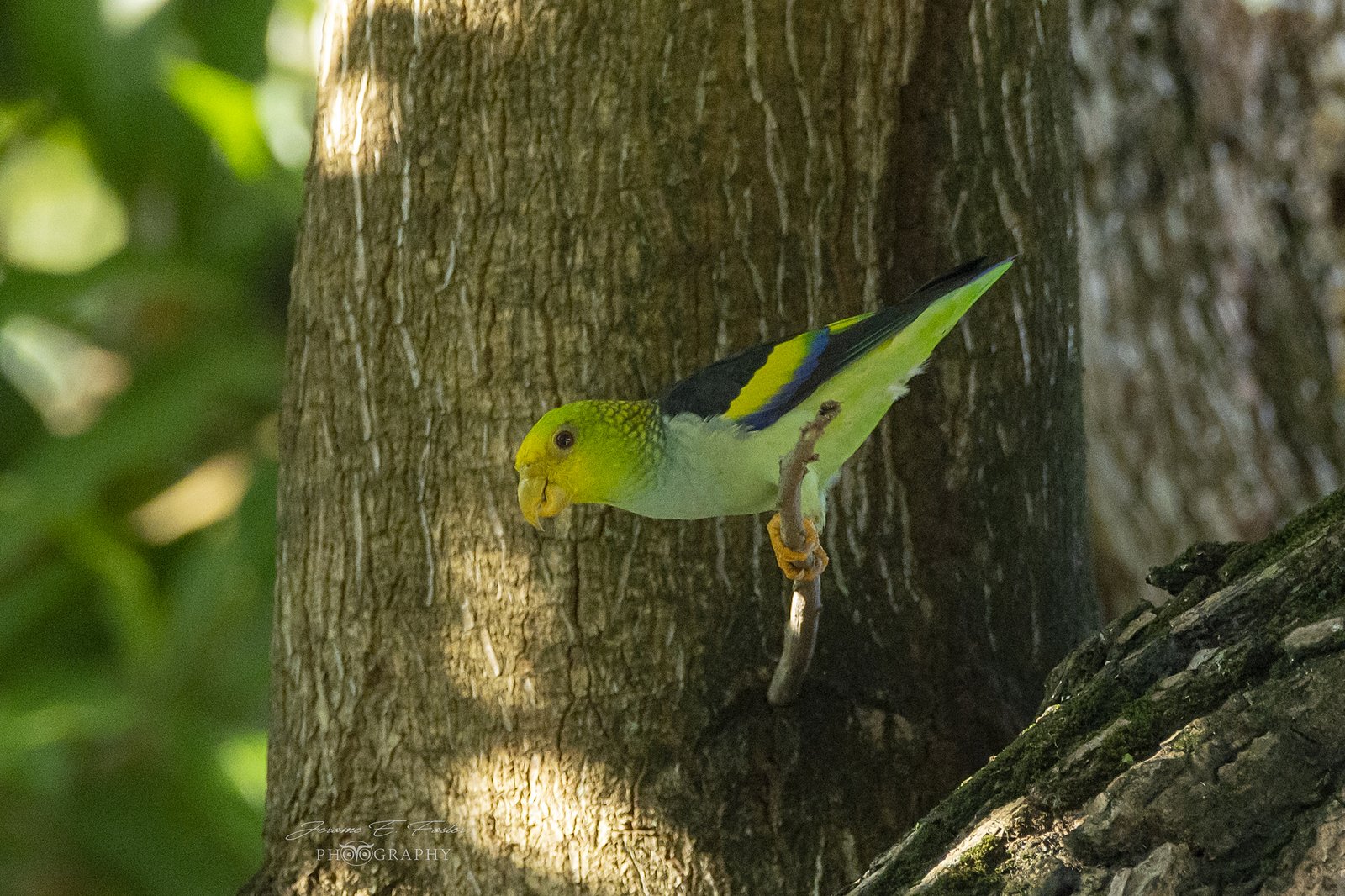
The Lilac-tailed Parrotlet is a small, short-tailed parrot with a black back, a yellow wing band and a lilac tail, found in the montane forest of Venezuela, Trinidad and Tobago and the Guianas. In the guide area it occurs only marginally and very locally, in northern and north-eastern Colombia. Flocks fly fast and high over the canopy and perch hidden among the leaves in the treetops.
Voice
A high, nasal, repeated call such as naak, and a soft chatter, mainly in flight.
Recording: Rosa Elena Albornoz @rosaelena_naturaleza — CC0 1.0 · xeno-canto
Identification
14 cm, with a short, square tail and a pale, yellowish bill. The forehead and face are yellowish green, and the crown and nape green with dark feather edges. The mantle and wings are mostly black, with a broad yellow band across the greater coverts and blue-violet flight feathers. The underparts are pale green with a bluish tinge. The tail is lilac to pinkish violet, with a black terminal band. The sexes are alike. Juveniles are duller.
Confusion species
Blue-fronted Parrotlet Touit dilectissimus is plain green above, with blue and red on the face and red under the wing, and lives in north-western Colombia. Orange-chinned Parakeet Brotogeris jugularis is green, with a longer, pointed tail, brown shoulders and an orange chin spot. Parrotlets of the genus Forpus are plain green, without a black back or yellow wing band.
Habitat
Humid montane forest and cloud forest, their edges and tall secondary forest, outside the guide area roughly between 400 and 1700 m. It feeds on fruit, seeds and flowers in the canopy. It nests in tree cavities, sometimes in termite nests.
Where the bird is most at home, classified by the vegetation units of the Andes and the west coast.


Range and movements
In Colombia only very locally in the north and north-east, in the border area with Venezuela; records are scarce. Absent from Ecuador, Peru, Bolivia and the Galápagos. Outside the guide area in the coastal mountains and tepuis of Venezuela, on Trinidad and Tobago and in the Guianas.
- Resident
- dark = core range, pale = thinly spread
How and when to look
Rarely recorded in the guide area itself; in montane forest of north-eastern Colombia watch for small flocks flying fast and high overhead with a nasal call. In the coastal mountains of Venezuela and on Trinidad the species is seen more regularly.
Conservation status
Least Concern. The species has a fairly large range outside the guide area; its population in Colombia is unknown.
Scientific name
Touit batavicus | (Boddaert, 1783)
Boddaert described the species in 1783 as Psittaca Batavica; because it was later moved to another genus, the author and year stand in brackets. The genus Touit was introduced in 1855 by Gray. The genus name comes from the extinct Tupi language, in which tuí eté means 'really little parrot'; Marcgrave used 'Tuiete' for a small parrot as early as 1648. The species name refers to Batavia (now Jakarta), the erroneous origin given by Daubenton; the species does not occur there. The specimen the first description was based on came from Venezuela.