All species › Parrots › African and New World parrots › Scarlet-shouldered Parrotlet
Scarlet-shouldered Parrotlet | Touit huetii
Roodschouderpapegaai | Periquito hombrirrojo | Apuim-de-asa-vermelha
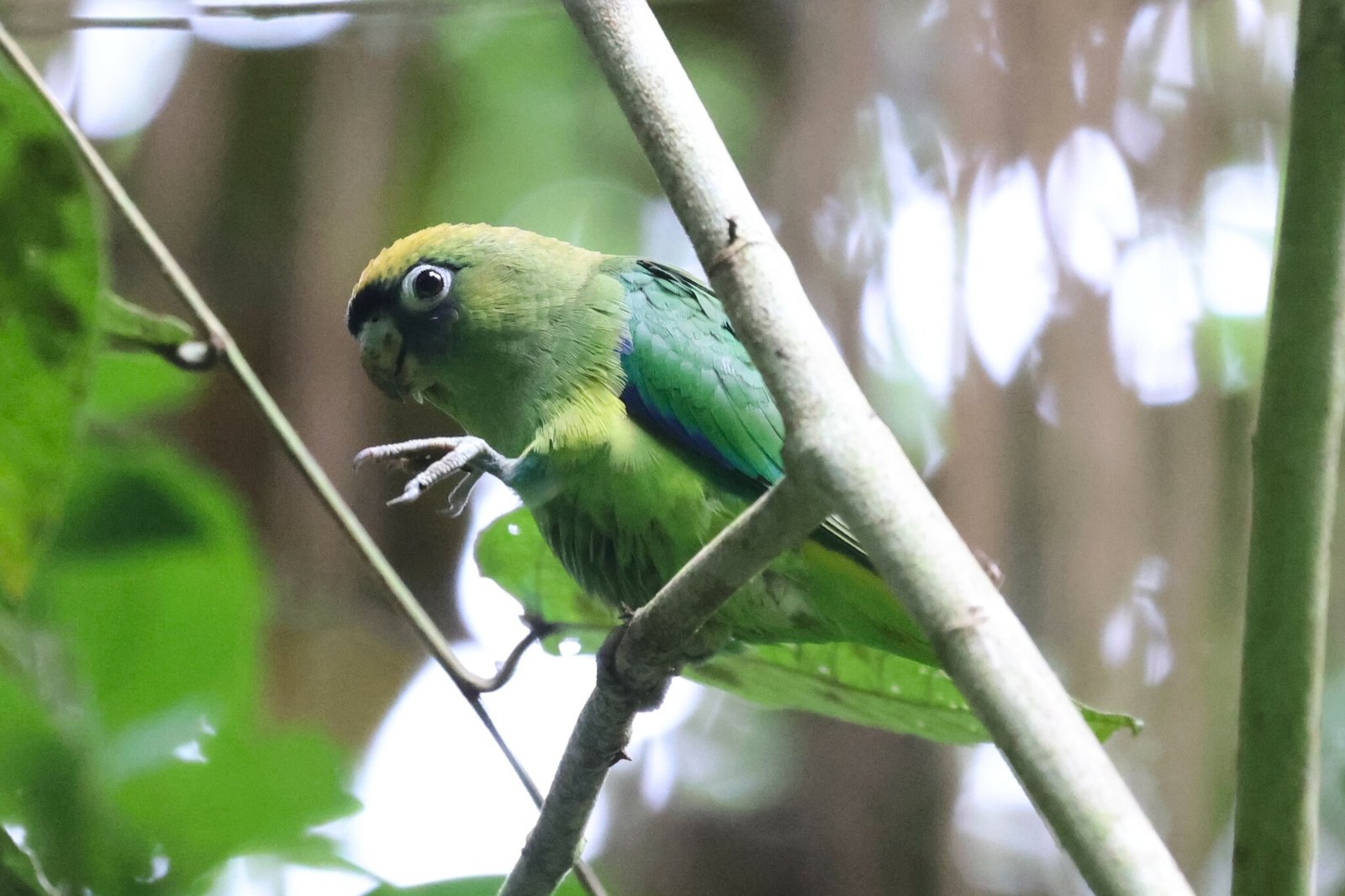
The Scarlet-shouldered Parrotlet is a small, short-tailed parrot of the Amazonian lowlands and foothills east of the Andes. Perched it is mainly green, but in flight the scarlet underwing coverts stand out, giving the species its name. Flocks wander over large distances and are present irregularly at many sites.
Voice
A high, nasal, somewhat grating call such as cheek or kweek, repeated in flight; flock members call over each other.
Recording: Guilherme Melo — CC BY-NC-SA 4.0 · xeno-canto
Identification
15–16 cm, with a short, square tail and a yellowish bill. The plumage is green, yellowish green below. The forehead and lores are blackish, the front of the face dark blue, and there is a pale, bare ring around the eye. The upperwing coverts are partly blue. The underwing coverts and axillaries are scarlet. In the male the outer tail feathers are magenta-red with a black tip, in the female greenish yellow. Juveniles are duller.
Confusion species
Sapphire-rumped Parrotlet Touit purpuratus has a blue rump, a brown shoulder patch and no red under the wing. Manu Parrotlet Nannopsittaca dachilleae is smaller, with a pale blue forehead and no red. Cobalt-winged Parakeet Brotogeris cyanoptera has a longer, pointed tail, blue flight feathers and an orange chin spot. Dusky-billed Parrotlet Forpus modestus is smaller, without red under the wing.
Habitat
Humid terra firme rainforest and foothill forest, flooded forest and their edges, from the lowlands to roughly 1200 m. It feeds on fruit, seeds and flowers in the canopy and in south-eastern Peru visits clay licks along rivers. It nests in tree cavities.
Where the bird is most at home, classified by the vegetation units of the Andes and the west coast.


Range and movements
In Colombia east of the Andes, mainly in the foothills and lowlands of the east. In Ecuador and Peru in the Amazonian lowlands and the foothills of the eastern slope. In Bolivia in the north and in the lowlands along the Andes. Absent from the Galápagos. Outside the guide area in Venezuela, the Guianas, Trinidad and Brazil.
- Resident
- dark = core range, pale = thinly spread
How and when to look
In the lowlands and foothills of south-eastern Peru, among other places at clay licks along the rivers, and elsewhere over the forest, where flocks pass fast and high. In flight look for the red underwing.
Conservation status
Least Concern. The species has a large range but occurs patchily and irregularly; forest is lost locally to clearance.
Scientific name
Touit huetii | (Temminck, 1830)
Temminck described the species in 1830 as Psittacus huetii; because it was later moved to another genus, the author and year stand in brackets. The genus Touit was introduced in 1855 by Gray. The genus name comes from the extinct Tupi language, in which tuí eté means 'really little parrot'; Marcgrave used 'Tuiete' for a small parrot as early as 1648. The species name honours Nicolas Huët (1770–1830), a French painter and bird illustrator. The specimen the first description was based on came from Upper Amazonia (probably Peru).