All species › Parrots › African and New World parrots › Blue-fronted Parrotlet
Blue-fronted Parrotlet | Touit dilectissimus
Blauwvoorhoofdpapegaai | Cotorrita cariazul | Apuim-de-fronte-azul
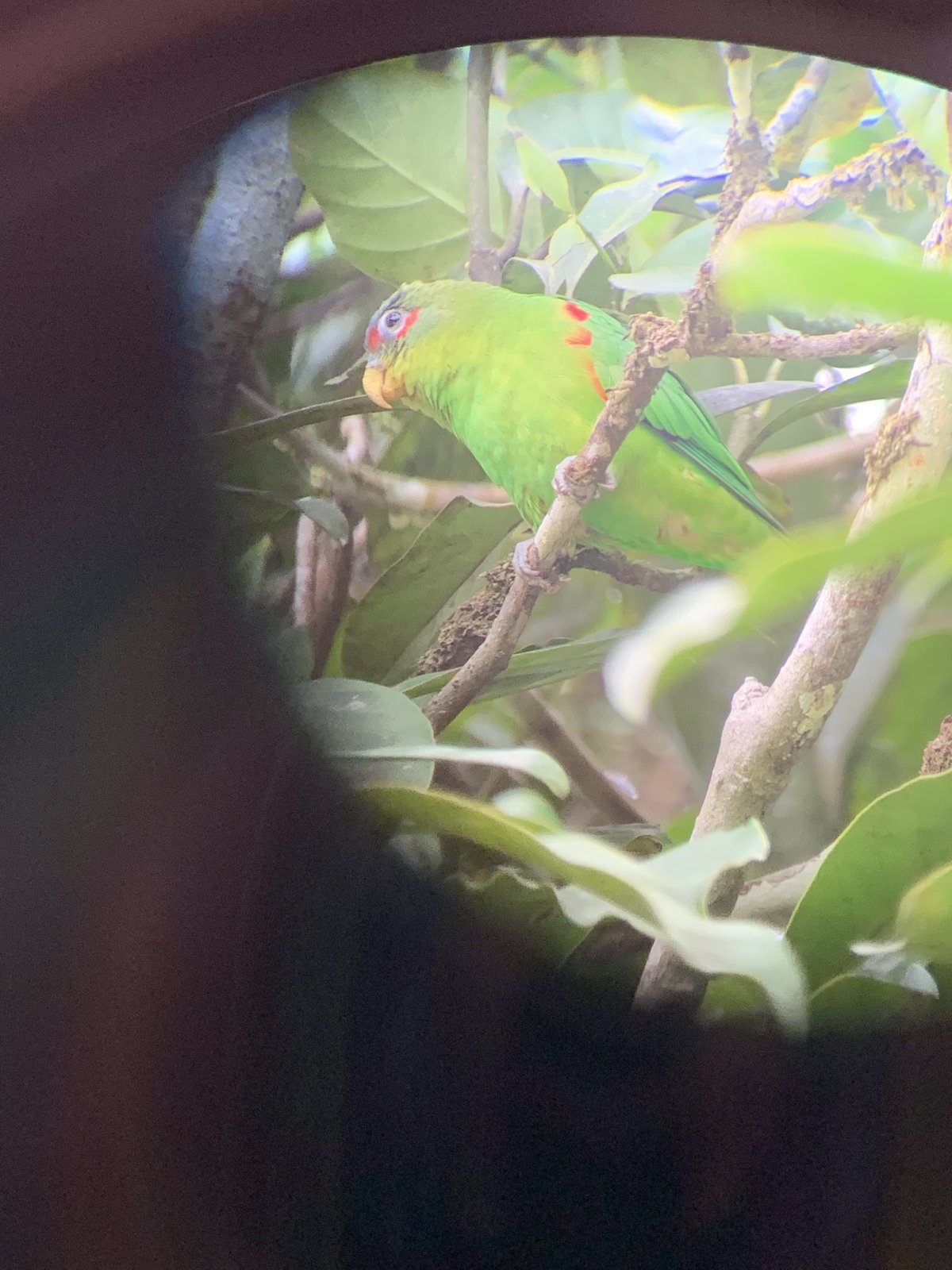
The Blue-fronted Parrotlet is a small, stocky parrot with a short, square tail, belonging to the genus Touit. It lives in humid foothill and montane forest on the Pacific side of the northern Andes, where pairs and small groups search for fruit high in the canopy. Groups fly fast and straight over the forest, giving a nasal call.
Voice
A high, nasal call, often repeated in flight, and soft chattering from feeding groups. Perched birds are mostly silent.
Recording: Francisco Sornoza — CC BY-NC-SA 4.0 · xeno-canto
Identification
17 cm, stocky, with a short, square tail and a pale bill. The plumage is grass green, slightly more yellowish below. The forehead and forecrown are blue, and there is a small red spot below the eye. The male has red coverts along the leading edge of the wing; in the female this red is limited or absent. The underwing coverts are yellow, the flight feathers dark. The outer tail feathers are yellow with a black tip. Juveniles are duller, with less blue and red on the head.
Confusion species
Spot-winged Parrotlet Touit stictopterus lacks the blue forehead, has dark, pale-spotted wing coverts and lives on the eastern slope of the Andes. Barred Parakeet Bolborhynchus lineola is finely barred black and has a pointed tail. Orange-chinned Parakeet Brotogeris jugularis has an orange chin spot, brown shoulders and a longer, pointed tail. Rose-faced Parrot Pyrilia pulchra is larger, with a pink face and a brownish head.
Habitat
Humid foothill forest, lower montane rainforest and cloud forest, also forest edges and tall secondary growth, roughly between 300 and 1700 m, locally lower. It eats fruit, berries and seeds high in the canopy, including those of epiphytes and mistletoes. Little is known about breeding; the nest is in a cavity high in a tree.
Where the bird is most at home, classified by the vegetation units of the Andes and the west coast.


Range and movements
In Colombia in the Chocó and on the western slope of the Western Andes, locally also in the northern spurs of the Central and Eastern Andes. In Ecuador in the north-west, mainly in Esmeraldas, Carchi, Imbabura and western Pichincha. Absent from Peru, Bolivia and the Galápagos. Outside the guide area in Costa Rica, Panama and north-western Venezuela.
- Resident
- dark = core range, pale = thinly spread
How and when to look
Search along forest edges and roads through humid foothill forest in north-western Ecuador and the Colombian Chocó. In the morning watch for small groups flying over the forest with a nasal call, and for fruiting trees and mistletoes where they come to feed.
Conservation status
Least Concern. The species depends on forest and has a fairly small range; deforestation in the Chocó and on the Andean slopes is a local threat. Its population is poorly known.
Scientific name
Touit dilectissimus | (Sclater & Salvin, 1871)
Sclater & Salvin described the species in 1871 as Urochroma dilectissima; because it was later moved to another genus, the author and year stand in brackets. The genus Touit was introduced in 1855 by Gray. The genus name comes from the extinct Tupi language, in which tuí eté means 'really little parrot'; Marcgrave used 'Tuiete' for a small parrot as early as 1648. The species name is Latin dilectissimus, 'most beloved', the superlative of dilectus. The specimen the first description was based on came from south of Mérida, Venezuela.