All species › Parrots › African and New World parrots › Sapphire-rumped Parrotlet
Sapphire-rumped Parrotlet | Touit purpuratus
Saffierstuitpapegaai | Periquito lomizafiro | Apuim-de-costas-azuis
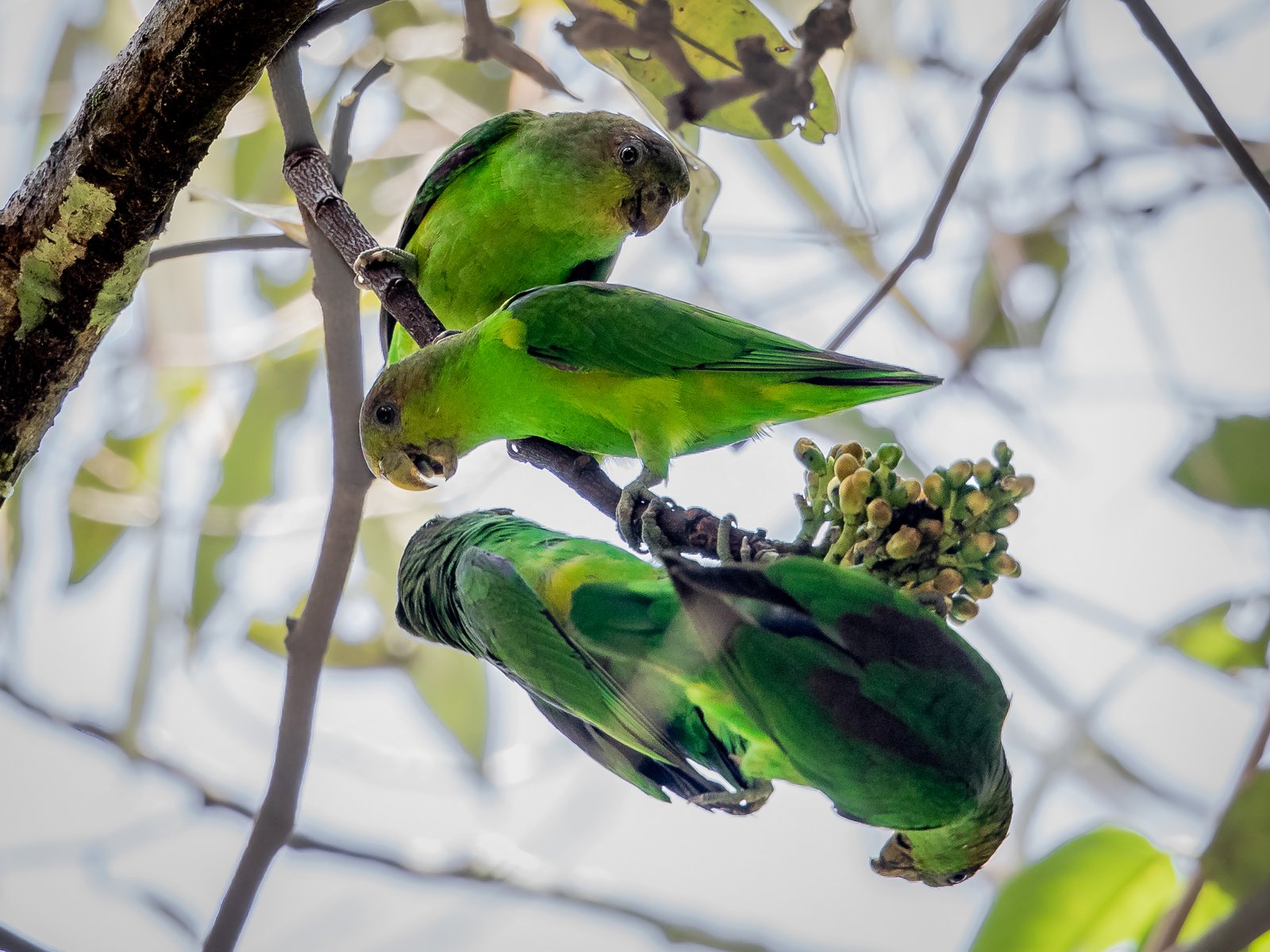
The Sapphire-rumped Parrotlet is a small, short-tailed parrot of the Amazonian lowlands. It lives high in the canopy of humid forest, usually in pairs or small groups, and is mostly seen as it flies over the forest with rapid wingbeats. In the guide area it reaches the western edge of its range.
Voice
A nasal, somewhat plaintive call, often repeated in flight. Feeding birds are mostly silent.
Recording: GABRIEL LEITE — CC BY-NC-SA 3.0 · xeno-canto
Identification
17 cm, stocky, with a short, rounded tail and a pale, yellowish bill. The plumage is green; the crown and nape are brownish olive. The scapulars are dark brown and form a dark band across the back, and the lower back and rump are sapphire blue, mainly visible in flight. In the male the outer tail feathers are purplish red with a black tip; in the female they have a green band before the tip. Juveniles resemble the female.
Confusion species
Scarlet-shouldered Parrotlet Touit huetii has a blackish forehead, a white eye-ring, red on the leading edge of the wing and red underwing coverts, but no blue rump. Cobalt-winged Parakeet Brotogeris cyanoptera has a longer, pointed tail, an orange chin spot and blue flight feathers. Dusky-billed Parrotlet Forpus modestus is smaller, with a dark upper mandible; the male has a blue rump but no dark band across the back.
Habitat
Tall, humid lowland forest on terra firme, also forest on white sand and the edges of flooded forest, mostly below 500 m. It eats fruit, seeds and flowers high in the canopy, including those of epiphytes. The nest is in a cavity high in a tree.
Where the bird is most at home, classified by the vegetation units of the Andes and the west coast.


Range and movements
In Colombia in the south-east, in Vaupés, Guainía, Caquetá and Amazonas. In Ecuador scarce in the north-eastern lowlands. In Peru in the north, mainly north of the Amazon and the Marañón in Loreto. Absent from Bolivia and the Galápagos. Outside the guide area in southern Venezuela, the Guianas and northern Brazilian Amazonia.
- Resident
- dark = core range, pale = thinly spread
How and when to look
In the north-eastern lowlands of Ecuador and Peru, watch from canopy towers or along forest edges in the morning for small groups flying over the forest. The blue rump is best seen as the birds fly away.
Conservation status
Least Concern. Over much of its range the forest is still intact, but the species is fairly scarce everywhere and little studied.
Scientific name
Touit purpuratus | (Gmelin, 1788)
Gmelin described the species in 1788 as Psittacus purpuratus; because it was later moved to another genus, the author and year stand in brackets. The genus Touit was introduced in 1855 by Gray. The genus name comes from the extinct Tupi language, in which tuí eté means 'really little parrot'; Marcgrave used 'Tuiete' for a small parrot as early as 1648. The species name is Latin purpuratus, 'clad in purple', for the purplish-blue tones in the plumage. The specimen the first description was based on came from Cayenne, French Guiana.