All species › Waders, gulls and terns › Sandpipers and allies › Little Stint
Little Stint | Calidris minuta
Kleine strandloper | Correlimos menudo | Maçarico-pequeno
The Little Stint is the smallest sandpiper of Europe and Asia. It breeds on the tundra from northern Scandinavia to Siberia and winters in Africa, the Middle East and southern Asia. In the Americas it is a rare vagrant; in the guide area there are at most a few records.
Voice
A short, high stit or tit, often repeated.
Recording: Stanislas Wroza — CC BY-NC-SA 4.0 · xeno-canto
Identification
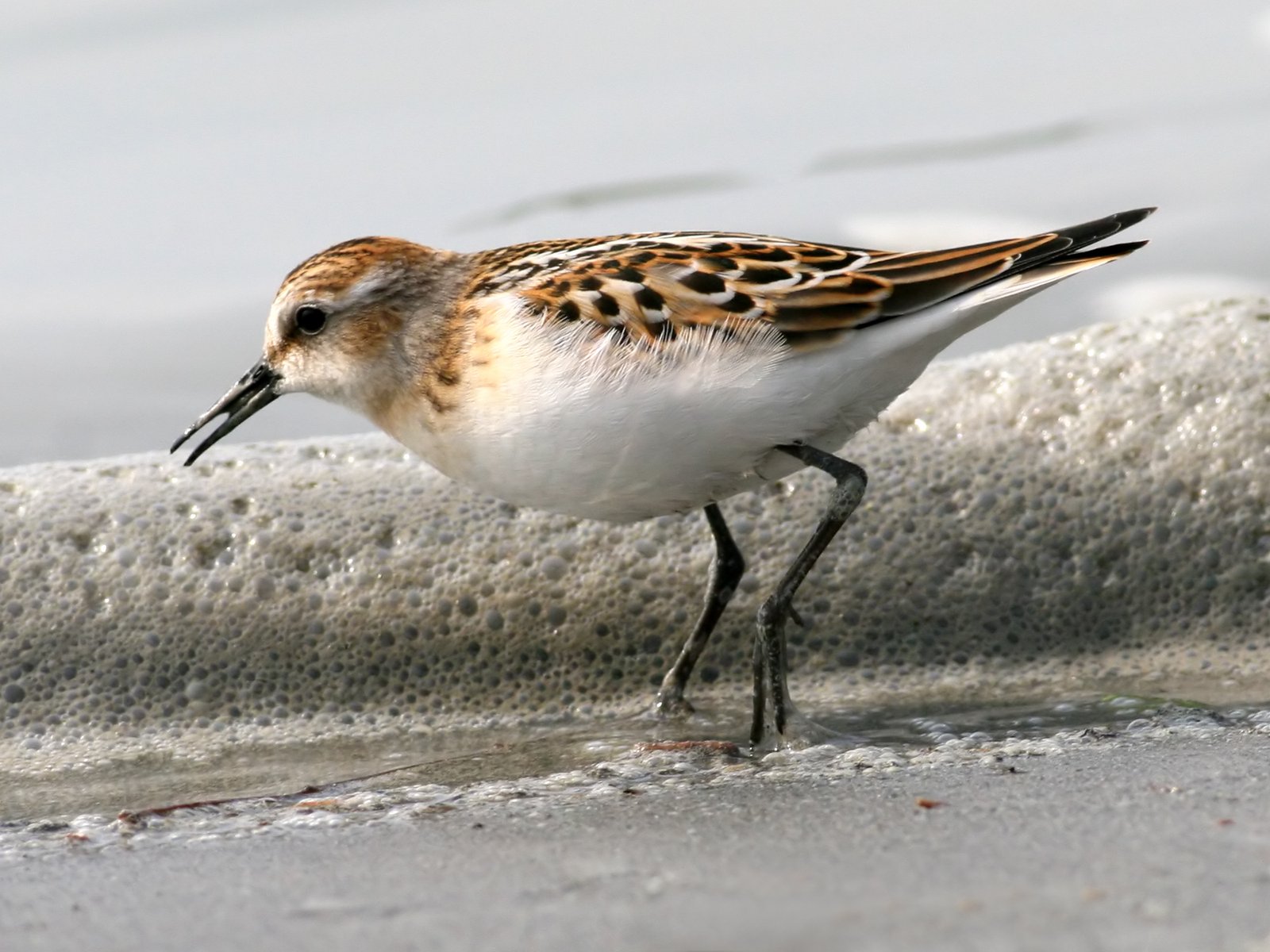
12–14 cm, a very small sandpiper with a short, straight, fine-tipped black bill and black legs without webbing. In non-breeding plumage greyish brown above with dark centres and white below, with grey breast sides. In breeding plumage rufous on the head, breast and back, with a white throat. Juveniles have rufous-fringed back feathers, a distinct white V on the mantle and a split pale supercilium. In flight a narrow white wing bar and a rump with a dark central stripe. The sexes are alike.
Confusion species
Semipalmated Sandpiper Calidris pusilla has small webs between the toes and a blunter, slightly thicker bill tip. Western Sandpiper Calidris mauri has a longer bill that droops at the tip. Least Sandpiper Calidris minutilla has yellowish green legs, a browner breast and a thinner, slightly decurved bill.
Habitat
Mudflats, lagoons, salt pans and muddy lake shores. It feeds with rapid pecking movements for small insects and crustaceans, often among other small sandpipers. It does not breed in the guide area.
Where the bird is most at home, classified by the vegetation units of the Andes and the west coast.


Range and movements
Only a very rare vagrant in the guide area, with at most a few records on the coast. Breeds on the Arctic tundra of northern Europe and Siberia and winters in Africa, the Middle East and southern Asia; in the Americas vagrants appear mainly in North America and the Caribbean.
How and when to look
A vagrant stands out among flocks of Semipalmated and Western Sandpipers on coastal mudflats; look for the fine bill tip, the lack of webbing and, in juveniles, the white V on the mantle.
Conservation status
Least Concern. The world population is large and widespread.
Scientific name
Calidris minuta | (Leisler, 1812)
Leisler described the species in 1812 as Tringa minuta; because it was later moved to another genus, the author and year stand in brackets. The genus Calidris was introduced in 1804 by Merrem. The genus name comes from Greek kalidris or skalidris, a term used by Aristotle for an unidentified grey waterside bird. The specific name comes from Latin minutus, 'small'. The specimen the first description was based on came from Hanau, Germany.