All species › Waders, gulls and terns › Sandpipers and allies › Dunlin
Dunlin | Calidris alpina
Bonte strandloper | Correlimos común | Maçarico-de-papo-preto
The Dunlin is one of the most numerous shorebirds of the northern hemisphere. North American birds winter along the coasts south to Mexico and Central America. In the guide area it has been recorded only as a very rare vagrant.
Voice
A rasping, shrill treee or kreeep, often when flushed.
Recording: Stanislas Wroza — CC BY-NC-SA 4.0 · xeno-canto
Identification
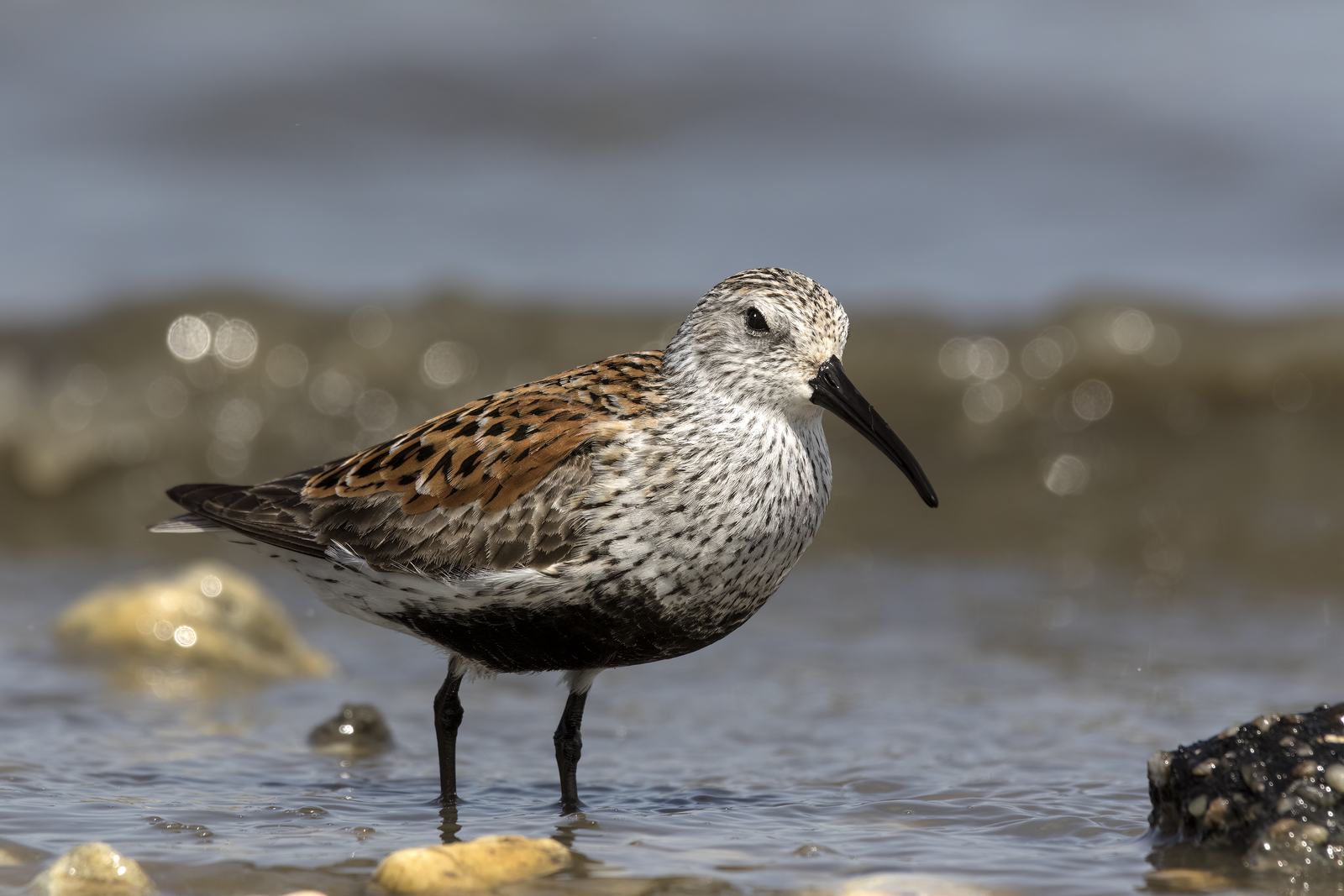
16–22 cm, a stocky sandpiper with a rather long black bill that droops slightly at the tip and short black legs. In non-breeding plumage plain brownish grey above, with a greyish, faintly streaked breast and a white belly. In breeding plumage a rufous back and a large black patch on the belly. Juveniles have rufous and black scaled upperparts and small black spots on the flanks. In flight a white wing bar and a rump with a dark central stripe and white sides. The sexes are nearly alike.
Confusion species
Western Sandpiper Calidris mauri is smaller, with a shorter bill and paler upperparts. Curlew Sandpiper Calidris ferruginea is slimmer and longer-legged, with a bill curved along its whole length and a white rump. Sanderling Calidris alba is whiter, with a shorter, straight bill and a black mark at the shoulder.
Habitat
Tidal flats, lagoons, estuaries and salt pans on the coast. It feeds in flocks, probing mud with rapid movements for worms, molluscs and crustaceans. It does not breed in the guide area.
Where the bird is most at home, classified by the vegetation units of the Andes and the west coast.


Range and movements
Only a very rare vagrant in the guide area, with a few records on the coast. Breeds on the tundra of North America, Europe and Asia; North American birds winter south to Mexico and Central America.
How and when to look
A vagrant is most likely among flocks of Western and Semipalmated Sandpipers on coastal mudflats between November and March; look for the longer, tip-drooping bill and the brownish grey breast.
Conservation status
Near Threatened. The world population is large, but some subspecies are declining through the loss of intertidal habitat along the flyways.
Scientific name
Calidris alpina | (Linnaeus, 1758)
Linnaeus described the species in 1758 as Tringa alpina; because it was later moved to another genus, the author and year stand in brackets. The genus Calidris was introduced in 1804 by Merrem. The genus name comes from Greek kalidris or skalidris, a term used by Aristotle for an unidentified grey waterside bird. The specific name comes from Latin alpinus, 'of the Alps' or 'alpine'. The specimen the first description was based on came from Lapland.