All species › Waders, gulls and terns › Sandpipers and allies › Curlew Sandpiper
Curlew Sandpiper | Calidris ferruginea
Krombekstrandloper | Correlimos zarapitín | Maçarico-de-bico-curvo
The Curlew Sandpiper breeds on the tundra of northern Siberia and winters in Africa, southern Asia and Australia. In the Americas it is a rare visitor, mainly on the east coast of North America. In the guide area it has been recorded only as a very rare vagrant.
Voice
A soft, rippling chirrip, often in flight.
Recording: Sergi Carreras — CC BY-NC-SA 4.0 · xeno-canto
Identification
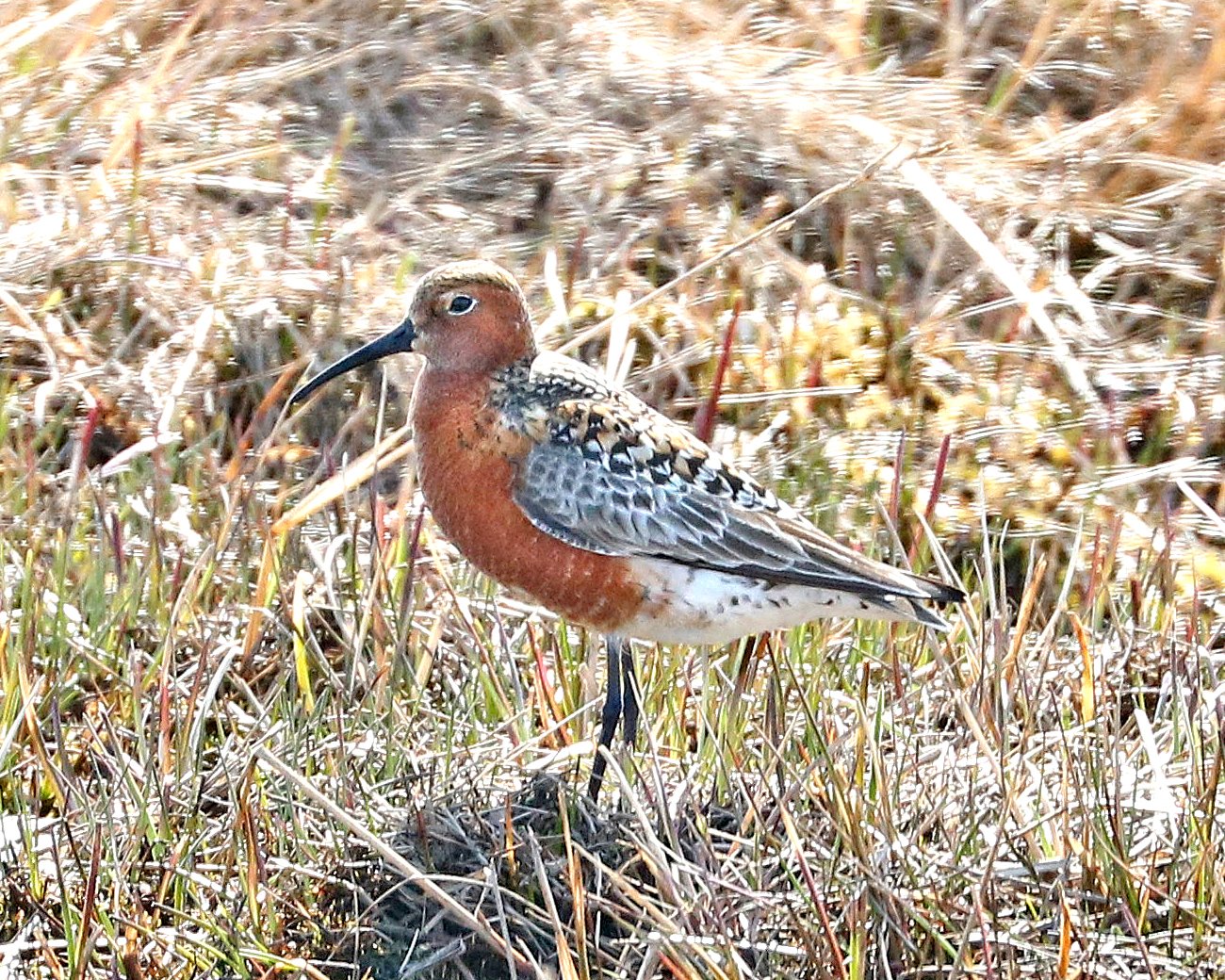
18–22 cm, a slender sandpiper with rather long black legs and a long black bill that curves gently downward along its whole length. In non-breeding plumage grey above and white below, with a white supercilium. Juveniles have scaly, greyish brown upperparts and a pale peach-coloured breast. In breeding plumage the head and underparts are brick red. In flight the pure white rump stands out, together with a narrow white wing bar. The sexes are nearly alike.
Confusion species
Dunlin Calidris alpina is stockier, with shorter legs, a bill that droops only at the tip and a rump with a dark central stripe. Stilt Sandpiper Calidris himantopus also has a white rump but has much longer, greenish yellow legs and a bill with a slightly thickened tip. Red Knot Calidris canutus is larger and stockier, with a straight, shorter bill.
Habitat
Tidal flats, lagoons, salt pans and shrimp farms on the coast. It feeds by walking in shallow water and probing in mud for worms, molluscs and crustaceans. It does not breed in the guide area.
Where the bird is most at home, classified by the vegetation units of the Andes and the west coast.


Range and movements
Only a very rare vagrant in the guide area, with a few records on the coast. Breeds on the tundra of northern Siberia and winters in sub-Saharan Africa, southern Asia and Australia.
How and when to look
A vagrant is most likely among flocks of other sandpipers on coastal salt pans and shrimp farms; look for the evenly decurved bill and the white rump in flight.
Conservation status
Vulnerable. The world population is declining, mainly through the loss of intertidal habitat along the flyways in Asia.
Scientific name
Calidris ferruginea | (Pontoppidan, 1763)
Pontoppidan described the species in 1763 as Tringa Ferrugineus; because it was later moved to another genus, the author and year stand in brackets. The genus Calidris was introduced in 1804 by Merrem. The genus name comes from Greek kalidris or skalidris, a term used by Aristotle for an unidentified grey waterside bird. The specific name comes from Latin ferrugo, ferruginis, 'iron rust', after the rust-coloured breeding plumage. The specimen the first description was based on came from (as per the description).