All species › Waders, gulls and terns › Sandpipers and allies › Sharp-tailed Sandpiper
Sharp-tailed Sandpiper | Calidris acuminata
Siberische strandloper | Correlimos acuminado | Maçarico-de-cauda-aguda
The Sharp-tailed Sandpiper breeds on the tundra of north-eastern Siberia and winters mainly in Australia and New Guinea. Juveniles regularly pass along the west coast of Alaska in autumn, and a few wander further south along the Pacific coast of the Americas. In the guide area it has been recorded only as a very rare vagrant.
Voice
A soft, dry wheep or trrt, often in short series, less rasping than the call of Pectoral Sandpiper.
Recording: Ukolov Ilya — CC BY-NC-SA 4.0 · xeno-canto
Identification
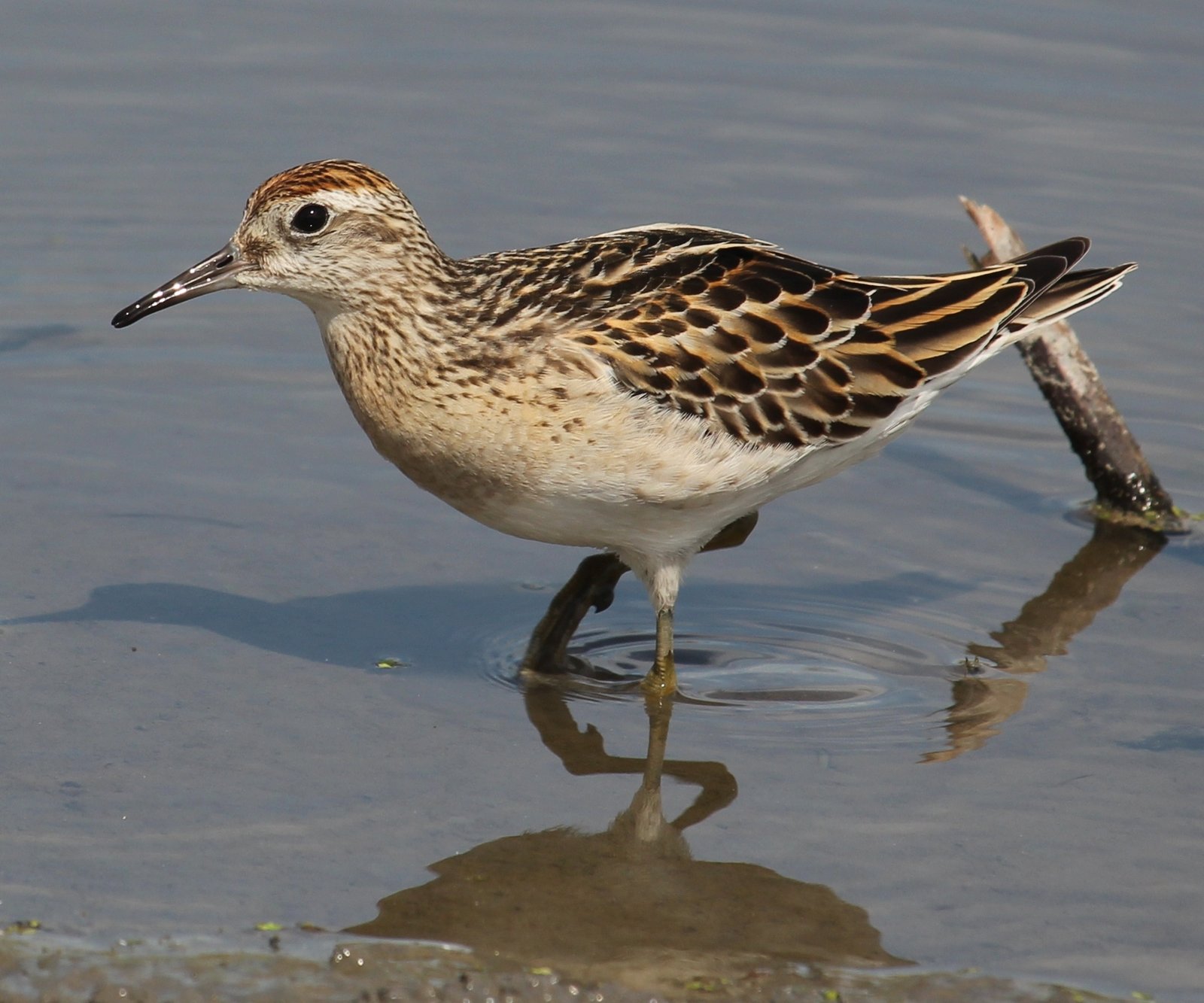
17–21 cm, a medium-sized sandpiper with a rather short, slightly decurved, dark bill and greenish yellow legs. Characteristic are a rufous crown, a clear white supercilium that broadens behind the eye and a white eye-ring. Juveniles, which occur most often as vagrants, have a warm orange-buff breast with fine streaks only on the sides and rufous-scaled upperparts. Breeding adults have arrow-shaped dark marks on the breast and flanks. In flight a narrow white wing bar and a dark central stripe on the rump with white sides. The sexes are alike.
Confusion species
Pectoral Sandpiper Calidris melanotos is very similar but has a densely streaked breast sharply demarcated from the white belly, a less prominent supercilium and a less rufous crown; it is a regular passage migrant in the guide area. The small sandpipers, such as Baird's Sandpiper Calidris bairdii, are smaller, with black legs and long wings projecting well beyond the tail.
Habitat
Shallow edges of fresh and brackish lagoons, salt pans, wet grassland and muddy margins with some vegetation. It feeds by picking and probing for insects, small worms and crustaceans. It does not breed in the guide area.
Where the bird is most at home, classified by the vegetation units of the Andes and the west coast.


Range and movements
Only a very rare vagrant in the guide area, with at most a few records on the Pacific coast. Breeds in north-eastern Siberia and winters mainly in Australia, New Guinea and on Pacific islands.
How and when to look
A vagrant is most likely among flocks of Pectoral Sandpipers on coastal salt pans and lagoons from September to November; look for the rufous crown, the white supercilium and the unstreaked, orange-buff breast of juveniles.
Conservation status
Vulnerable. The world population is declining, mainly through the loss of intertidal habitat along the East Asian flyway, especially around the Yellow Sea.
Scientific name
Calidris acuminata | (Horsfield, 1821)
Horsfield described the species in 1821 as Totanus acuminatus; because it was later moved to another genus, the author and year stand in brackets. The genus Calidris was introduced in 1804 by Merrem. The genus name comes from Greek kalidris or skalidris, a term used by Aristotle for an unidentified grey waterside bird. The specific name comes from Latin acuminatus, 'pointed', after the pointed tail. The specimen the first description was based on came from Java, Indonesia.