All species › Waders, gulls and terns › Sandpipers and allies › Common Snipe
Common Snipe | Gallinago gallinago
Watersnip | Agachadiza común | Narceja-comum
Common Snipe is the snipe of Europe and Asia, breeding in marshes from Iceland to eastern Siberia and wintering south to Africa and southern Asia. In the guide area it occurs only as a very rare vagrant. It closely resembles Wilson's Snipe, which until recently was treated as a subspecies of Common Snipe.
Voice
On take-off a hoarse, rasping catch, single or repeated.
Recording: Stanislas Wroza — CC BY-NC-SA 4.0 · xeno-canto
Identification
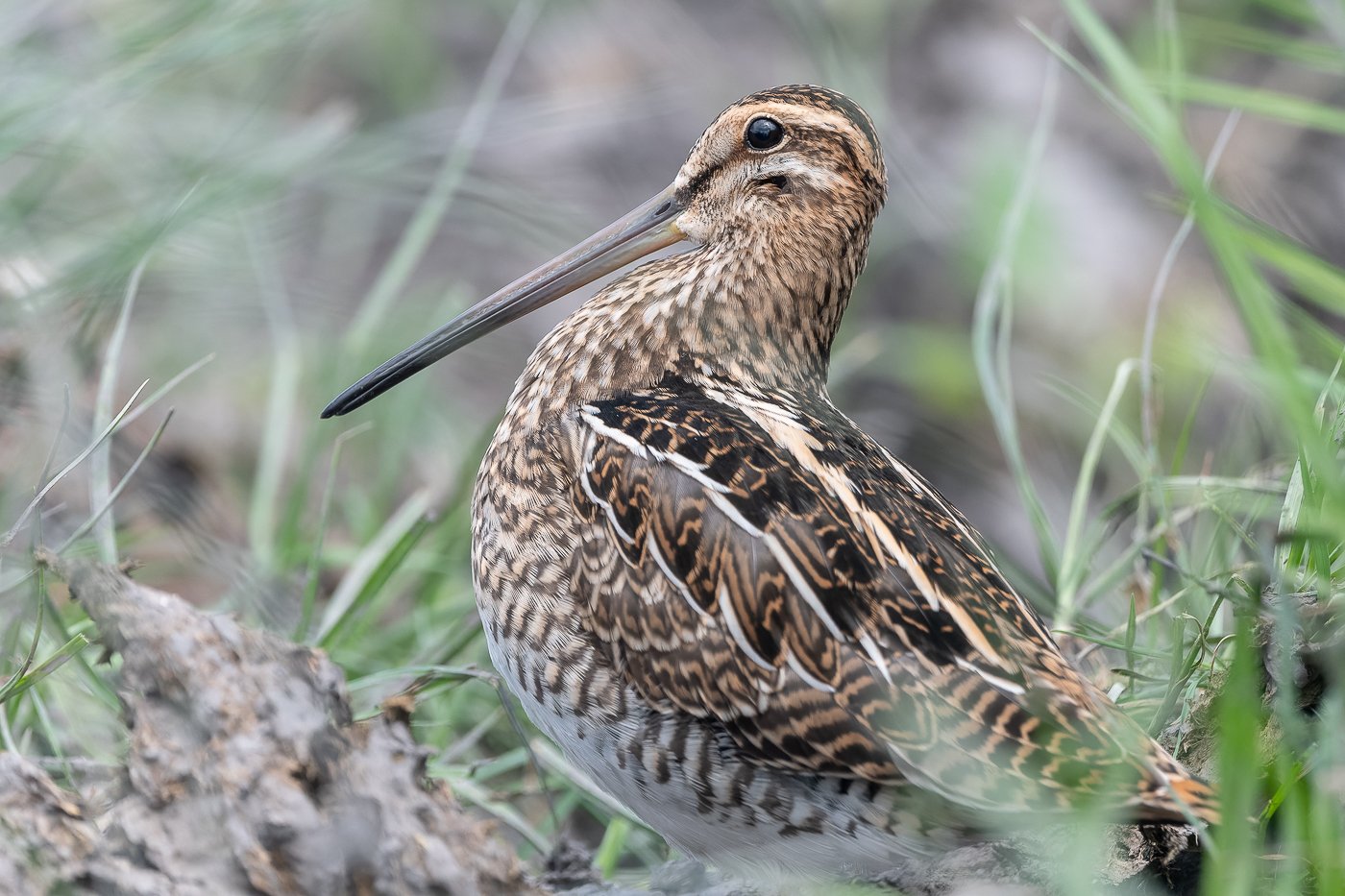
25–27 cm, with a long, straight bill, a striped head and a dark brown back with creamy longitudinal stripes. The breast is spotted brown, the flanks are barred and the belly is white. In flight a broad white trailing edge to the secondaries and a pale underwing with white bars across the coverts. The flight is fast and zigzagging. The sexes are alike.
Confusion species
Wilson's Snipe Gallinago delicata has a narrower white trailing edge to the secondaries and a darker, more densely barred underwing; without good photographs of the wing the distinction in the field is uncertain. Pantanal Snipe Gallinago paraguaiae is resident in the lowlands east of the Andes and is also very similar.
Habitat
Marshes, wet pastures, muddy, vegetated shores of pools and rice fields. It probes soft ground for worms and insect larvae. It does not breed in the guide area.
Where the bird is most at home, classified by the vegetation units of the Andes and the west coast.


Range and movements
Only a few records in the guide area, mainly from Colombia; not all are documented with certainty, and confusion with Wilson's Snipe is an obvious possibility. Outside the guide area it breeds in northern Europe and Asia and winters in western Europe, Africa and southern Asia.
How and when to look
A possible Common Snipe deserves careful documentation with photographs of the upper and under wing in flight; note the width of the white trailing edge and the white bars on the underwing.
Conservation status
Least Concern. In parts of Europe the population is declining through drainage of breeding sites.
Scientific name
Gallinago gallinago | (Linnaeus, 1758)
Linnaeus described the species in 1758 as Scolopax Gallinago; because it was later moved to another genus, the author and year stand in brackets. The genus Gallinago was introduced in 1760 by Brisson. The genus name is New Latin for a woodcock or snipe, from Latin gallina, 'hen', with the suffix -ago, 'resembling'. The species name repeats the genus name, New Latin for snipe (a tautonym). The specimen the first description was based on came from Sweden.