All species › Waders, gulls and terns › Sandpipers and allies › Bar-tailed Godwit
Bar-tailed Godwit | Limosa lapponica
Rosse grutto | Aguja colipinta | Fuselo
The Bar-tailed Godwit is a godwit of the Arctic tundra of Europe, Asia and western Alaska that winters mainly in the Old World and Australasia. Birds from Alaska fly in a single stage across the Pacific to New Zealand, the longest non-stop flight known for any bird. In the guide area it has been recorded only as a very rare vagrant.
Voice
A nasal kee-wee or kak-kak, mainly in flight.
Recording: Arjun Dutta — CC BY-NC-SA 4.0 · xeno-canto
Identification
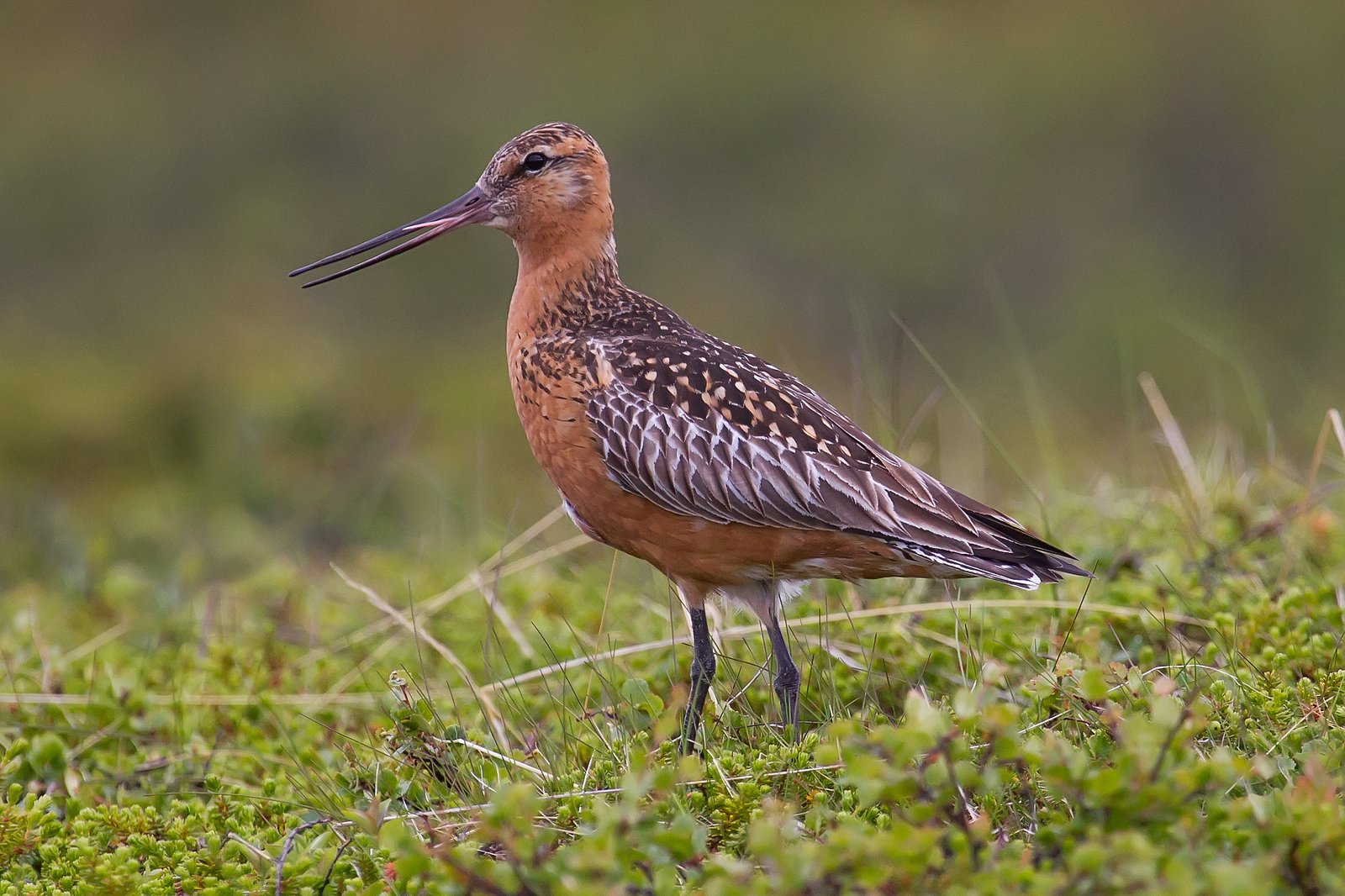
37–41 cm, a godwit with rather short legs and a long, slightly upturned bill, pink at the base and dark towards the tip. In non-breeding plumage greyish brown, with dark shaft streaks on the upperparts, which therefore look streaked, a pale supercilium and a dull white belly. In breeding plumage the male is deep rufous on the head, neck and underparts, the female paler and less rufous. In flight no white wing bar, a white or brown-barred lower back and rump depending on origin, and a barred tail.
Confusion species
Hudsonian Godwit Limosa haemastica has a narrow white wing bar, black underwings, a white rump and a black tail, and plainer grey upperparts in non-breeding plumage. Marbled Godwit Limosa fedoa is larger and cinnamon brown, with cinnamon-rufous underwings and no white rump. Hudsonian Whimbrel Numenius hudsonicus has a down-curved bill.
Habitat
Mudflats, estuaries and sandy beaches. It probes the mud for worms, molluscs and crustaceans, often in shallow water. It does not breed in the guide area.
Where the bird is most at home, classified by the vegetation units of the Andes and the west coast.


Range and movements
In the guide area recorded only as a very rare vagrant on the coast, with just a few records. Breeds on the tundra of northern Europe, Siberia and western Alaska and winters along the coasts of western Europe, Africa, southern Asia, Australia and New Zealand.
How and when to look
A vagrant is most likely among other shorebirds on mudflats and beaches on the coast, during the northern winter; look for the streaked upperparts, the white rump and the lack of a wing bar.
Conservation status
Near Threatened. The world population is declining, mainly through the loss of mudflats around the Yellow Sea, an important stopover on the migration route.
Scientific name
Limosa lapponica | (Linnaeus, 1758)
Linnaeus described the species in 1758 as Scolopax lapponica; because it was later moved to another genus, the author and year stand in brackets. The genus Limosa was introduced in 1760 by Brisson. The genus name comes from Latin limosus, 'muddy', from limus, 'mud'. The species name refers to Lapland. The specimen the first description was based on came from Lapland.