All species › Waders, gulls and terns › Sandpipers and allies › Eurasian Whimbrel
Eurasian Whimbrel | Numenius phaeopus
Regenwulp | Zarapito trinador | Maçarico-galego-euroasiático
The Eurasian Whimbrel breeds in northern Europe and Asia and winters mainly along the coasts of Africa, southern Asia and Australia. It closely resembles the Hudsonian Whimbrel but has a white rump. In the guide area it is at most a very rare vagrant on the coast.
Voice
A rapid series of clear whistles, pi-pi-pi-pi-pi-pi-pi, not distinguishable from that of Hudsonian Whimbrel.
Recording: Stanislas Wroza — CC BY-NC-SA 4.0 · xeno-canto
Identification
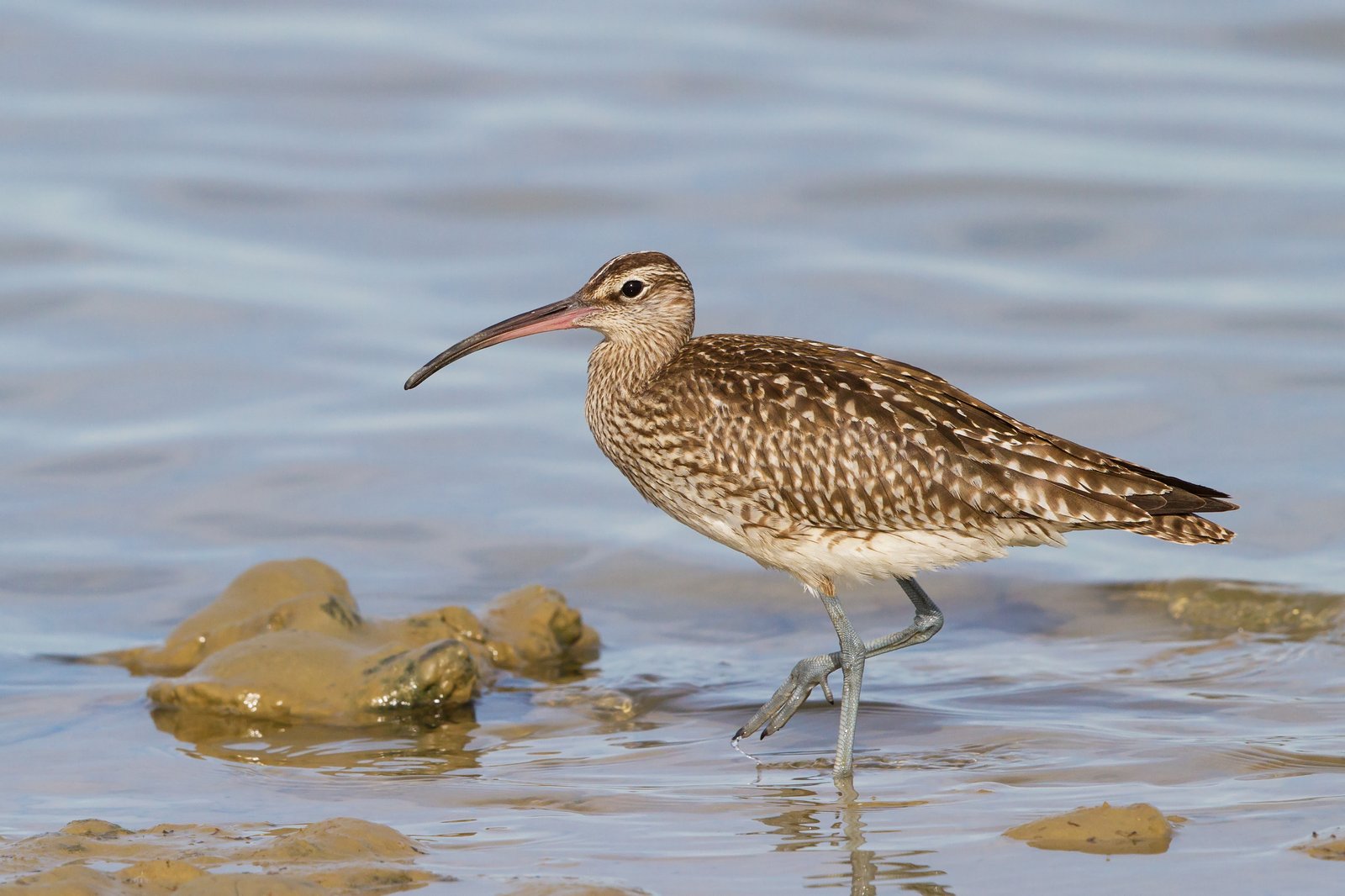
40–46 cm, a medium-sized, greyish brown curlew with a long, down-curved bill, a dark crown with a pale central stripe, a pale supercilium and a dark eye-stripe. Upperparts greyish brown with pale spots and fringes, often slightly more contrasting and greyer than in Hudsonian Whimbrel; neck and breast finely streaked, belly dull white. In flight a white lower back and rump, extending as a wedge between the wings, and whitish underwings. Legs bluish grey. The sexes are alike.
Confusion species
Hudsonian Whimbrel Numenius hudsonicus, common along the coast, has a brown back and rump and brown, barred underwings; the difference is clear only in flight. Long-billed Curlew Numenius americanus is larger and cinnamon, with a much longer bill and no clear head stripes.
Habitat
Mudflats, estuaries, beaches and rocky shores; in the guide area to be expected among flocks of Hudsonian Whimbrels. It feeds on crabs, worms and other invertebrates. It does not breed in the guide area.
Where the bird is most at home, classified by the vegetation units of the Andes and the west coast.


Range and movements
In the guide area only to be expected as a very rare vagrant on the coast; there are at most a few documented records. Breeds from Iceland and Scandinavia to Siberia and winters along the coasts of Africa, southern and south-east Asia and Australia; in the Americas it has been recorded mainly as a vagrant on the Atlantic coast.
How and when to look
Check flocks of Hudsonian Whimbrels at high-tide roosts and look for a white back and rump on birds taking off; a record calls for a photograph of the upperside in flight.
Conservation status
Not evaluated as a separate species; the world population is large.
Scientific name
Numenius phaeopus | (Linnaeus, 1758)
Linnaeus described the species in 1758 as Scolopax Phaeopus; because it was later moved to another genus, the author and year stand in brackets. The genus Numenius was introduced in 1760 by Brisson. The genus name comes from Greek noumēnios, a bird mentioned by Hesychius. It appears to derive from neos, 'new', and mēnē, 'moon', after the crescent-shaped bill. The species name combines Greek phaios, 'dusky', with pous, 'foot'. The specimen the first description was based on came from Sweden.