All species › Waders, gulls and terns › Sandpipers and allies › White-rumped Sandpiper
White-rumped Sandpiper | Calidris fuscicollis
Bonapartes strandloper | Correlimos culiblanco | Maçarico-de-sobre-branco
The White-rumped Sandpiper makes one of the longest migrations of any shorebird: from the tundra of northern Canada to Patagonia and Tierra del Fuego and back. Most birds travel over the western Atlantic and Amazonia, so in the guide area it is mainly a scarce passage migrant. In all plumages it can be identified by the completely white rump.
Voice
A high, thin, mouse-like tzeet or jeet, unlike the calls of other small sandpipers.
Recording: Jacob Wijpkema — CC BY-NC-SA 4.0 · xeno-canto
Identification
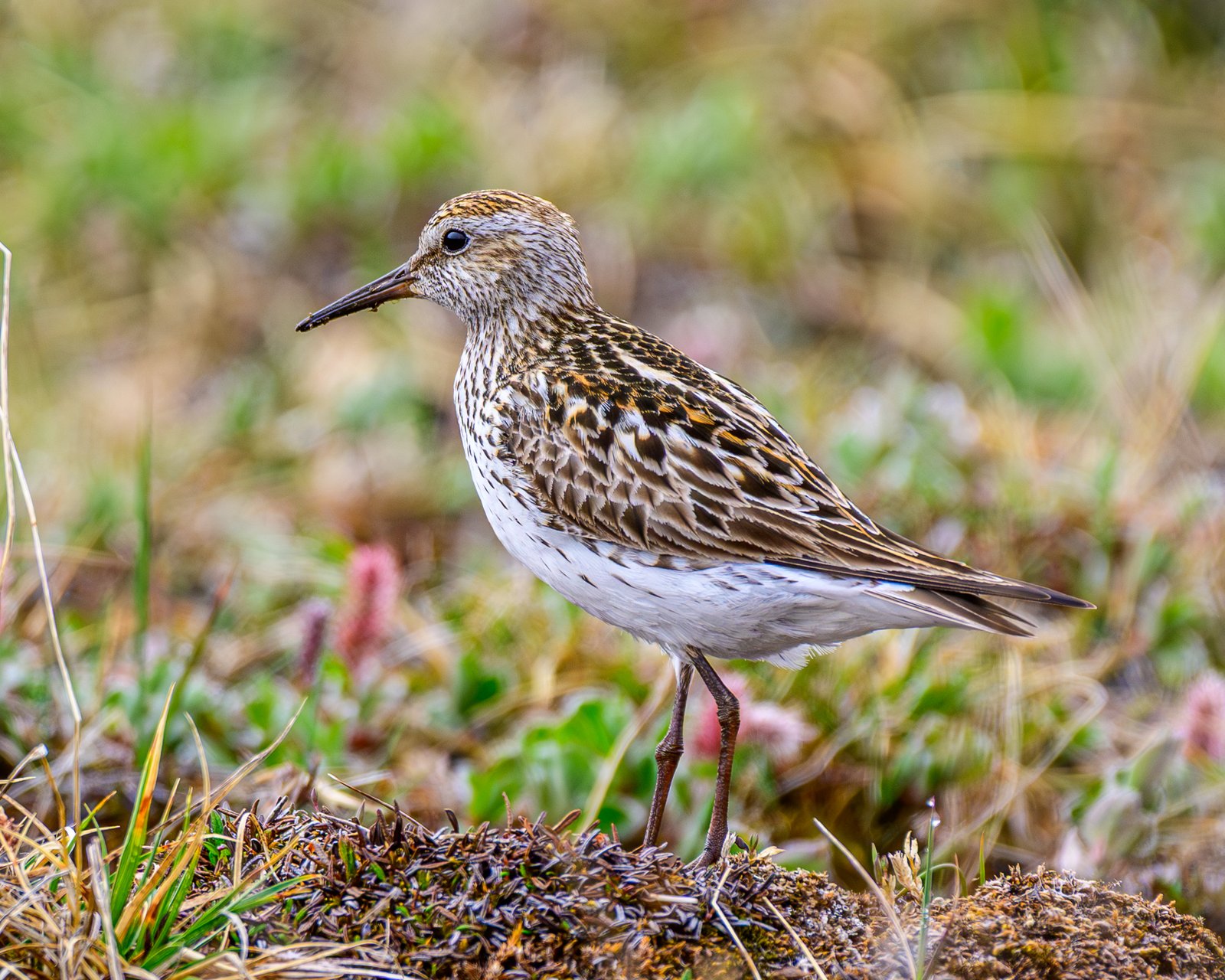
15–18 cm, a slender sandpiper with long wings that extend well beyond the tail, a rather short, slightly decurved black bill with a reddish brown base to the lower mandible and black legs. In non-breeding plumage grey above, with a grey-streaked breast whose streaks continue finely onto the flanks. In breeding plumage browner, with rufous on the crown, ear coverts and scapulars and distinct chevrons on the breast and flanks. Juveniles have rufous-fringed scapulars and a white supercilium. In flight a narrow wing bar and a completely white rump, contrasting sharply with the dark tail. The sexes are alike.
Confusion species
Baird's Sandpiper Calidris bairdii also has long wings but is buffier and scaly, with a dark central stripe on the rump and no streaks on the flanks. Stilt Sandpiper Calidris himantopus also has a white rump but is longer-legged, with greenish legs and a longer bill. Semipalmated Sandpiper Calidris pusilla and Western Sandpiper Calidris mauri are smaller, with shorter wings and a dark central stripe on the rump. Curlew Sandpiper Calidris ferruginea, a very rare vagrant, has a white rump but a longer bill curved along its whole length.
Habitat
Shallow shores of lakes and lagoons, flooded grasslands, river sandbars, tidal flats, and lakes and bofedales in the Andes. It feeds with rapid pecking and probing movements for insect larvae, small crustaceans and molluscs, often wading in shallow water. It does not breed in the guide area.
Where the bird is most at home, classified by the vegetation units of the Andes and the west coast.


Range and movements
In Colombia a scarce passage migrant, mainly in the lowlands east of the Andes and on the Caribbean coast. In Ecuador a rare passage migrant in the Amazonian lowlands, the Andes and on the coast. In Peru a scarce passage migrant in the Amazonian lowlands and on puna lakes, rare on the coast. In Bolivia a passage migrant in the lowlands, mainly in the savannas of Beni and Santa Cruz, and on the altiplano. On the Galápagos a very rare visitor. Breeds on the tundra of northern Canada and Alaska and winters in southern South America, mainly in Argentina south to Tierra del Fuego.
- Resident
- Summer visitor (c. Apr–Sep)
- Winter visitor (c. Oct–Mar)
- Passage (Mar–Apr, Oct–Nov)
- dark = core range, pale = thinly spread
How and when to look
From September to November and from March to May on shallow lake shores and in flooded grasslands in the lowlands of Bolivia and Peru and on puna lakes; the white rump is most visible when the bird takes flight.
Conservation status
Vulnerable. The population has declined rapidly, probably through the loss and degradation of wetlands along the flyway and on the wintering grounds; the species depends on a small number of stopover sites.
Scientific name
Calidris fuscicollis | (Vieillot, 1819)
Vieillot described the species in 1819 as Tringa fuscicollis; because it was later moved to another genus, the author and year stand in brackets. The genus Calidris was introduced in 1804 by Merrem. The genus name comes from Greek kalidris or skalidris, a term used by Aristotle for an unidentified grey waterside bird. The specific name comes from Latin fuscus, 'dusky', and collis, 'neck', so 'dusky-necked'. The specimen the first description was based on came from Paraguay.